
Chance Encounters, Edition 69
Joseph Cornell's Poetic Theaters

Nearly every profile of Joseph Cornell (American, 1903-1972), including this one, begins by mentioning his reclusive life, sometimes even describing the artist as a hermit. The artist’s life story confirms that Cornell had few close relationships beyond his mother and his younger brother, who was disabled by cerebral palsy. However, he had many friends and contacts within the New York art world, avidly attended theatrical and ballet performances. He also spent time exploring less elevated aspects of contemporary culture – the movie theaters, shop windows, and junk shops of the city. His explorations of the city led to the collections of books, maps, pictures, and large quantities of small objects that would eventually serve as the raw materials of Cornell’s art.
Cornell’s father having died when the artist was 13 years old, the young man took on support of his family with a series of sales jobs in the city. The jobs themselves were unsuited to Cornell’s personality but he loved being in the city and began collecting ephemera just for its own sake. In 1931, Cornell encountered the Surrealist collages of Max Ernst (German-French, 1891-1976) which introduced him to the idea that art encompassed creations other than paint on canvas. He was especially drawn to Ernst’s use of 19th century engravings which were also among the artist’s collections. Surrealism allowed Cornell to see the power of art and the way that common objects could shed their ordinary meanings and create beauty and strangeness.
Creative filing
Creative arranging
As poetics
As technique
As joyous creation – Joseph Cornell, diary entry, March 9, 1959
At the beginning and end of his career, Cornell created collages. He was also an innovative filmmaker who created experimental movies throughout his life; the first was Rose Hobart (1936), a 19-minute collage of found film footage. In this post, I have chosen to focus on the works for which the artist is best known, the small shadow-box assemblages which Cornell called “poetic theaters.”
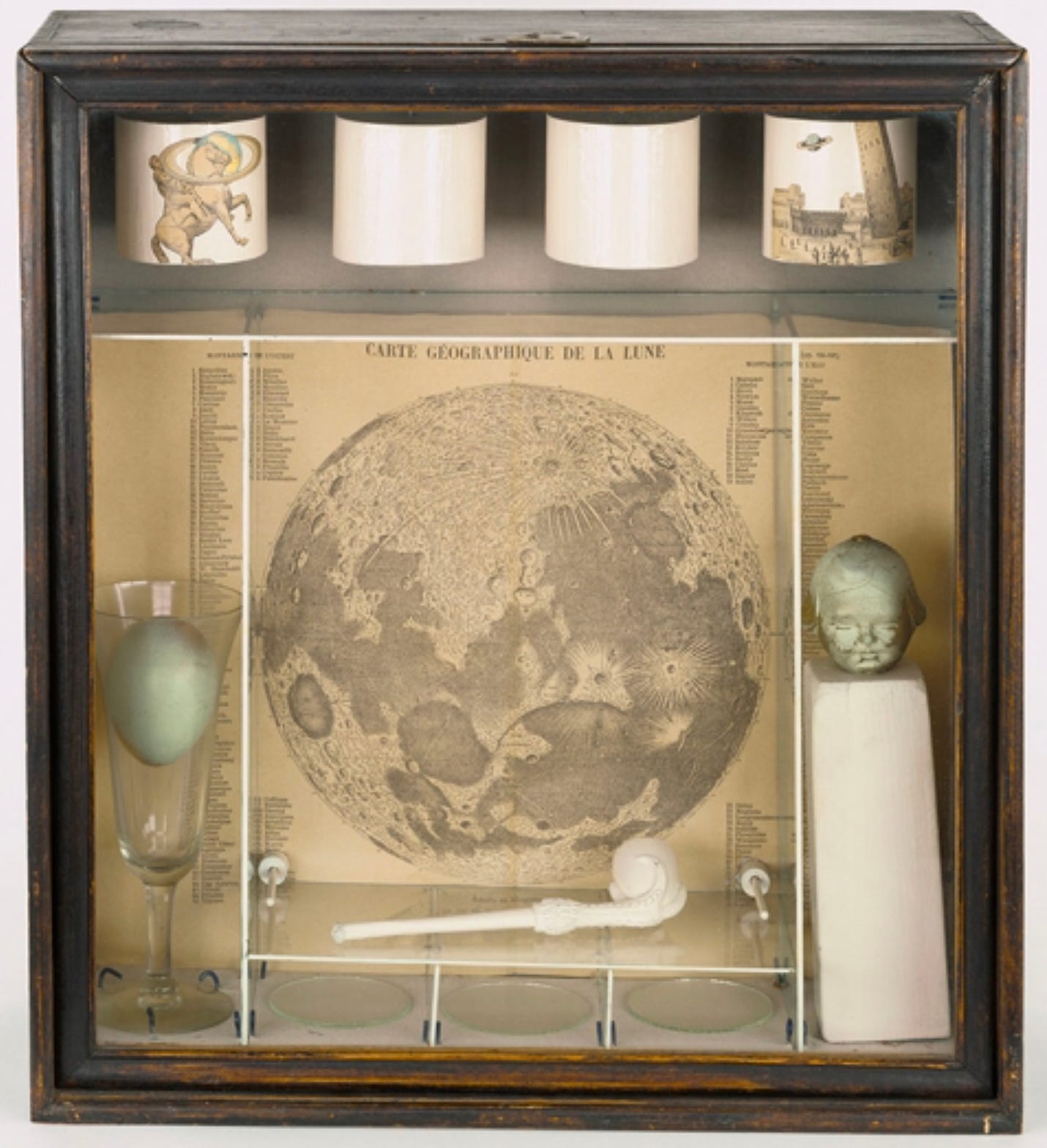
Soap Bubble Set of 1936 is not only one of Cornell’s first boxes, it was the first of the artist’s works to be acquired by a museum. In early boxes like this, he used existing boxes that he found in the junk and antique shops he frequented. Later he learned how to make his own boxes. Cornell was a self-taught artist but not an outsider. He had many connections in the New York art world, having begun to exhibit at New York galleries and museums in the early 1930s, shortly after he began creating art.
Cornell’s boxes were created in series that reflect the artist’s interests in literature, music, theater, ballet, art history, the natural world and astronomy. The Soap Bubble series, in Cornell’s words, “metamorphosed the elements of a childhood pastime.” This example is the first of the series. A clay pipe lying on the shelf appears to be the source of the bubble-like moon. Cornell himself made this association in discussing this series, that the delicate soap bubble is turned into the more permanent planets or moons. One of Cornell’s lifelong obsessions was astronomy, a theme which appears in many series. Cornell meant for his objects to undergo a magical transformation by being combined in these boxes. At the same time, the components of this example had specific symbolism to the artist. The doll’s head at right, painted pale blue and gold, connects the box to childhood while the similarly painted egg at left has long symbolized rebirth. The clay pipe signified his Dutch ancestry, of which the artist was proud. Soap bubbles traditionally symbolize transience and the passage of time, but to Cornell they meant reverie, the state of daydreaming that the artist often experienced while creating and which he hoped the observer would experience while looking at the work.
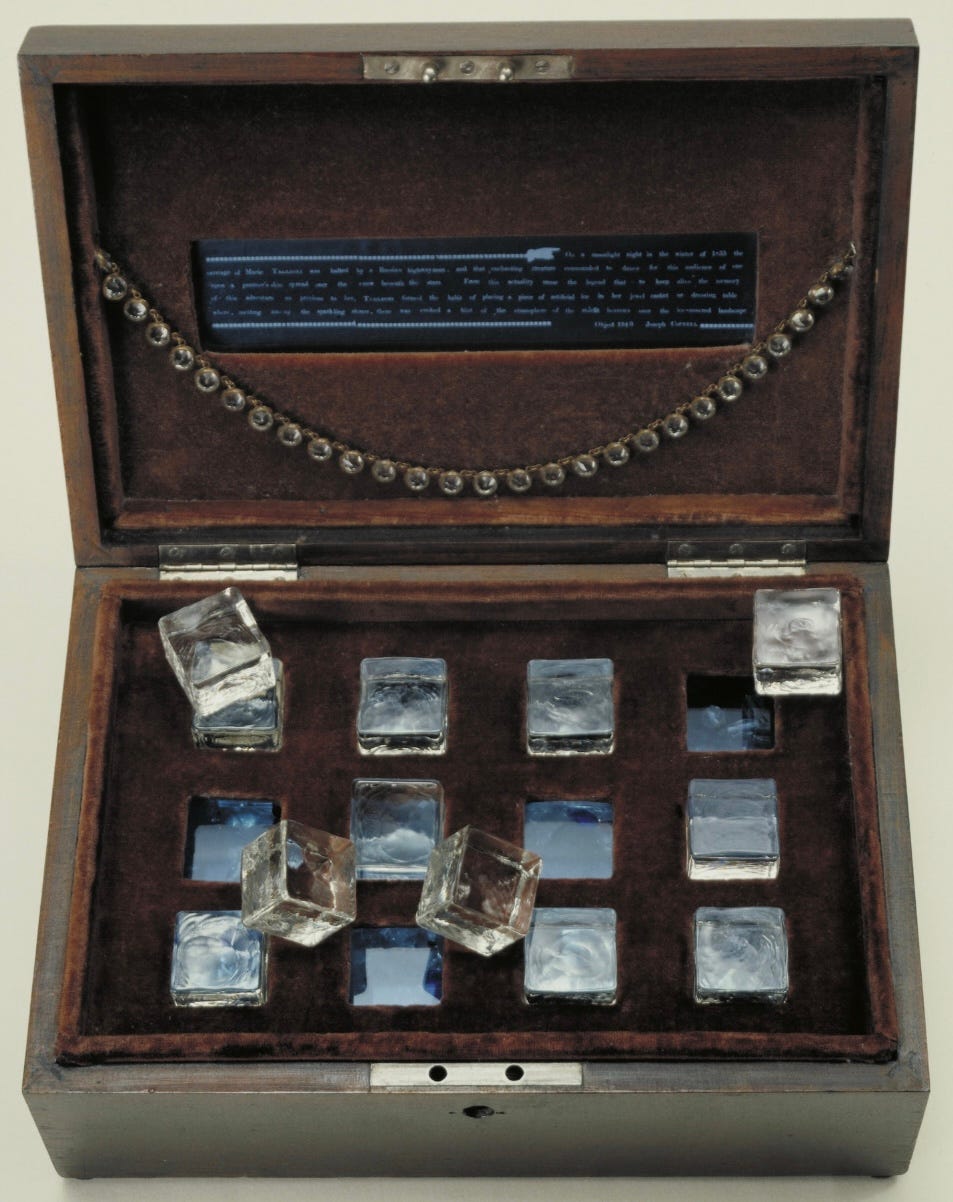
Throughout his life, Cornell was fascinated by opera divas and prima ballerinas of the past. This work celebrates a specific story about Marie Taglioni, a Swedish-born ballerina of Italian descent (1804-1884). The event is described in the inscription inside the lid of Taglioni’s Jewel Casket (1940).
On a moonlight night in the winter of 1835 the
carriage of Marie TAGLIONI was halted by a Russian highwayman, and the enchanting creature commanded to dance for this audience of one
upon a panther’s skin spread over the snow beneath the stars. From this actuality arose the legend that to keep alive the memory
of this adventure so precious to her, TAGLIONI formed the habit of planting a piece of artificial ice in her jewel casket or dressing table/where, melting among the sparkling stones, there was evoked a hint of the atmosphere of the starlit heavens over the ice-covered landscape.
The first of Cornell’s works devoted to a ballerina, the object is a velvet lined wooden box with a necklace of glass beads attached inside the lid, framing the inscription. In the lower part of the box, there are three levels. The top level supports three rows of four glass “ice cubes.” When the cubes are removed, the two lower levels which are separated by blue glass can be seen. These contain costume jewelry fragments, glass chips, and another necklace. The bottom of the box is lined with mirror, reflecting the glass and jewelry. One feels one has found a treasure of the past, which was clearly Cornell’s intention.
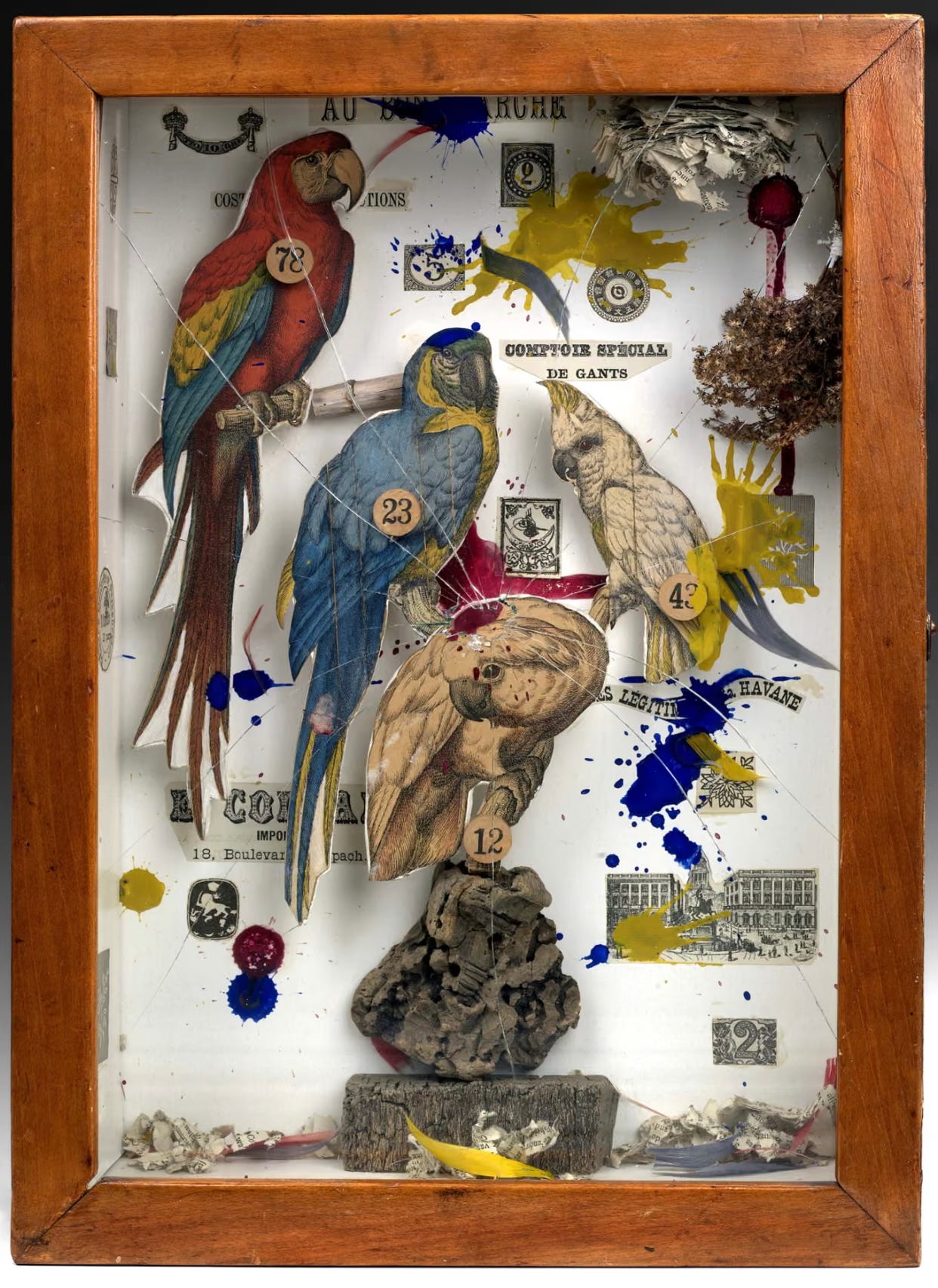
Some of the artist’s best known works focus on birds, usually exotic ones like the parrot, macaws, and cockatoo seen in Habitat Group for a Shooting Gallery (1943). This work stands apart from the majority of Cornell’s works because of the implied violence, not just of the title but of the display itself. In this box, Cornell suspended cutouts of 4 birds (printed images applied to wood backing). The background is spattered with bits of yellow, blue, and red paint, but the most important splash is the red one on the head of the parrot. This lines up with the hole in the shattered glass front. (It is stabilized between two intact panes. Cornell was always careful to secure the items in his boxes or to attach instructions for restoring loose items to their proper places.) The title of this work connects it to two different threads in the artist’s career; the Habitats, which are usually peaceful depictions of birds, and childhood. Dolls, blocks, and jacks are a few of the toys incorporated into boxes. The title also refers to the artist’s memories of arcade games from his own childhood before his father’s death. The explicit combination of violence with these happy and peaceful references suggests dark personal feelings that Cornell rarely allowed to surface in his boxes.
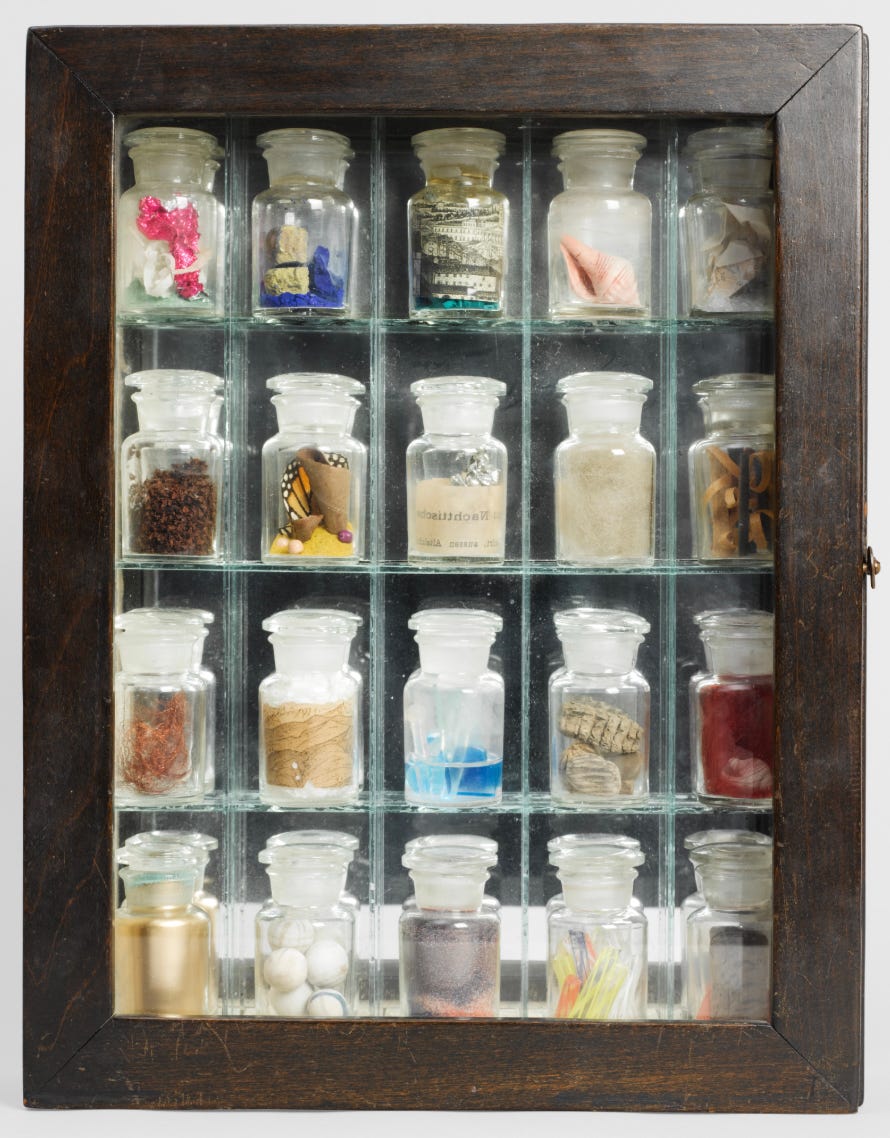
With Pharmacy (1943), we encounter another series within Cornell’s boxes, the Collections. These works use a grid to display objects in a uniform format, as with the corked bottles in this example. Other examples mimic butterfly collections or shop window displays. The title suggests we are looking at medicines, but a closer look shows that the bottles contain colored sand, a butterfly wing, paper shreds, ribbon, a shell, and other bits from Cornell’s collections. The artist was a devoted adherent of Christian Science, so the idea of a pharmacy full of reminders of God’s creation and of one’s own connection to that creation begins to make sense.
Gratitude, acknowledgement & remembrance for something that can so easily get lost – Joseph Cornell, in his diary, December 1972
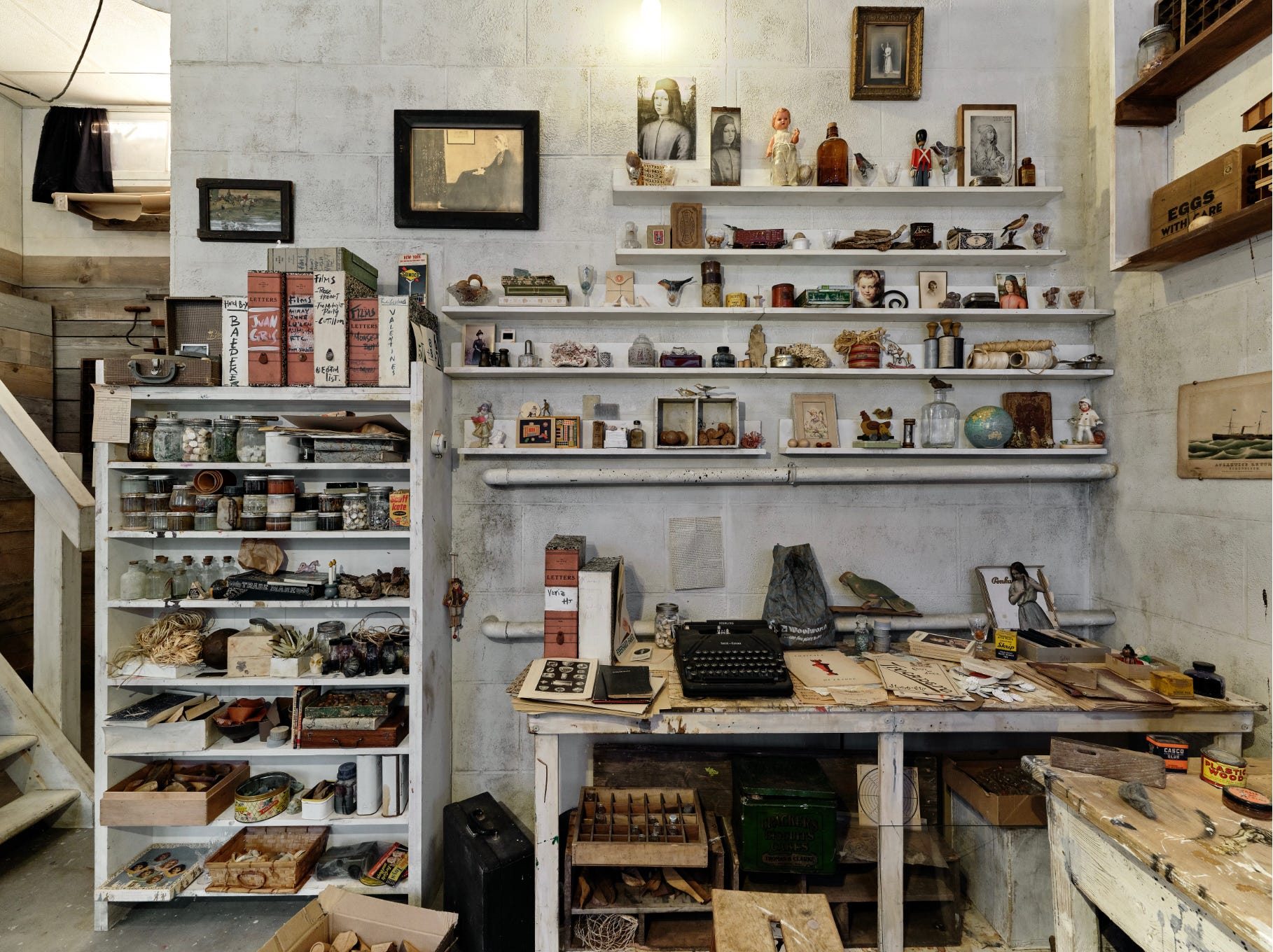
Pharmacy is included in a current exhibition at Gagosian in Paris, The House on Utopia Parkway: Joseph Cornell’s Studio Re-Created by Wes Anderson gives viewer’s a glimpse of the basement studio, where the artist worked which he called his “laboratory.” The studio recreation includes boxes, bottles and folders like the ones in which Cornell kept his collections. Over the years, the artist created extensive portfolios, his “dossiers,” of the people and subjects he found most compelling. Over 150 survive covering favorite artists like Jan Vermeer, dancers and opera singers, actresses like Claire Bloom and Jennifer Jones, and favorite themes like astronomy, circuses, birds, history and mythology. He also created large folders of words and images collected from various sources, saved for future use in his artworks. They were, Cornell said, “a clearing house for dreams and visions.”
He uses selected, sought-for, desired objects. He must have been clipping all the time, poring through magazines, collecting things and haunting junk shops and flea markets, looking for the images that corresponded to his imagination. – Susan Sontag (American writer and critic, 1933-2004)
Cornell really did live in a house on Utopia Parkway, in Flushing, Queens, New York. His mother had moved the family there in 1929 and the artist lived there for the remainder of his life. In addition to his collections, Cornell owned books on many subjects; he had a vast appetite for culture, ranging from 18th and 19th century French literature to the movies stars of his own time. He kept journals in which he recorded what he read and the associations they called to his mind. He carried on correspondence with people he met in the cultural milieu of New York. Writer-critic Susan Sontag knew and admired him, though she never found Cornell comfortable to be around. Artist Yayoi Kusama (Japanese, b. 1929) had an especially close friendship with the artist, which began in New York, and after she moved back to Japan, continued long distance through calls and letters until Cornell’s death in 1972.
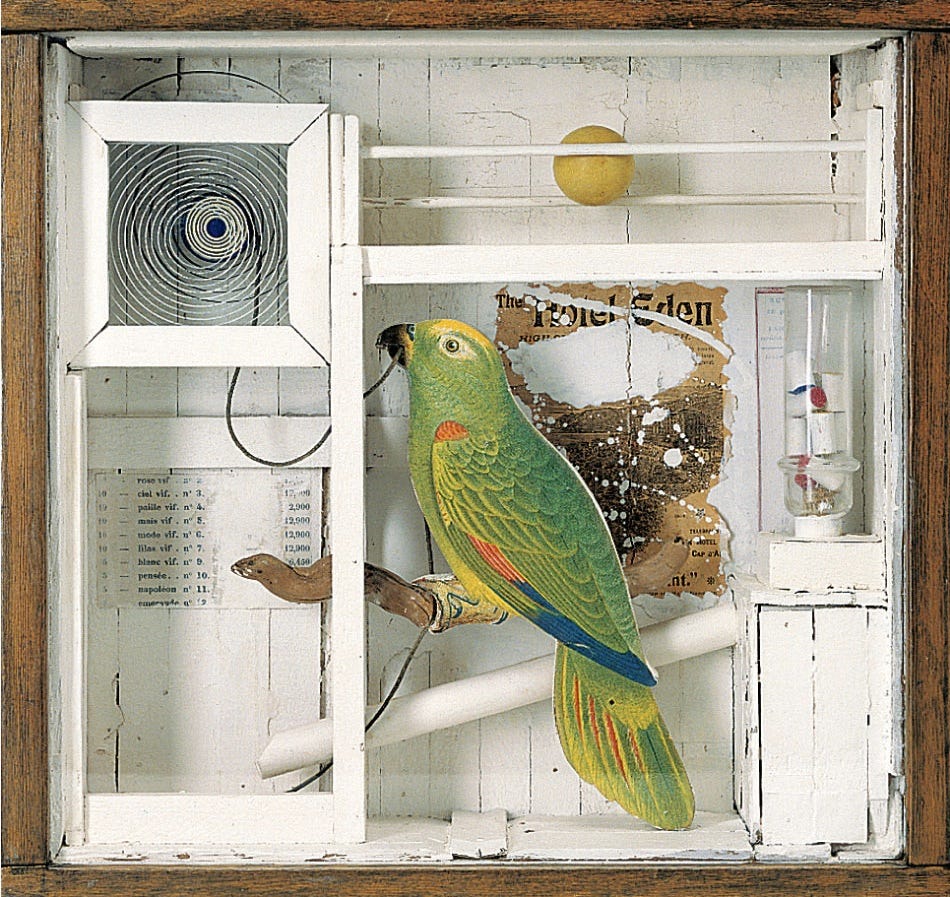
Looking at any Cornell work requires narrowing one’s focus to the people, places, objects, and connections in the little world the artist created for us. The Hotel Eden (c. 1945) is more typical of the artist’s bird boxes, with its bright parrot surrounded by various objects intended to “elicit further dreams and musings,” as Cornell said. The title is drawn from an advertisement for Hotel Eden, attached to the back wall and partially obscured by white paint. Other contents include a set of spirals in the upper left, one painted on the glass, one painted on paperboard and the third an actual coil of metal. From these a cord descends, enters the parrots beak and then trails to the bottom of the box. Hotels and other references to travel are common in Cornell’s work although he almost never went further from his home than Manhattan. The artist travelled in his imagination and boxes like The Hotel Eden beckon to our imaginations to journey with him.
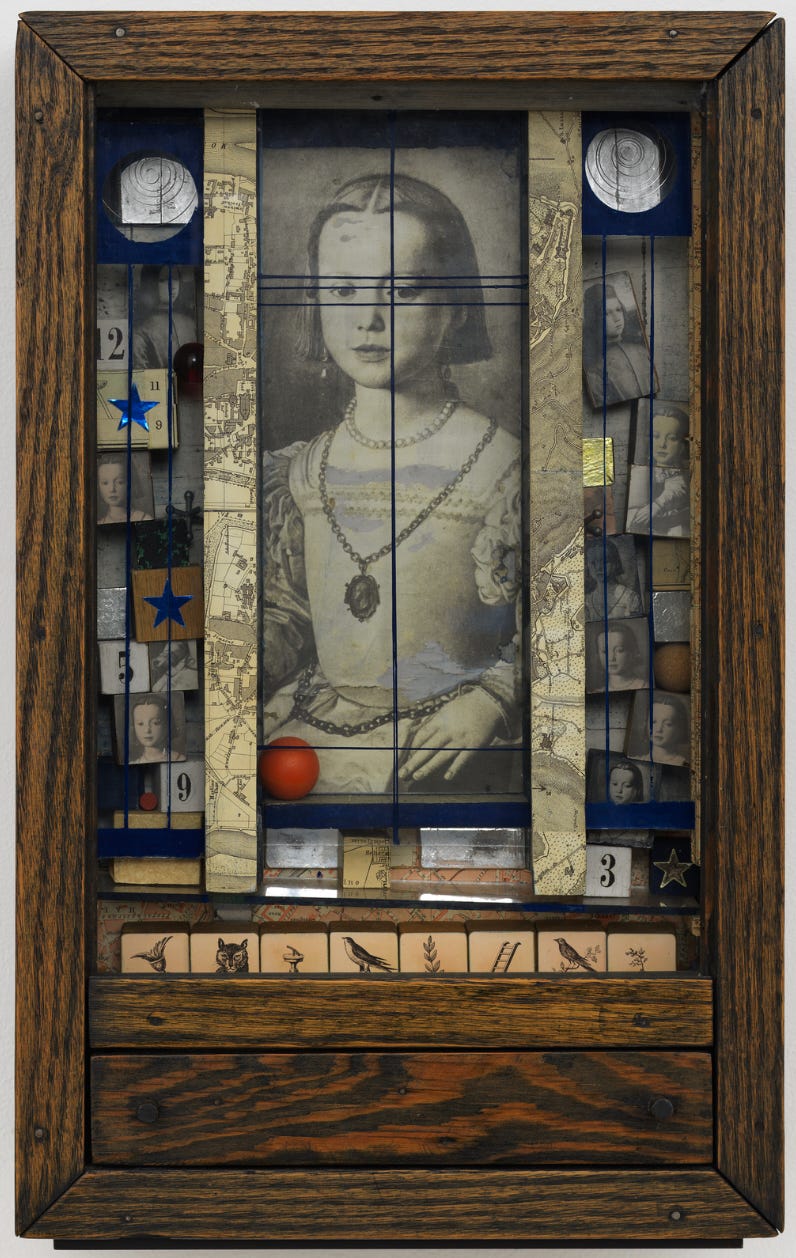
Untitled (Medici Princess) (1948) is one of a series of boxes focused on Renaissance portraits of children. In this case, the main image is a reproduction of Bronzino’s Portrait of Bia di Cosimo de’ Medici (1542-1545). There are additional fragments of this portrait on some of the wooden blocks at the sides, along with some details of Pinturicchio’s A Boy (1485-1500). Many objects included in this box are reminders of childhood: a ball, blocks, and jacks. The spiral motif seen in The Hotel Eden reappears here, at the top of each side section, and is thought to refer to time and its steady unrolling in a human life. In this work it is particularly poignant as the child in the painting died at the age of 6, and Bronzino’s portrait was created posthumously. Even without that knowledge, this work appears melancholy with its blue and brown tones and the child seemingly seen at a great distance from the viewer.
As in every Cornell box, all paths lead away from the present and into the mists of the imagination. – Deborah Solomon, New York Times, January 16, 2024
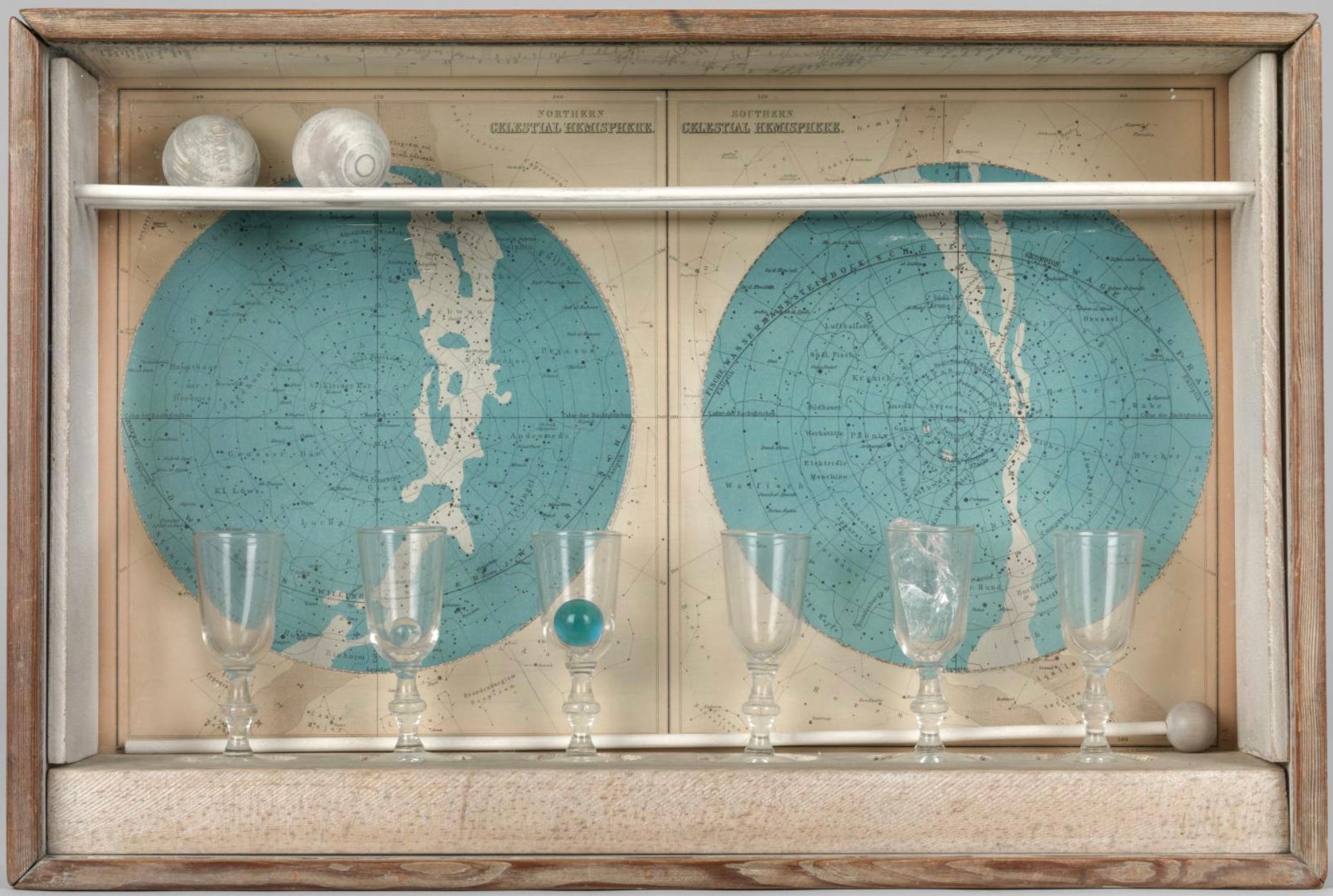
Planet Set (1950) is dominated by the charts Cornell applied to the back of the box, showing the Northen and Southern celestial hemispheres. On the shelf above, two white balls suggest planets or moons. Six liqueur glasses are aligned in front of the celestial maps. The second glass from the left contains a clear crystal ball and the glass next to it holds a blue ball. The second glass from the right holds a piece of rock crystal. In the context of the rest of the work, the objects in the glasses may represent air, water, and ice. Planet Set appears to focus almost exclusively on Cornell’s fascination with astronomy, but the title tells us the artist has not forgotten his beloved 19th century culture stars. The work is dedicated to Giuditta Pasta, an opera singer, whose voice was described in a contemporary account as evoking the beauty of the night sky. Figures like Pasta and Taglioni conjured a lost Romantic world for Cornell and in his imagination and his art, that world could be recovered through the threads of meaning he created.
Cornell found it painful to sell his works, created from such intense personal interests and treasured objects. He preferred to give them away, often to his theater, dance or movie star crushes. To sometimes unsuspecting recipients, the gifts must have been disconcerting, creepy, or simply bizarre. The shy artist from the house on Utopia Parkway produced a large body of work from his humble materials, sharing his fascinations in small collages, boxes, and films. I first encountered Cornell’s work at the retrospective held at the Art Institute of Chicago in 1982. I found that exploring the artist’s boxes carried me to other worlds and at the same time, made me want a key to decipher their mysteries. I learned that there is no key. Cornell had his own ideas about the meanings of his works, but he intended us to continue the journey where our imaginations lead us.
Exhibition:
The House on Utopia Parkway: Joseph Cornell’s Studio Re-Created by Wes Anderson, through March 14, Gagosian, rue de Castiglione, Paris, France. LINK: https://gagosian.com/exhibitions/2025/the-house-on-utopia-parkway-joseph-cornells-studio-re-created-by-wes-anderson/
Thanks you for subscribing. Your likes, shares, and comments are greatly appreciated. I’ll be back soon with more art.
I am wondering if the measurements provided for Soap Bubble Set are correct. Looking at the image it is difficult to believe that the width of the box is only 5.4 inches. I have been intrigued by the work of Cornell ever since I first saw images in the ‘80’s, and I truly appreciate being reminded of it once again. Thank you.