
Chance Encounters, Edition 76
Lynette Yiadom-Boakye: Anything is Possible

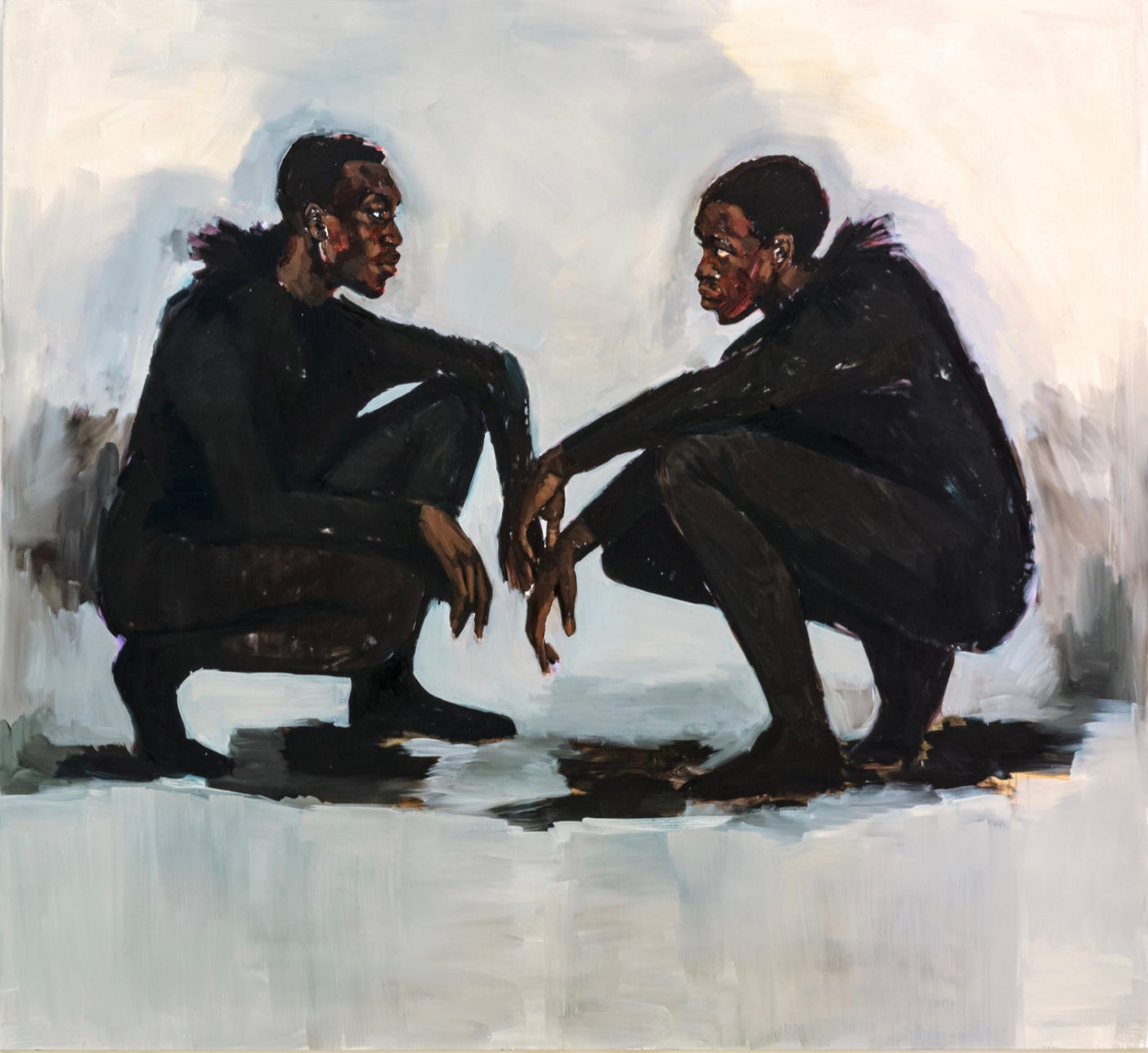
Who are these two lithe young Black men, clad in black while squatting together in a bright, undefined space? The young man to the right appears to have a decorative frill at his neck. A similar flourish of marks behind the other man’s neck looks more like gathered hair but both have a flash of pink-violet among the dominant black tones. Touches of color echoing one another across the painting aren’t limited to that example. The blue that backs the left figure appears below the other figure. Touches of golden yellow were used to outline feet and highlight hands and faces but appear brightest below the deep shadow on the right. The intent gazes of the men are directed toward one another; they are completely unaware of any observer. The title, No Need of Speech, suggests more narrative possibilities, but nothing about the painting insists on a single interpretation.
I have come to realize that having a measure of uncertainty is vital to the way I work. – Lynette Yiadom-Boakye (British, b. 1977)
British painter and writer Lynette Yiadom-Boakye didn’t consider art as a career until her last year of high school. She has focused on painting figurative works since her college years, around the turn of the century. Her works have been well received and she has had exhibitions at prestigious museums, including Tate Britain, Guggenheim Bilbao, and the Studio Museum in Harlem, New York. The artist was a Turner Prize nominee in 2013 and was awarded the 2018 Carnegie Prize at the 57th Carnegie International. No Need of Speech was acquired by the Carnegie Museum of Art at the time of that exhibition. Today the artist is considered part of a renaissance of Black figure painting that also includes Kerry James Marshall (American, b. 1955), Mickalene Thomas (American, b 1971), Toyin Ojih Oduntola (Nigerian, b. 1985), and Njideka Akunyili Crosby (Nigerian, b. 1983).
Instead of trying to put complicated narratives into my work, I decided to simplify, and focus on just the figure and how it was painted. That in itself would carry the narrative. – Lynette Yiadom-Boakye
As Yiadom-Boakye was completing her graduate studies, she realized that she was most interested in the process of painting and the acts of looking and seeing. She usually prefers to speak about the challenges her materials present rather than what her paintings might mean. The artist begins from a particular color, gesture, fall of light, or pose. She works quickly, often completing a painting in a single day in spite of depicting her figures at or over life size. Everything is worked out on the canvas as the artist paints.
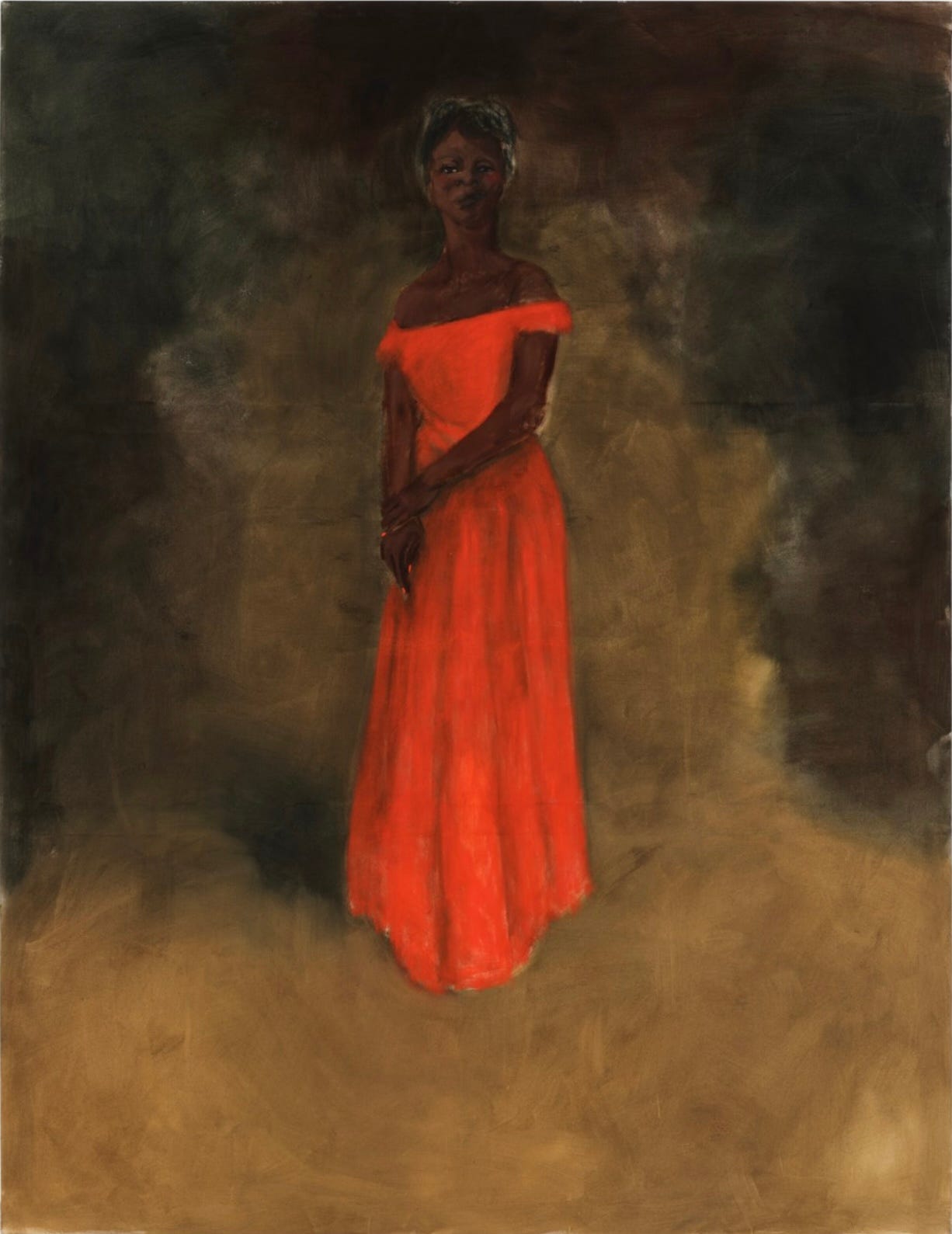
Periodical was painted in 2006, the year Yiadom-Boakye was first included in a major exhibition (Bienal Internacional de Arte Contemporaneo, Seville, Spain). The work is typical of her early paintings in which figures emerge out shadows. Bright or light garments attract the eye first before the subtle variations of brown tones that separate figure from ground draw the viewer into closer observation. Many of Yiadom-Boakye’s figures suggest performers, either on stage as in Periodical or in rehearsal as in No Need of Speech.
No matter how convincingly rendered, Yiadom-Boakye’s subjects are not drawn from life. They are built from a variety of images which the artist collects and saves, photographs of friends and family, magazine illustrations, and art history. These sources are filtered through Yiadom-Boakye’s imagination and painting process to create works which have been described as familiar, mysterious, calming, warm, and ambiguous.
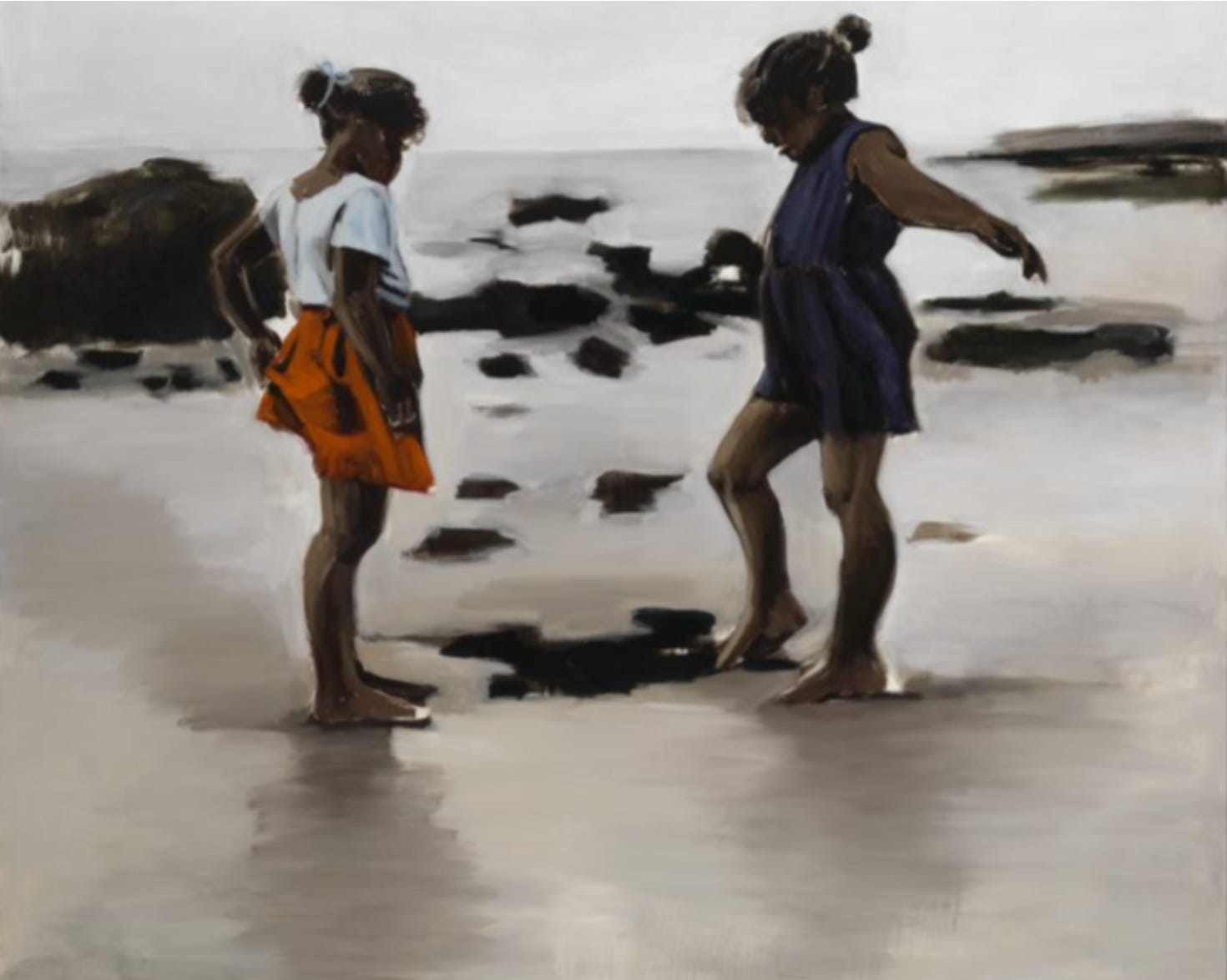
One of the artist’s concerns is to maintain a sense of timelessness in her works. Clothing and spaces are generic and no details are included that might anchor the figures in a specific era or place. Condor and the Mole shows the distinctive poses of two children who want to explore while simultaneously feeling unsure that what they’ve found is safe to touch. The shimmer of light on wet sand and darkly silhouetted rocks could be a beach nearly anywhere in the world. The familiarity of setting and pose makes us want to believe the work was painted from life but even when the inspiration is a memory or photograph, Yiadom-Boakye universalizes her figures to allow viewers an opportunity to insert their personal narratives.
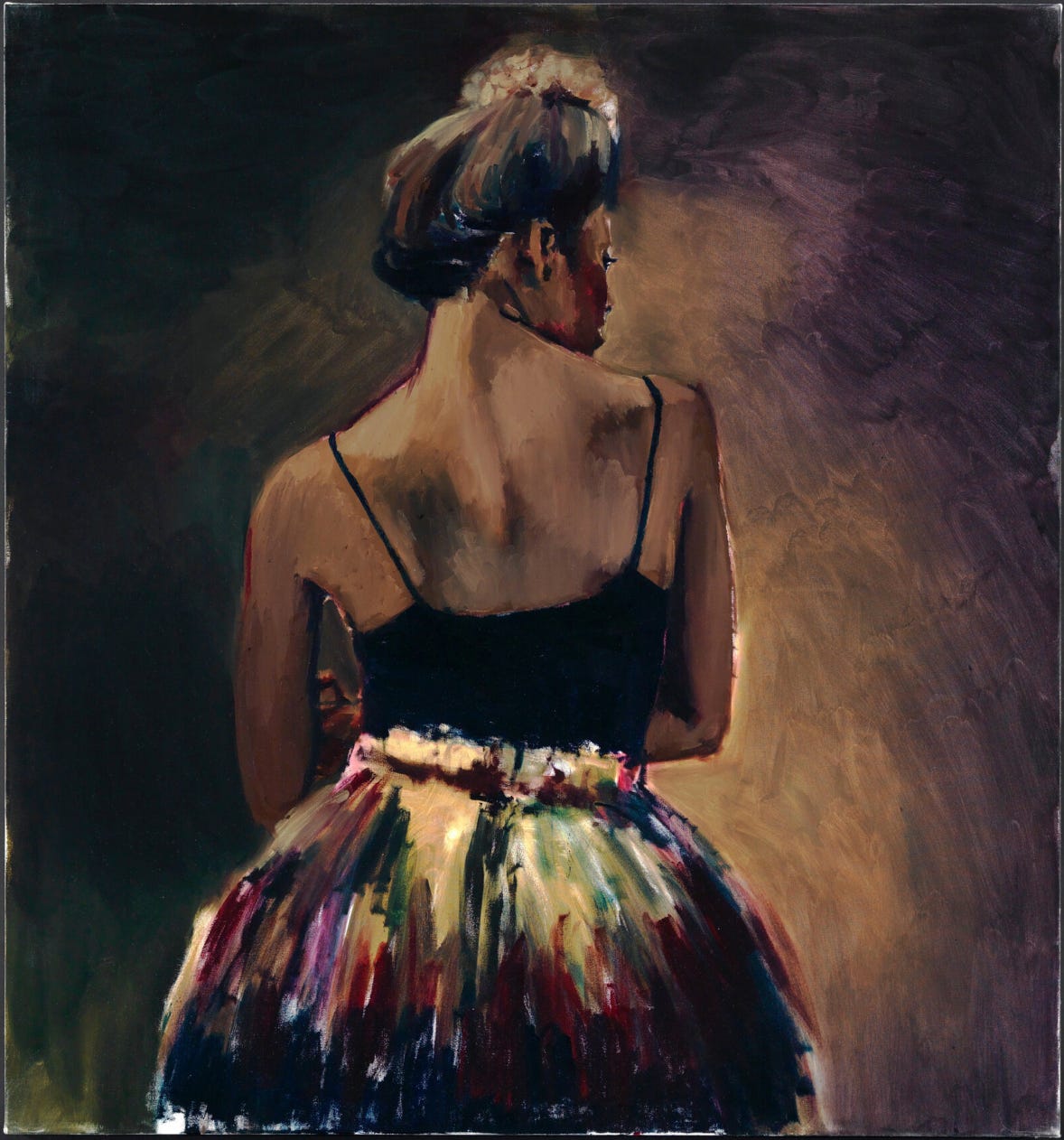
Switcher (2013) was the first work by Yiadom-Boakye to catch my attention. I was drawn to it for many of the reasons others mention in connection with this artist’s works, its warmth and familiarity most of all. To me, this back view suggests vulnerability. I’m reminded of women and girls at parties and clubs (in real life and in film) looking to the side or peeking over a shoulder in search of friends or dates. And so I have fallen under Yiadom-Boakye’s spell and started weaving a story about this figure.
Over time I realised I needed to think less about the subject and more about the painting. So I began to think very seriously about colour, light and composition. – Lynette Yiadom-Boakye
Turning our attention to colors and light, we see how the artist has woven these together in this painting. Though also lit from the back, the figure is silhouetted against a bright light, more on the right than the left. Light shining onto her hair turns it to a pale crown against the darker background. That background is built up of layered brushstrokes, greens, blue and browns to the left and yellows and purples to the right. All of these colors are joined in the skirt, suggesting a shimmering, colorful, feathery mass that anchors the figure. The reds from the skirt are echoed in the figure’s contours, especially the shoulders and a few patches appear on the woman’s cheek.
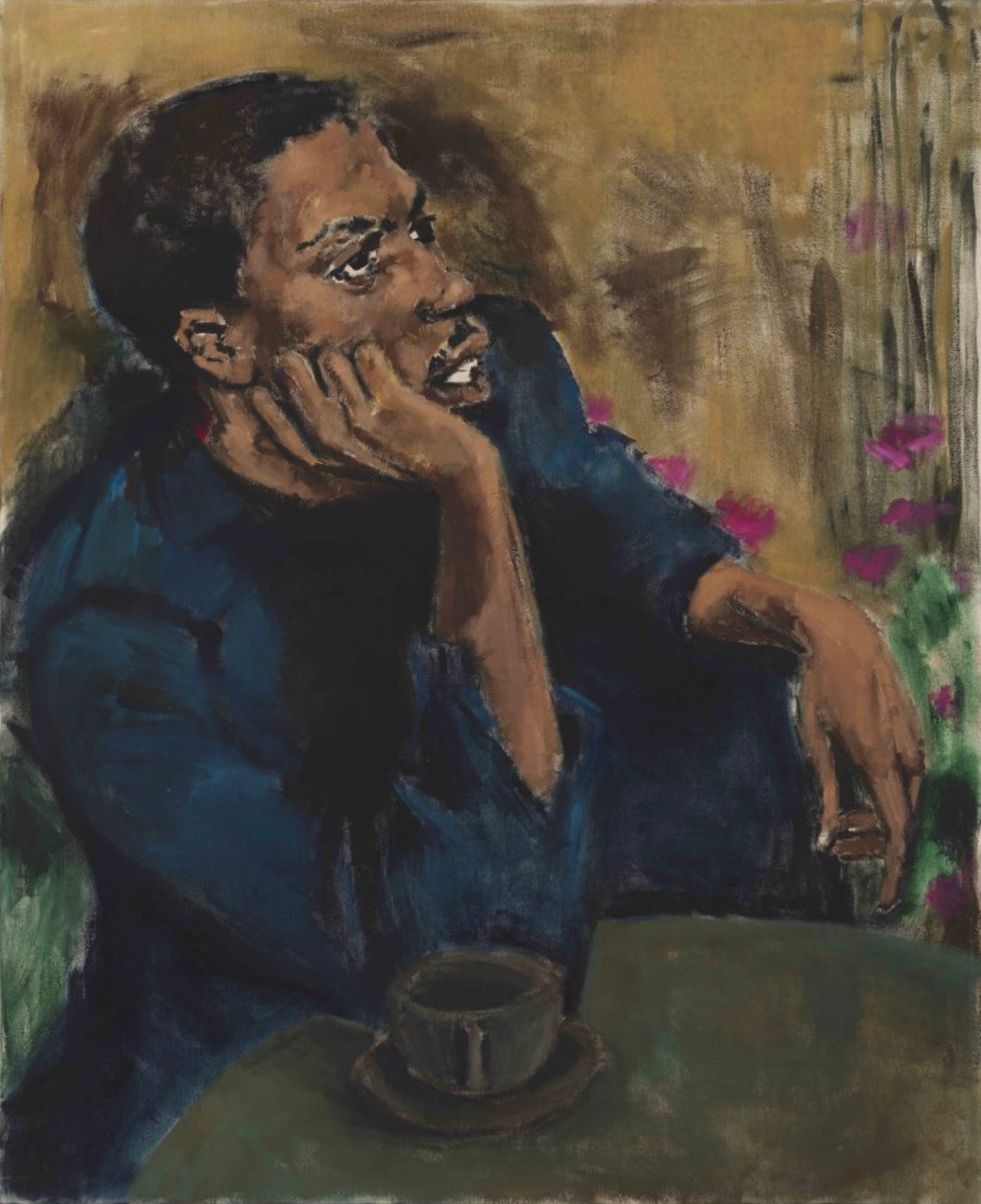
Around 2017, Yiadom-Boakye began to incorporate more details of the setting in some of her paintings. The general effect remained universal and timeless, but in works like Brothers of a Garden, new contexts for the artist’s figures appear — a table, a drink, a tile floor, plants and flowers. Rare at first, these setting details have become more common over the last decade. Here the seated figure looks out of the picture space to the right, as if in conversation with an unseen figure. Like the figures in No Need of Speech, he is absorbed in his own concerns and unaware of any observer. That sense of existing in a self-sufficient reality requiring no one from outside to justify or explain its meaning is a characteristic the artist values highly.
It isn’t so much about placing black people in the canon as it is about saying that we’ve always been here, we’ve always existed, self-sufficient, outside of nightmares and imaginations, pre and post “discovery”, and in no way defined or limited by who sees us. – Lynette Yiadom-Boakye
Many critics and curators comment on how this artist’s Black subjects might be understood within the history of art and society. Is Yiadom-Boakye challenging the historical representation of Blackness in art with her works? Does she intend to insert Black bodies into the Modernist art which mostly ignored them? Is she making references to paintings by Rembrandt, Édouard Manet, the Impressionists, the history of portraiture? In some ways the answer to all of these questions is yes. Yiadom-Boakye’s works as a group do all of these things, but at the same time, each painting responds to its own evolution as the artist creates it.
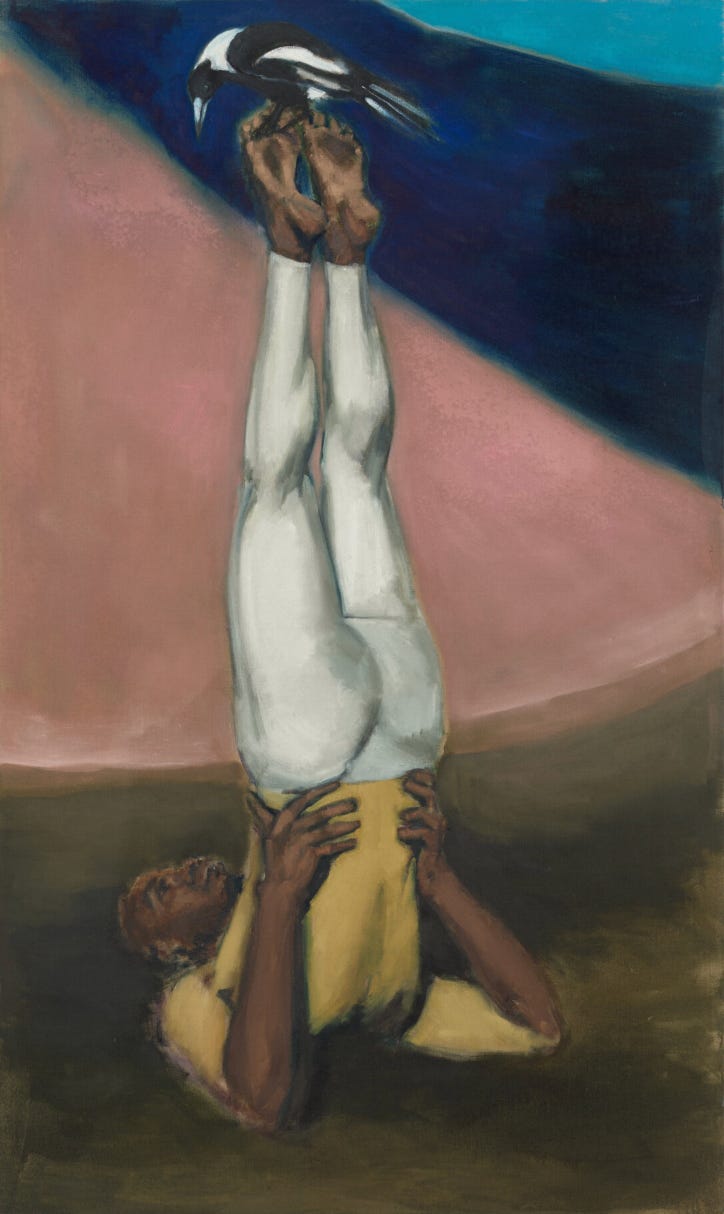
The remaining works in this edition are drawn from Yiadom-Boakye’s current exhibition at Jack Shainman Gallery in New York, “Many a Moonlit Caveat” (details below). These recent works, painted in 2025 and 2026, maintain characteristics of earlier works while expanding compositional variety, setting details, and palettes. The Honour Between Thieves shows a Black man clad in yellow and white tights against a backdrop of pink and blue wedges. Braced by his shoulders and upper arms, he has raised his legs and pointed his toes in a tumbler’s pose. Perched on his foot is a black and white bird, perhaps intended to depict a magpie as those birds have the reputation of stealing shiny objects and the title refers to thieves.
The presence of animals is a recent development in the artist’s works, though they have been an important presence in her poetry for much longer. The artist has often said that she writes about the things she can’t paint, and paints the things she is unable to write about. Most of the artist’s exhibitions have been accompanied by poems, short stories, and other written fragments by the artist. Yiadom-Boakye’s titles also have a poetic quality suggesting references to ideas beyond the literal appearance of the works. The poem accompanying the current exhibition shares its title and, as can be seen below, refers to several birds and their superior wisdom.
Many A Moonlit Caveat
By Lynette Yiadon-Boakye

The Barn Owl Knew Better
Than to Listen to Them.
With their Fanciful and Fictional accounts,
Of gentle sleights and creative aggressions.
He Just Knew Better.

So when the night air carried their lies aloft,
The Barn Owl balked and brushed them off

The Night Jar Knew Better
Than to Talk To Them.
And waste on them what little small-talk
She could muster between twilight and sunrise
She Knew Better Than That.

So when they paused their chatter, that she might speak her mind
The Night Jar chose silence, and kept her thoughts unaligned

The Corncrake Knew Better
Than to Consume Anything They Served Him.
His being a Stomach too Sentient
For such Speculative Sustenance.
The Corncrake Knew So Much Better.

And when, to tempt him, they laid the table full of ale, bread and fish
The Corncrake held his nerve and declined every proffered dish

The Woodcock Knew Better
Than to Let Them Lay on the Hands.
Because, invariably, what began as a soothing stroke
Quickly became something akin to a strangulation
The Woodcock Simply Knew Better.

So whenever he felt Their Feral Fingers float to where they had no right,
The Woodcock spun around and used his beak to snap them tight

And Then There Is The Nightingale.
Oh, The Nightingale!
The Nightingale Knows Best.
She Knows That It Is Better To Exist
In Their Myths and Imaginings
And Keep the Hell Out Of Their Rank Reality.
She Knows That To Blend in Like the Chameleon,
Is To Perplex the Potentially Murderous Gaze.

The Nightingale Knows That To Be Unseen,
Is Ofttimes to Be Truly Free.

So from the safety of the thicket and clean out of sight
The Nightingale’s song drifts from dusk to daylight,
To Mesmerise Jinns with high notes and hums,
As Nightly They Contemplate Whence It Comes.
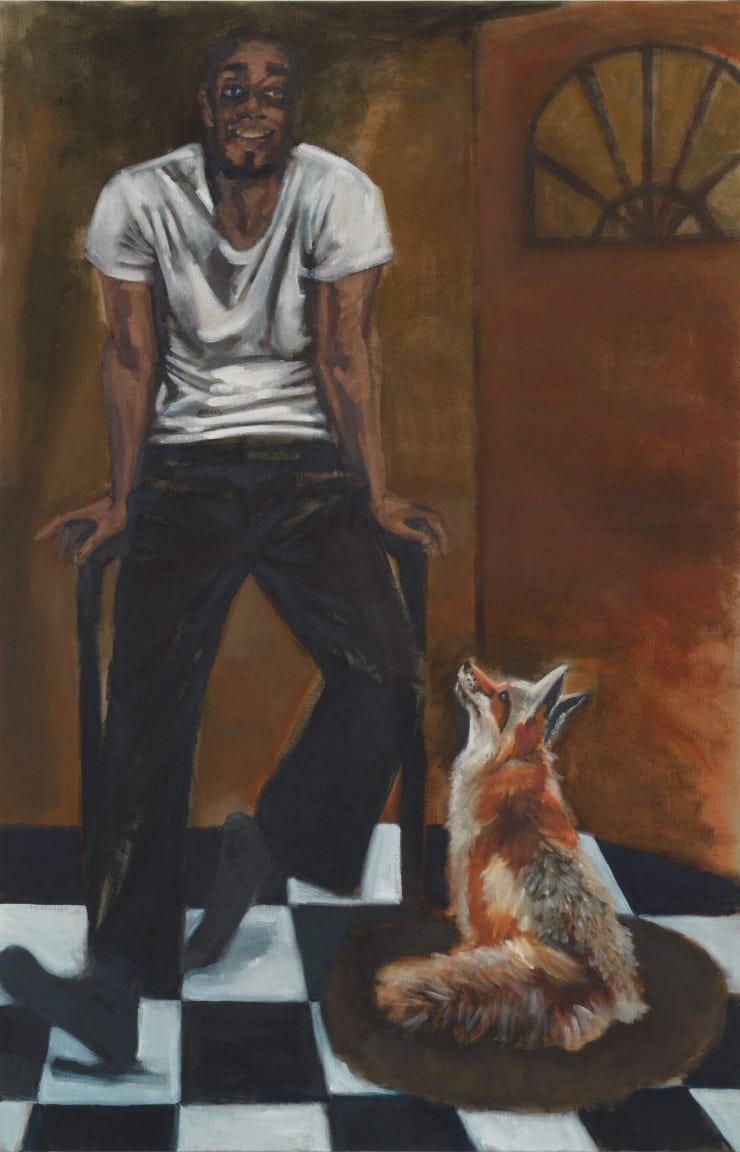
As in all of Yiadom-Boakye’s paintings, the man in Black Deference to Cunning seems quite real; then we notice that he’s being watched attentively by a fox. The colors of the fox are echoed in the walls and the arched window shape mimics the shrugged shoulders of the man, in keeping with the artist’s long-standing practice. There is a surreality to this painting that isn’t seen in the artist’s earlier works. The combination of fox and man moves beyond most of Yiadom-Boakye’s compositions which exist in a timeless reality similar yet removed from our own. This painting might relate to myth and fantasy, a world in which humans and animals relate to one another differently than in ours. An allegorical interpretation is also possible. Does the fox symbolize cunning tricksters who might lead someone astray? The man’s expression is wide-eyed and cheerful; perhaps he is under the fox’s spell already.
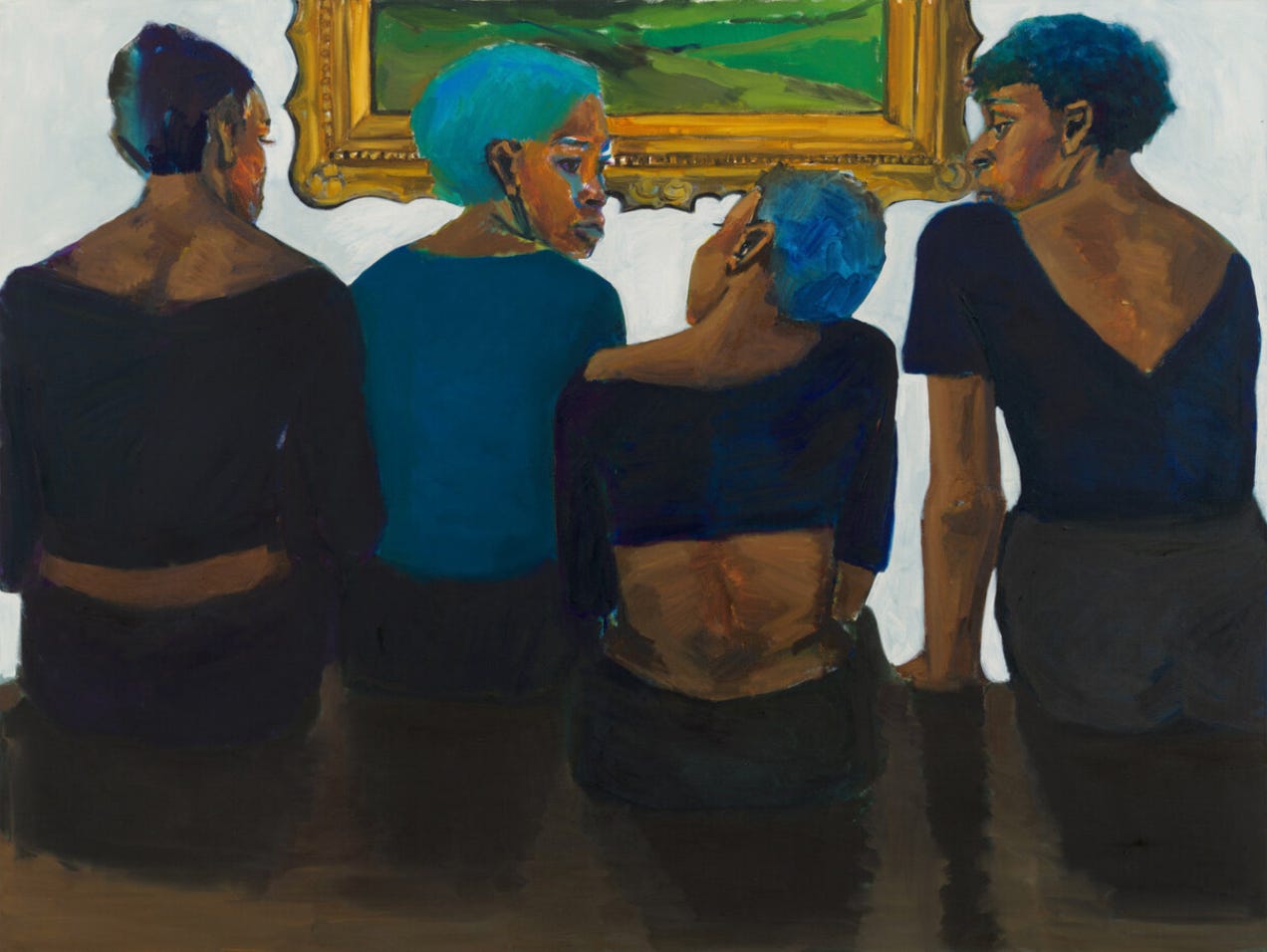
A Cause for Pastoral Concern is the most recent painting I’ve included here. Like the previous work it shows affinities with earlier paintings while introducing a new element. A group of women are seated on a bench facing away from the viewer. They are united by the blue tones that define their hair, clothing and contours. Beyond them, a golden-framed landscape painting hangs on the wall, its top half cut off by the upper edge of the composition. The artist is playing another word game here – landscape paintings have often been referred to as pastorals in the past – but “pastoral concern” suggests spiritual uncertainty or difficulty which may be reflected by the turned heads and closely gathered bodies.
Like all of Yiadom-Boakye’s paintings, this work uses expressive poses and a familiar situation to suggest portraiture while refusing to make clear who these people are or what is going on. There is a sense of intimacy among the figures but the viewer isn’t included. Still, the overall effect is of an exploration of states of being with which most of us are familiar.
But the idea of infinity, of a life and a world of infinite possibilities, where anything is possible for you, unconstrained by the nightmare fantasies of others, to have the presence of mind to walk as wildly as you will, that’s what I think about most, that is the direction I’ve always wanted to move in. – Lynette Yiadom-Boakye
Exhibition:
“Lynette Yiadom-Boakye: Many a Moonlit Caveat, through July 31, 2026 at Jack Shainman Gallery, 46 Lafayette Street and 513 West 20th Street, New York, New York, USA. https://jackshainman.com/exhibitions/lynette_yiadomboakye_chelsea
Thanks for reading and subscribing. We’d love to hear your responses to this important Contemporary artist in the comments. Likes and shares are greatly appreciated. I’ll be back soon with more art to share.
Thank you for this discussion. Her paintings do evoke some very strong emotions, something which is not always examined in portraits. Thank you for introducing her to us. It is refreshing to see new contexts for thoughtful subjects.
She did some interesting paintings and I seem to be back in good graces since I got this email 😜😜