
Chance Encounters, Edition 79
Orientalism: West Meets East

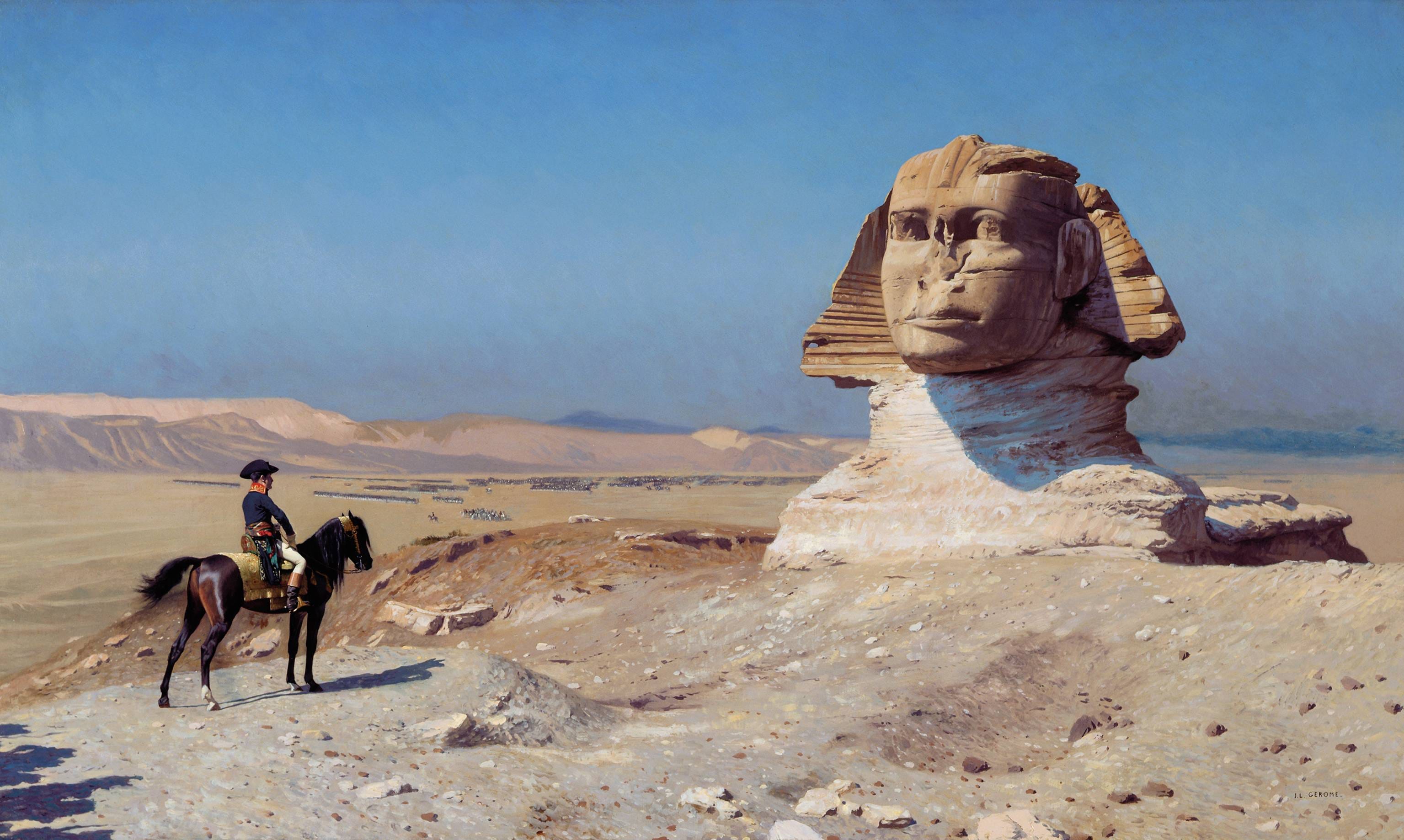
At the moment, the Metropolitan Museum of Art in New York is presenting a large exhibition (through February 28, 2027) which explores 19th century European and American ideas of The East through paintings and drawings, but also photographs, illustrated books, textiles and garments, arms and armor, glass, metalwork, and ceramics. Inspired by this exhibition, this edition of Chance Encounters explores Orientalism as a visual art movement.
Contact with cultures to the east inspired periodic fads in Europe beginning as early as the Roman Empire. The waxing and waning of interaction with Eastern cultures meant that Europeans of different periods would discover anew the products of these distant cultures. In the 19th century, improved travel encouraged more direct contact with distant lands, and unfortunately often led to political and economic interference by European powers. The Met’s exhibition begins with Napoleon Bonaparte’s conquest of Egypt in 1798, a time when European scholars and artists began to take a greater interest in the cultures of what was called the Orient. From the Latin oriens or east, direction of the rising sun, the geographic definition of “the Orient” has shifted among nearly all of the cultures of Asia and North Africa over time. In the context of this exhibition and much of 19th century thought, it refers to the Arab world.
As an artistic movement, Orientalism was the imitation or depiction of aspects of the Eastern World, especially West Asia and North Africa, by artists, writers, designers of the Western world (Western Europe and North America). The style was so popular that Orientalism became one of the specialties of artists in the French Academy of Fine Arts, and it was also influential in England, Germany, and America. The opening image above, Oedipus or Bonaparte before the Sphinx, was painted by French Orientalist Jean-Léon Gérôme (1824-1904). Completed in 1868, 40 years after Napoleon’s death, Gérôme’s painting depicts the general seemingly alone in the vast desert, confronting the Great Sphinx, only the head of which is visible above the dunes. With the artist’s and our knowledge of the failure of Napoleon’s dreams of conquest, the ruined sculpture seems like a harbinger of doom.
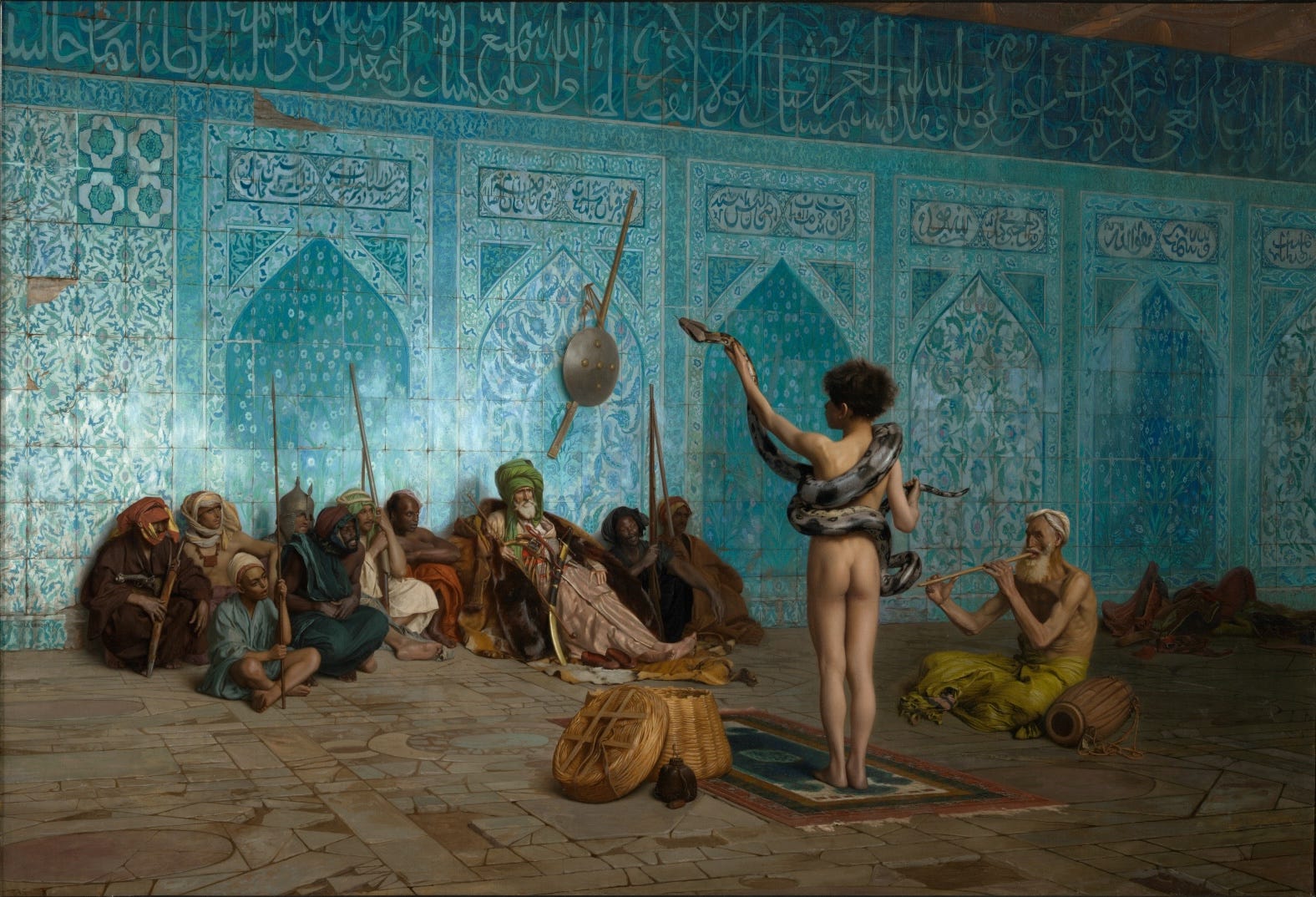
Gérôme’s The Snake Charmer has all of the elements of Orientalist art. The painting is brightly colored and precisely detailed. Though elements of the work are based on real places, it is a fantasy of Ottoman culture, rather than an observed scene. The beautiful turquoise tiled wall is based on the Topkapi Palace in Istanbul while the patterned stone floor is similar to one in a Cairo mosque. The pointed helmet worn by the fourth figure from the left resembles one known to have been owned by the artist and included in the Met’s exhibition. The audience for the snake charmer is made up of armed men surrounding a turbaned figure who sits higher than the others and wears a curved sword. However, the costumes and weapons originate from several different cultures and the mesmerized gazes suggest that the snake isn’t the only one being charmed. The painting perpetuates stereotypes of Arab culture as more bloodthirsty, mystical, and sensual than European culture.
Gérôme was one of the most successful French artists of the mid-19th century. His works were widely reproduced, expanding his fame far beyond Paris. The artist’s early paintings focused on Classical (Greek and Roman) themes in the Academy’s preferred highly idealized and smoothly finished style. In 1856, Gérôme visited Egypt for the first time. As he traveled up and down the Nile and across the Sinai to Jerusalem and Damascus, he collected objects and costumes to take back to his studio as props for future paintings. He also made small oil sketches to capture scenes he saw, intending these as preparations for future paintings. The paintings he made after returning to Paris were highly successful and expanded his reputation; his subjects there after varied between Orientalist and Classical themes.
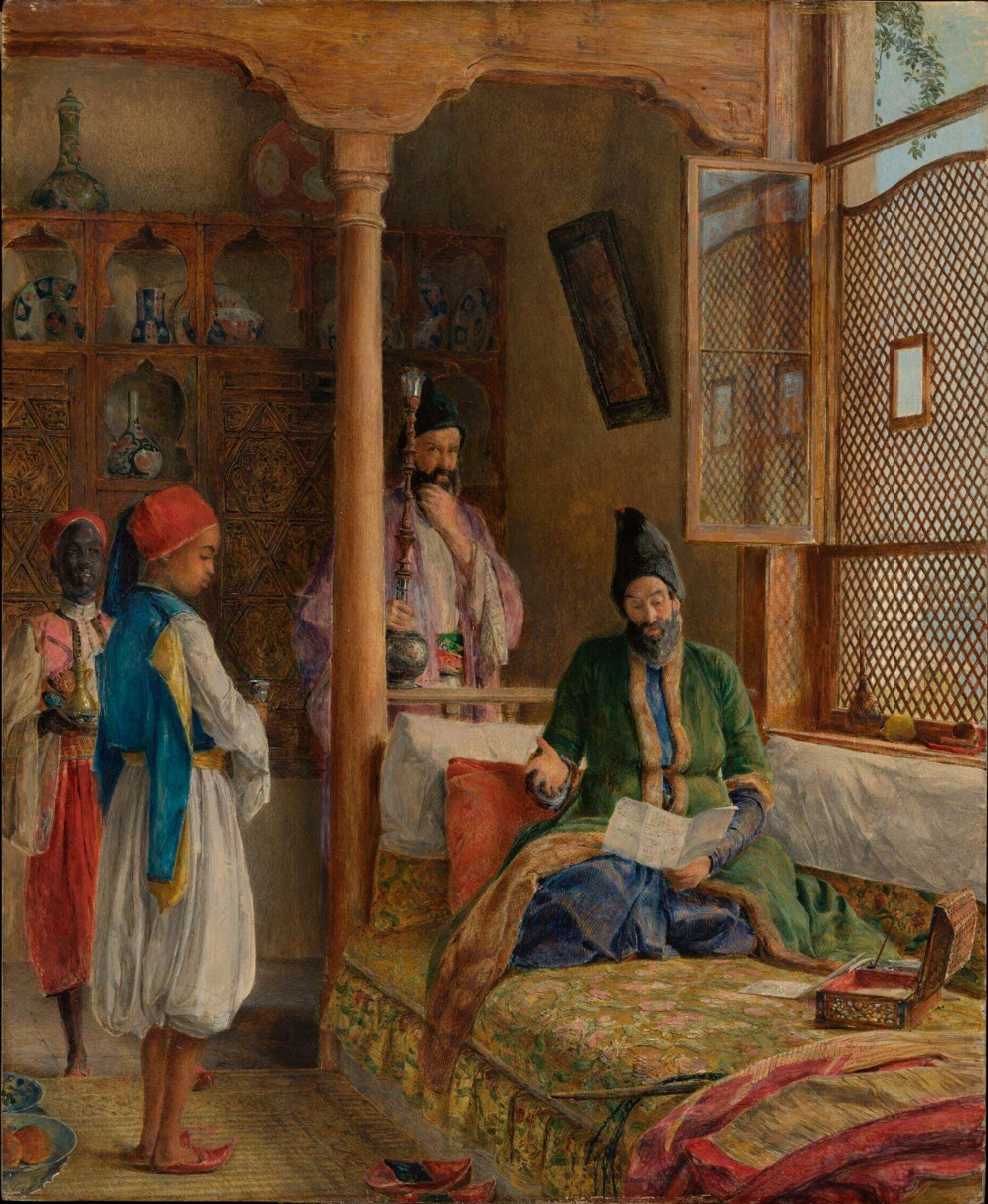
John Frederick Lewis’ (English, 1804-1876) An Oriental Interior matches Gérôme’s style in its vivid colors and ornate interior, but Lewis has captured real people in a specific moment of daily life. The artist traveled widely, arriving in Constantinople (now Istanbul) in 1840. While there he painted portraits of members of the household of Prince Hulugu Mirza, an exiled cousin of the Shah of Iran. Lewis utilized his portrait studies for this painting, which shows the Prince complaining to his servants about the very high bills he is perusing. In spite of the exotic setting and portraits, the scene would have been familiar to any Victorian Englishman. Lewis lived in Cairo, Egypt for ten years, living in a traditional upper-class Egyptian house which he often used as a setting for his paintings. Often dressed in Egyptian garments and carrying a scimitar, he lived a “dreamy, hazy, lazy, tobaccofied life” according to author William Makepeace Thackaray (English, 1811-1863), the artist’s friend.
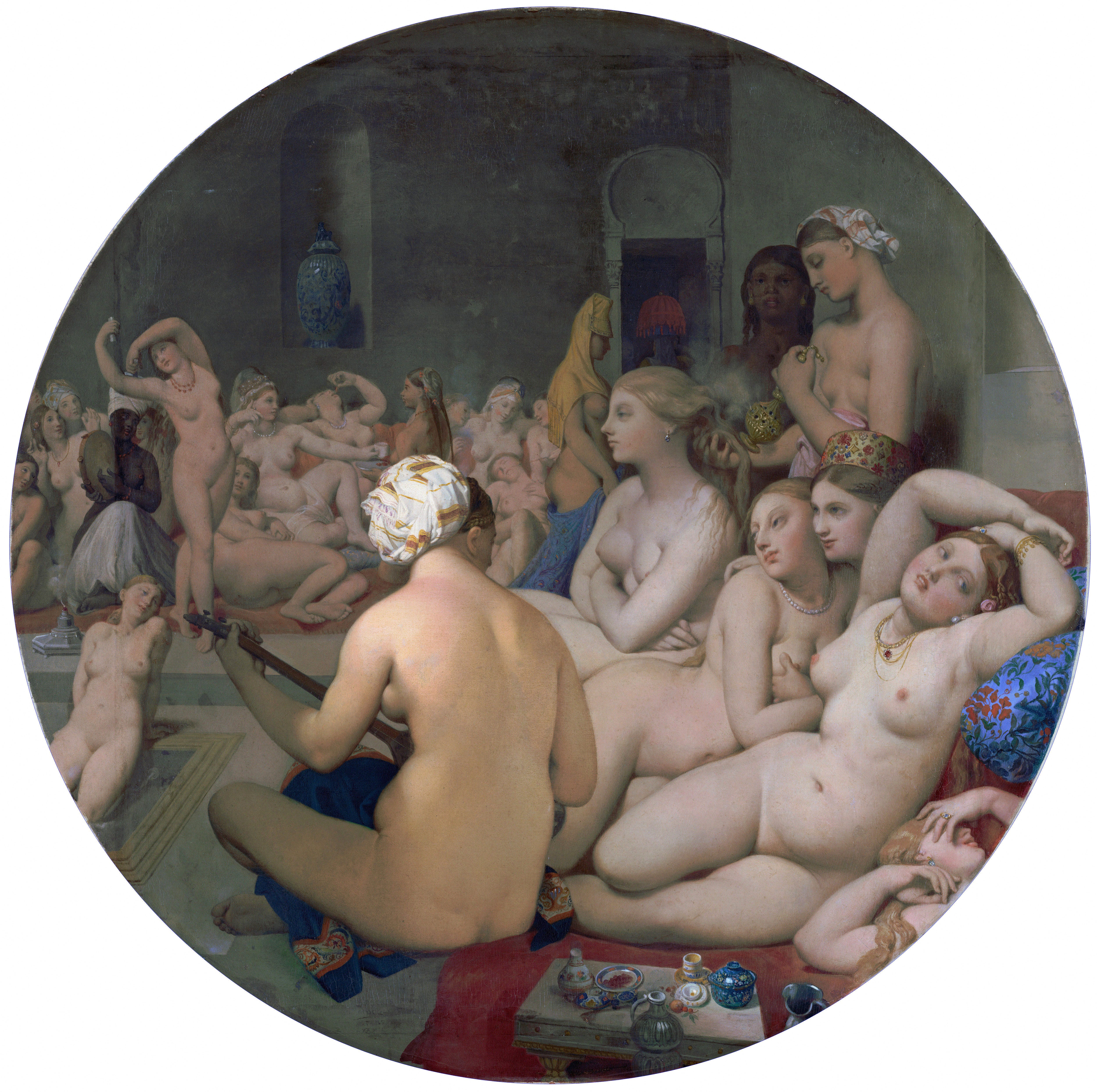
One of the popular themes among Orientalist painters was female nudes, paintings which took a longstanding European tradition and transferred it to the exotic environments of the harem and the bath house. European men would never have been admitted to the female spaces of the harems or women’s baths, but that didn’t stop the artists from imagining these subjects. Jean-Auguste-Dominique Ingres (French, 1780-1867) is well-known for his idealized and stylized nudes, often in quasi-oriental settings. Unlike Gérôme and Lewis, Ingres never visited Egypt or Turkey, though he had read published reports of the harems and baths. Authenticity rarely mattered to the artist though. Here he was using the veneer of Orientalism to depict a scene of passive sexuality. The Turkish Bath shows a crowd of nude women arranged in a curve from the center foreground, counter-clockwise to the woman reclining in the pool in the left middleground. Ingres depicts a mix of practical behavior (servants, eating and drinking, performing music and dancing) and explicit eroticism in this painting.
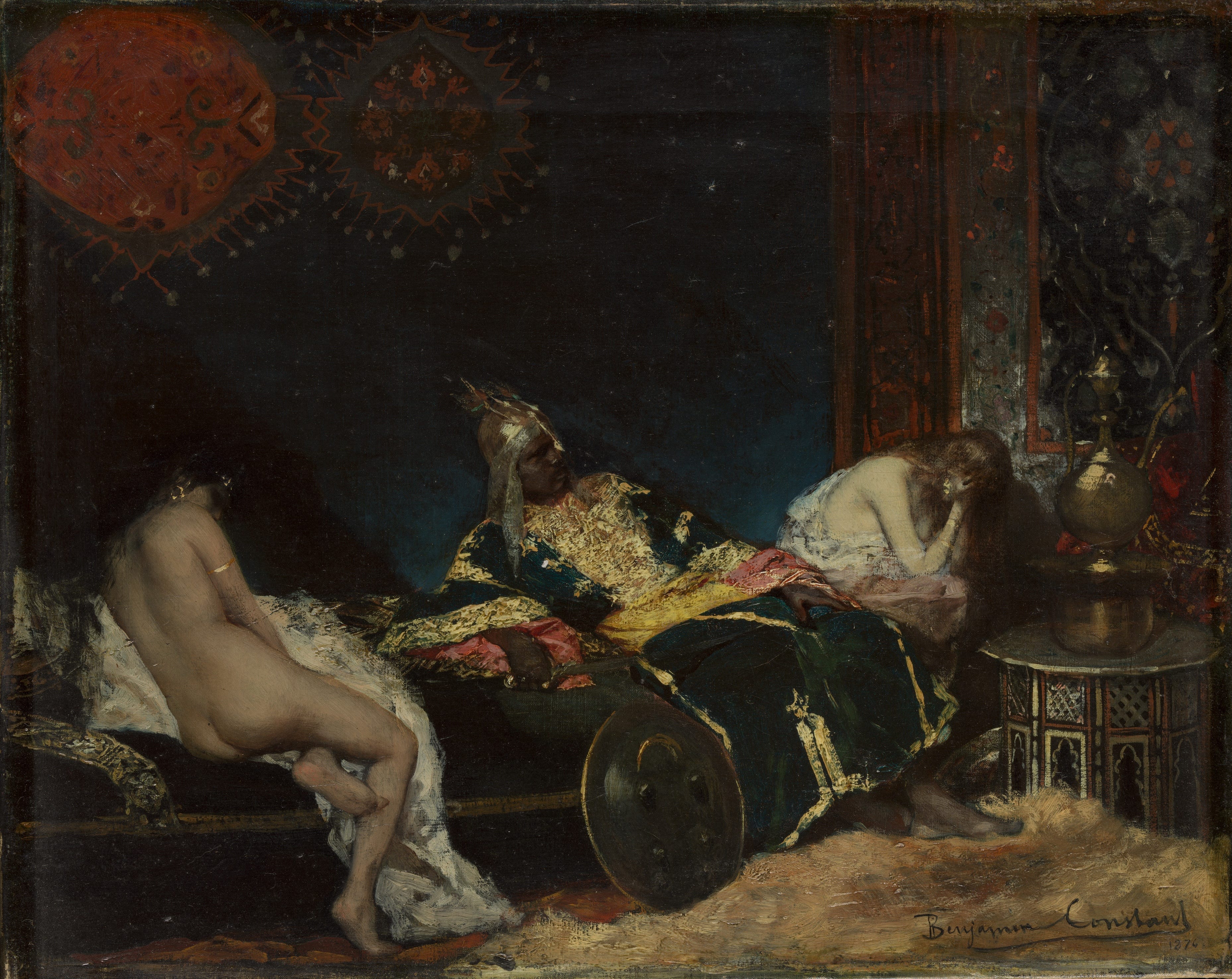
Ingres’ sensual fantasy differs greatly from Scene in a Harem by Jean-Joseph Benjamin-Constant (French, 1845-1902). Though also a fantasy, the artist’s dark vision of the harem evokes the stereotype of the dangerous, alien East. A helmeted, dark-skinned man in ornate green robes reclines on a low bed next to his shield. To the left, a dark-haired, nude woman leans against a white blanket; she seems to have withdrawn into a private world. At the far end of the bed crouches a pale-skinned, red-haired woman, partially covered by torn clothing, hiding her face with her hands. The painting exploits fears among Western European and North American societies of white women enslaved in Ottoman harems. There was traffic in white women, but unlike the tabloid stories of kidnapped English and American girls, most of the women involved were captives taken during Ottoman wars in Eastern Europe.
The style of this painting is noticeably different from that used by the previous artists. Benjamin-Constant’s brushwork is much looser and the details blend into the threatening darkness. The rich colors of Orientalism are still present but they are tempered by the dark atmosphere. Painterly form, exotic themes, and emotion-inducing depictions are characteristic of the Romantic artistic movement of the first half of the 19th century. Though the exotic themes of Gérôme, Lewis, and Ingres are also Romantic in tone, their painting styles are characteristic of Neoclassicism, the precise and linear style advocated by the French Academy of Fine Arts in the 19th century.
During the first half of the 19th century, French art was divided among advocates of Neoclassicism and Romanticism. The leader of the Neoclassicists was Ingres and the style was entrenched within the powerful Academy of Fine Arts. The leader of the Romantic painters was Eugène Delacroix (French, 1798-1863). His painterly, colorful works were intended to provoke emotional responses in viewers. In 1832, Delacroix traveled to North Africa as part of a diplomatic mission to Morocco. Upon arrival, the artist became enamored of the culture.
The aspect of this country will remain forever in my eyes, all my life long the men of this noble race will live and move in my memory; it is they who have really brought back to me the beauty of the ancients. – Eugène Delacroix
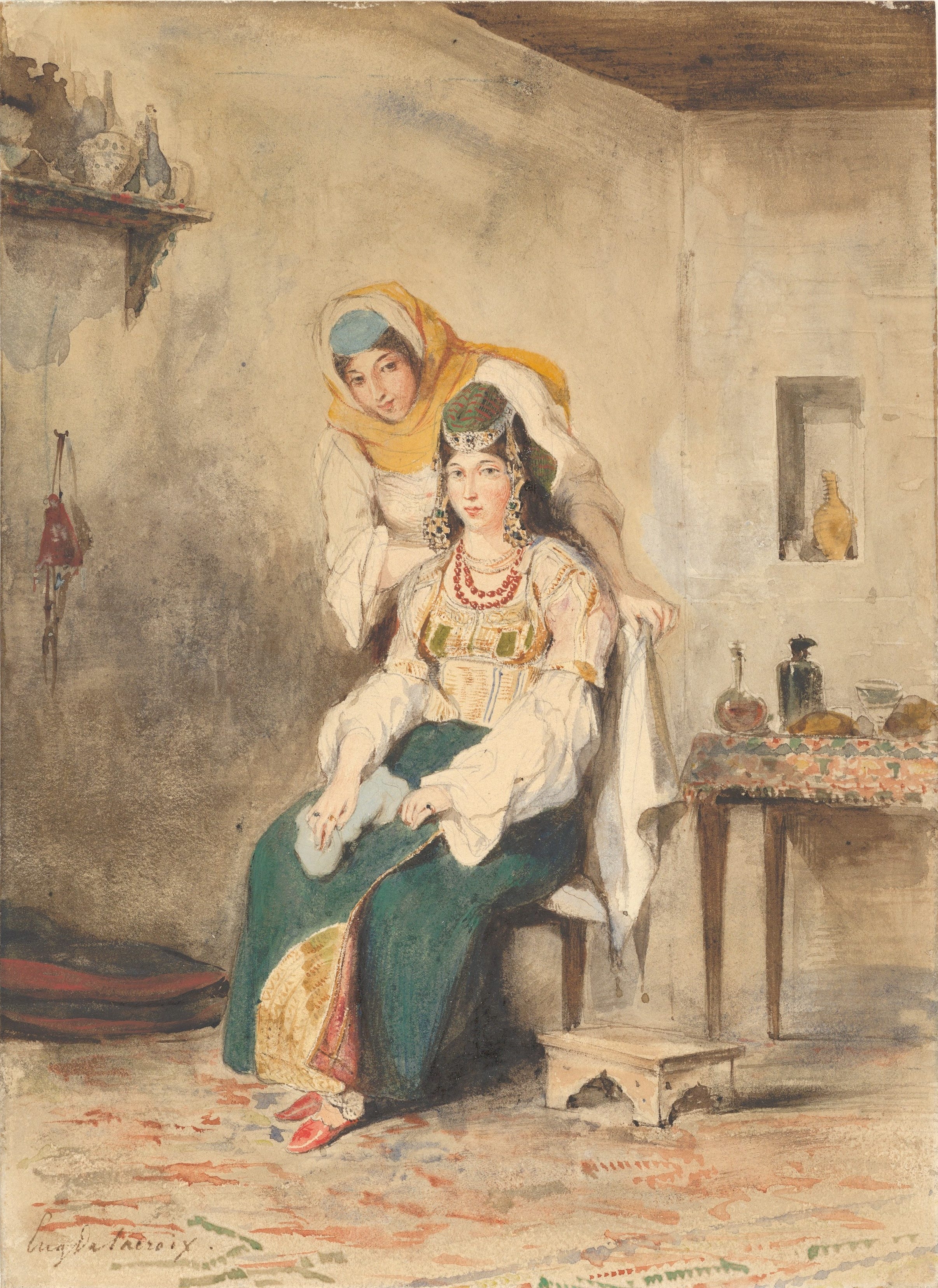
In spite of seeing the Arabs as an embodiment of Classical Antiquity, the artist took pains to capture the reality of the people, scenery, and wildlife. Though he used many of the watercolors and sketches from his visit as the basis for later oil paintings, the watercolors themselves show how attentive Delacroix was to the culture he was observing. Saada and Preciosa portrays family members of a wealthy Jewish man who agreed that the artist could paint them. It was very difficult for Western artists to paint Muslim women as social rules prevented them from appearing uncovered in public. The bright colors and ornate jewelry give the sense of an exotic culture though the poses and expressions seem universal.
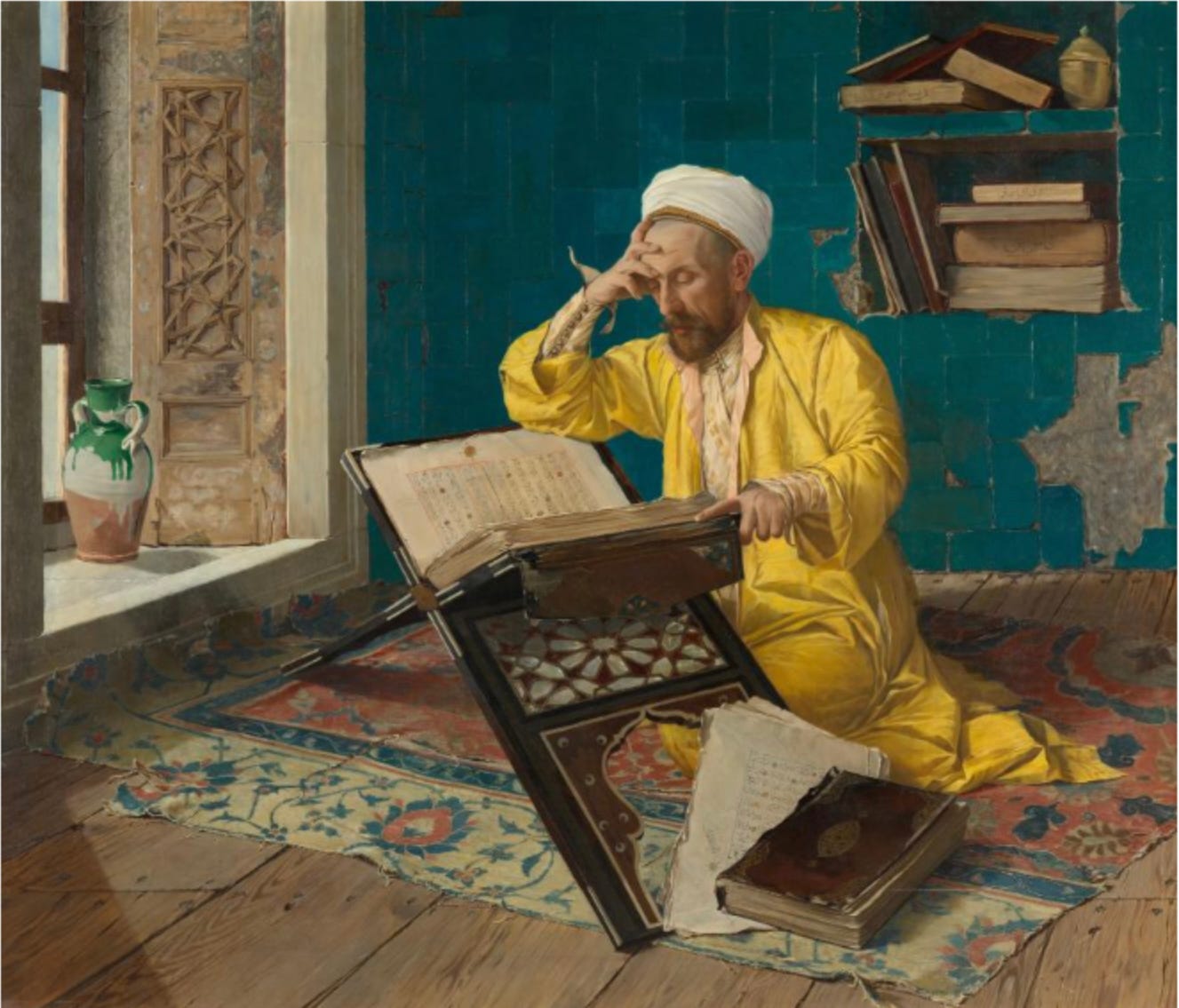
The Met’s exhibition ends with paintings by Osman Hamdi Bey (Ottoman Greek, 1842-1910). His works fit the descriptions of Orientalist painting but where the artists we’ve seen were outsiders looking in, Hamdi was depicting the Ottoman culture of which he was a part. Traveling to Paris in 1860 to study law, a career he’d begun in Constantinople, the young scholar switched to painting and trained with Gérôme. Hamdi remained in Paris for nine years, becoming an accomplished painter as well as a keen student of contemporary culture. Man Meditating Over the Qur’an has the vivid color and linear form that the artist learned from Gérôme, but instead of exoticizing his subject, Hamdi provides a sympathetic image of the scholar deep in thought over the sacred text. The energetic combination of golden yellow and turquoise blue contrast with the stillness of the figure; in spite of authentic furnishings, all our attention is on the figure. Today, in addition to being admired for his paintings, Hamdi is considered the founder of museum studies, archeology, and curatorship in Turkey.
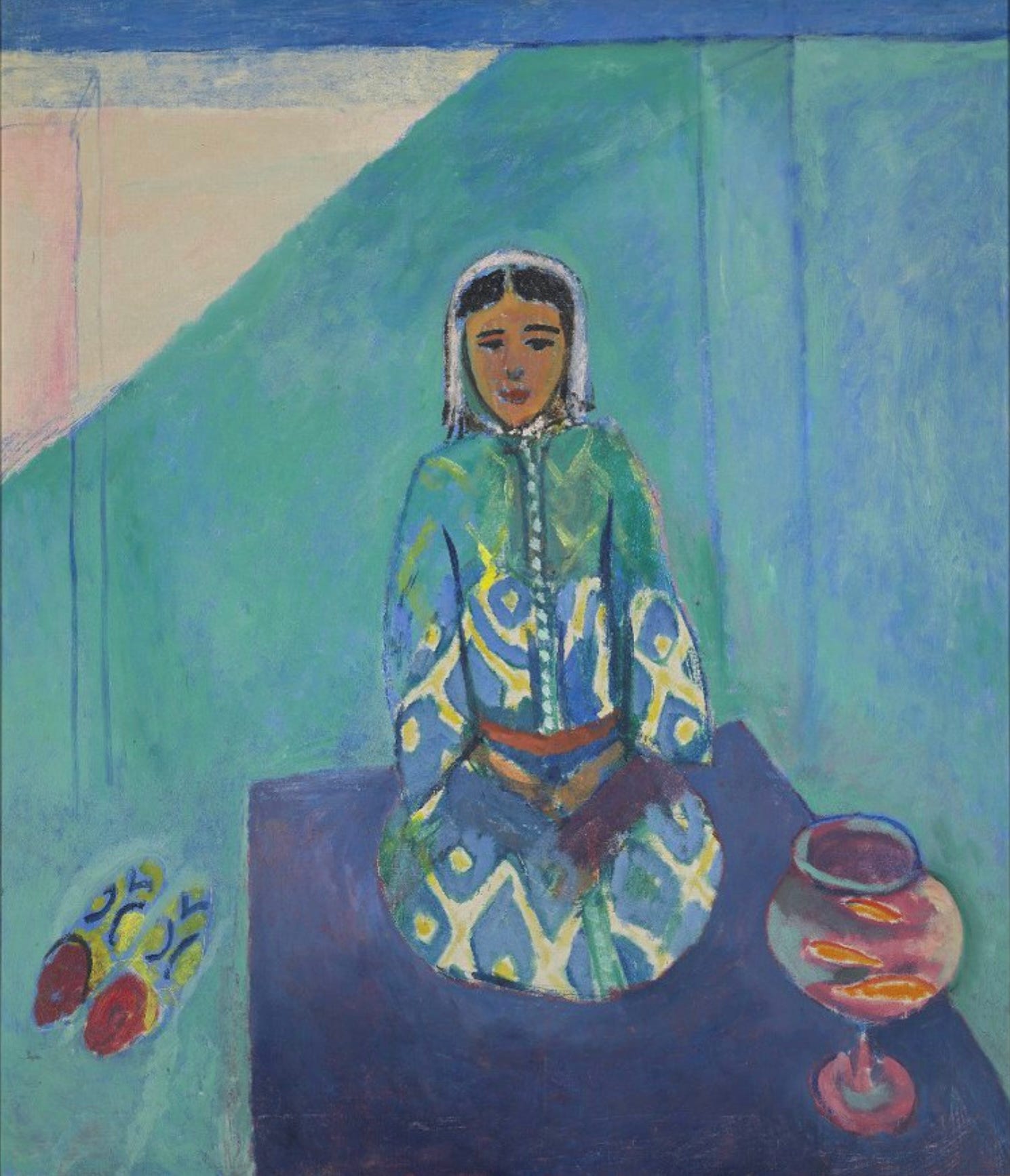
I have taken one step closer to the present than the Met’s exhibition by including Zorah on the Terrace by Henri Matisse (French, 1869-1954). Though Orientalism had mostly faded from French art with the rise of Post-Impressionism at the end of the 19th century, Matisse was drawn to the idealized world of harem women, Islamic décor, and Mediterranean light. The artist spent seven months in Morocco in 1912-1913. He created about 24 paintings and many drawings, including this work. The predominantly blue palette is characteristic of Matisse’s Moroccan paintings and this work contains a motif which the artist continued to use throughout his later career – goldfish in a bowl. Matisse’s works are more abstract than those created by earlier Orientalists, but they demonstrate a similar stereotype of the East as colorful, exotic, and sensual. The idealized world Matisse’s Orientalist paintings is closely tied to his view that visual art should provide an escape from mental strain of daily life.
The idea of representation is a theatrical one: the Orient is the stage on which the whole East is confined. – Edward Said (Palestinian-American, 1935-2003)
In 1978, Edward Said published Orientalism, a book which critiqued the traditions of Orientalism as creating barriers to cultural equality between Western and Eastern cultures. He described the stereotypes created by Orientalism as freezing African and Asian cultures in an unchanging, uncivilized state permitting colonization of these cultures by imperialist forces. Said’s interpretation is based primarily on French literature but his view that culture expression reflects the political and economic context in which it is created is now seen as a valid means of interpreting culture. Said’s work reminds us that outsiders aren’t the best source for understanding foreign cultures and that real harm comes from stereotyping others. On the other hand, most of the visual artists who participated in the Orientalist movement sincerely admired the cultures they were representing. The Met’s exhibition looks at all aspects of the Orientalist movement, its fantasies and exaggerations, its contribution to expanding the visual languages available to Western creators, and the doors it cracked open for authentic Eastern cultural expression to enter the Western world.
Exhibition:
Orientalism: Between Fact and Fantasy, through February 28, 2027 at the Metropolitan Museum of Art, 1000 Fifth Avenue, New York, New York, USA https://www.metmuseum.org/exhibitions/orientalism-between-fact-and-fantasy
Thank you for reading and subscribing. Your comments, likes, and restacks are very much appreciated. I’ll be back soon with more art to share.
This is a wonderful summary of the exhibit. Informative text and excellent selection of works.
Thank you for sharing Osman Hamdi Bey's work. I was not familiar with him. I'd like to explore more of his wotk.