
Chance Encounters, Edition 77
William H. Johnson’s Fighters for Freedom

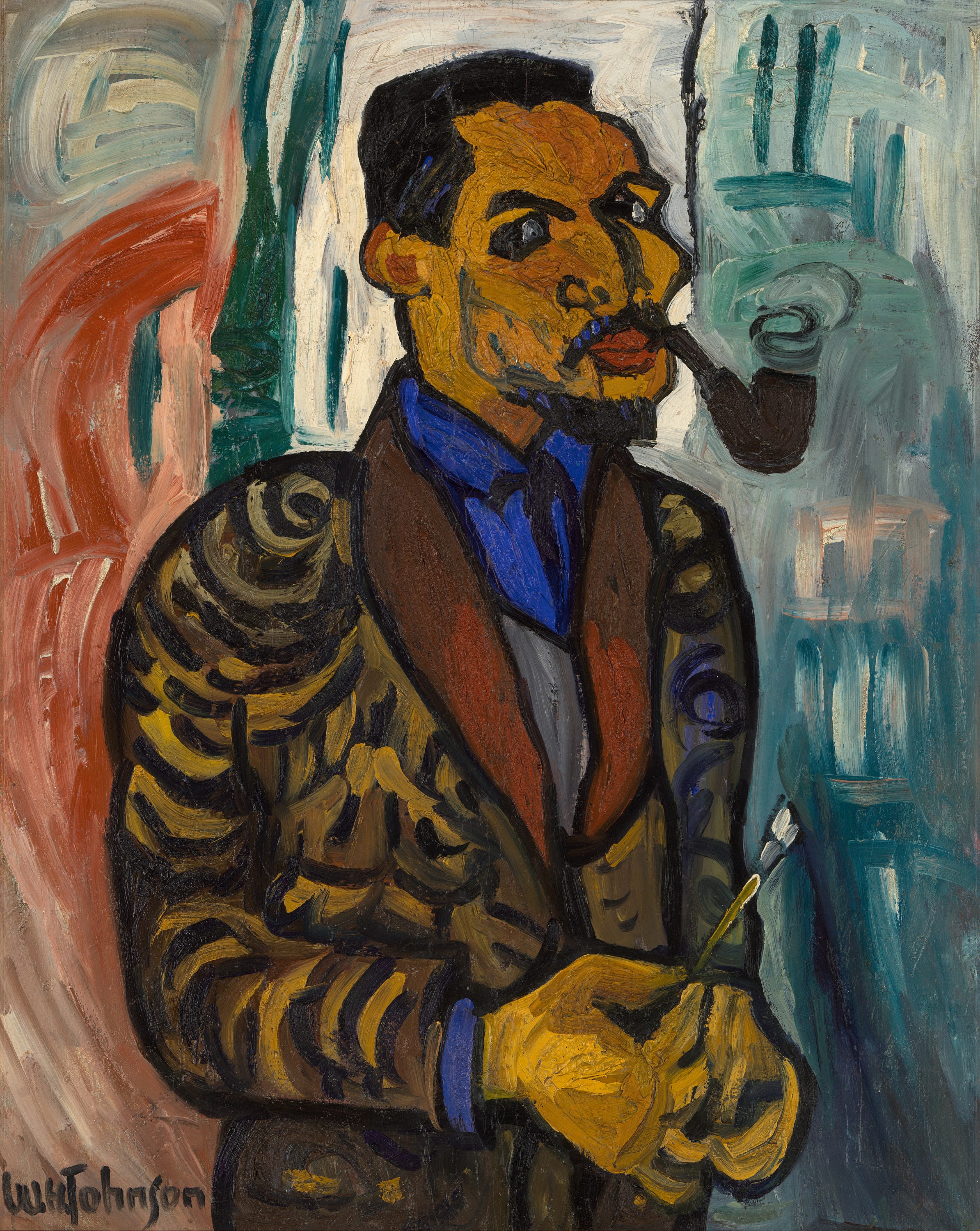
William H. Johnson (American, 1901-1970) was an African-American artist working during the first half of the 20th century. Born in South Carolina to an impoverished Black family, he was interested in drawing from a young age, training himself by copying newspaper comic strips. Johnson moved to New York City at the age of 17, living with an uncle and working a variety of jobs to earn enough to attend art school. He studied at the National Academy of Design where the young artist won several prizes and the approval of his teachers for his mastery of the academic style they taught. During the summers, Johnson attended the Cape Cod School of Art in Provincetown, Massachusetts. When Johnson was passed over for a grant which would have allowed him to travel to Europe, his mentor, Charles Webster Hawthorne (American, 1872-1930), provided funding for the young artist to continue his studies abroad.
And even if I have studied for many years and all over the world, . . . I have still been able to preserve the primitive in me. . . . My aim is to express in a natural way what I feel, what is in me, both rhythmically and spiritually, all that which in time has been saved up in my family of primitiveness and tradition, and which is now concentrated in me. – William H. Johnson
Once he was exposed to the Modernist art in 1920s Paris, the artist’s style shifted away from the academic style he’d been taught. Johnson passed through Impressionist, Cubist, and Expressionist phases, before developing his mature style. This Self-Portrait is mostly Expressionist in style, though it shows some of the outlining that Johnson favored in later works. His bold style of simplified forms and bright colors was described by the artist as primitive, a term which is often avoided by scholars today due to its association with the appropriation of indigenous imagery by Western artists. Johnson, however, associated the concept of the primitive with what he called “the community values and folkways of marginalized people.”
Around 1945, Johnson painted a series of works honoring African American activists, scientists, teachers, and performers, as well as international leaders working to bring peace to the world. He titled the group Fighters for Freedom which was exhibited together in 1946. The works are being shown together at the Dayton Art Institute for the first time since then. (see below for details)
In all my years of painting, I have had one absorbing and inspiring idea, and have worked towards it with unyielding zeal – to give in simple and stark form – the story of the Negro as he has existed. – William H. Johnson
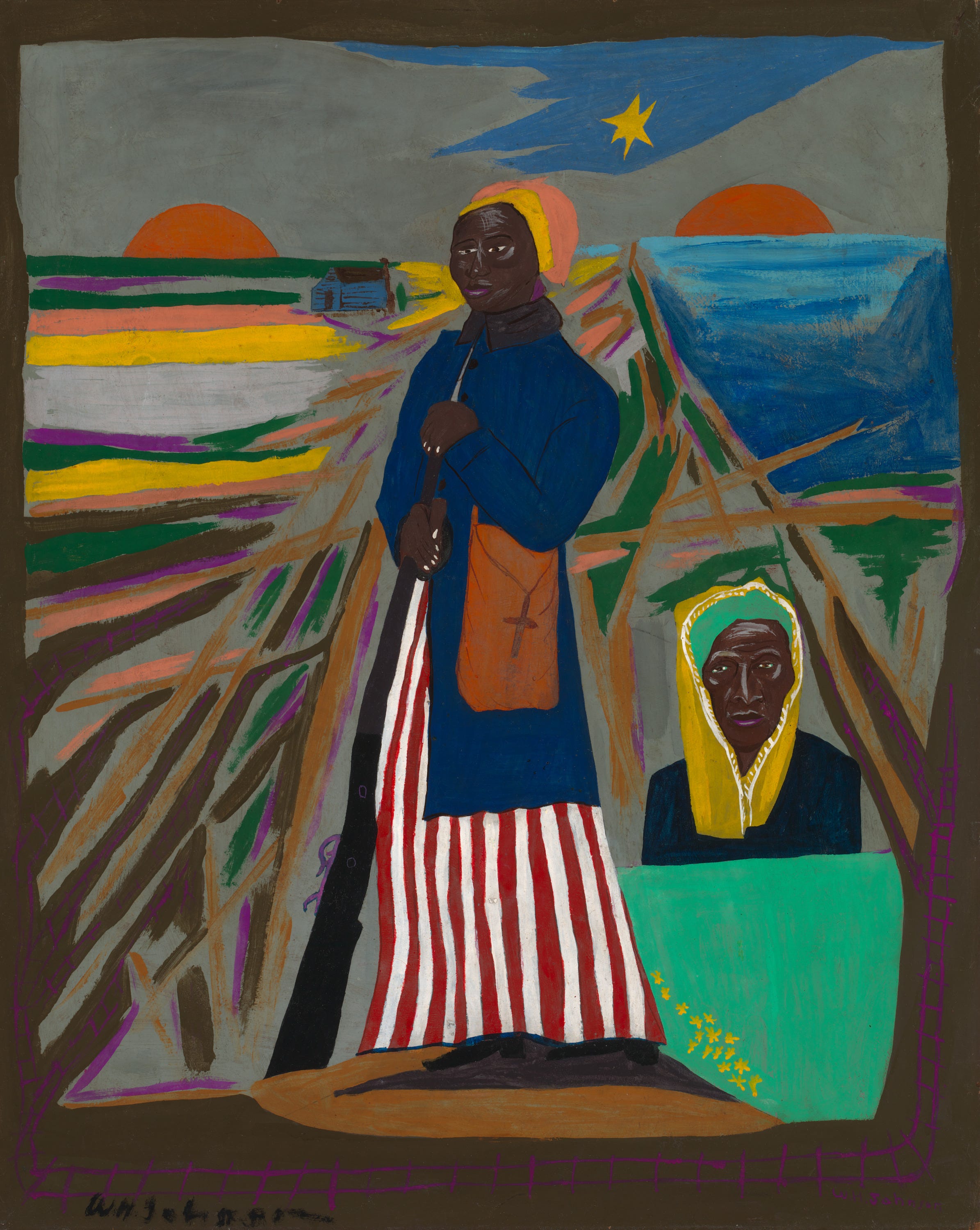
Harriet Tubman honors the woman (American, 1822-1913) who escaped slavery and led many others to freedom, who acted as a scout and spy for the Union during the Civil War and who, later in life, advocated for women’s suffrage. Johnson focuses on the first of these in his painting, depicting Tubman enclosed within lines symbolizing the winding paths on which she led others to safety. Above her is the North Star and to each side of the large figure, the sun rises and sets. Johnson’s preferred practice for works like this was to trace a published image of the subject and then simplify it and add bright color. In this case, he utilized a popular 19th century woodcut of Tubman in a long jacket with a striped skirt, which Johnson interpreted in patriotic red, white, and blue. The yellow and orange headwrap is like a halo around Tubman’s head. The smaller bust-length image to the right is also Tubman, this time based on the 1911 photograph of her wrapped in the shawl given to her by Queen Victoria.
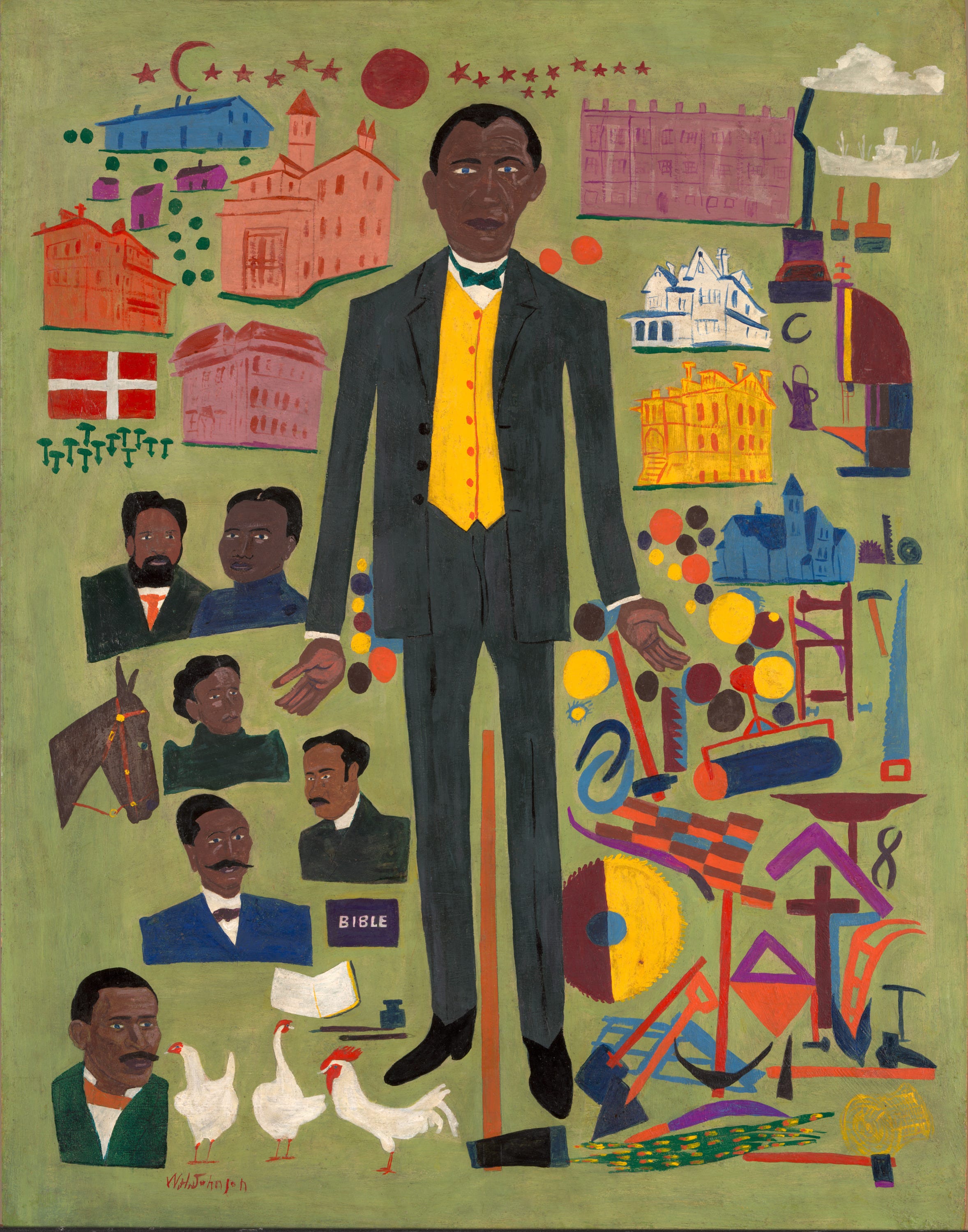
Harriet Tubman differs from many of the compositions in the series because it lacks the small-scale narrative vignettes and symbols that surround the main figures in other works. Booker T. Washington Revelation is more typical, with a tall, slender central figure flanked on both sides by portrait heads, flags, buildings, and tools. Johnson’s use of color enlivens the surface of the painting, contrasting dark tones for the serious portraits with the brightly colored tools and buildings. Across the top of the composition are stars, a crescent moon, and the sun, a feature of many paintings in the series.
In 1881, Booker T. Washington (American, 1856-1915) was invited to establish a school for Black students in Tuskegee, Alabama. Beginning with a few students in a broken-down structure donated by a church, Washington raised money, set his students to building, and eventually developed Tuskegee Normal and Industrial Institute (now Tuskegee University) into a school of 1,500 students and more than 35 fields of study. In Booker T. Washington Revelation, Johnson depicts several recognizable structures from the school, agricultural, engineering, and building tools, and portraits of several individuals who contributed to the success of Tuskegee, including Olivia A. Davidson (American, 1854-1889), Washington’s second wife and vice-principal of the school, and Robert Robinson Taylor (in blue, American, 1868-1942), the first accredited African American architect and a teacher at the school.
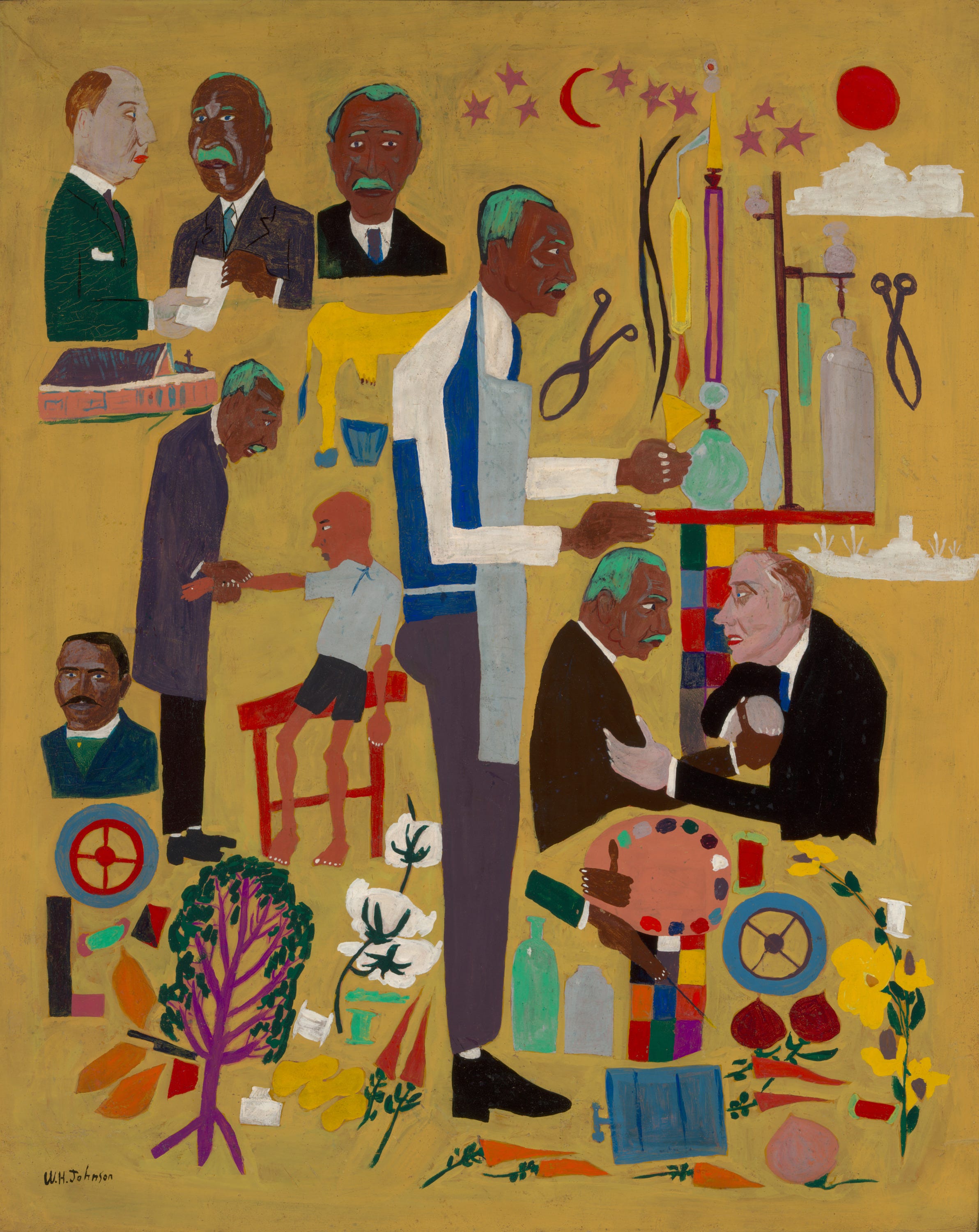
Dr. George Washington Carver has many similarities with Booker T. Washington Revelation, but the main figure is more active, shown at work with lab equipment. George Washington Carver (American, c. 1864-1943) was one of, if not the most famous African Americans in the world during his lifetime. Famous among both black and white communities, Carver even traveled to India to visit Mahatma Gandhi (Indian, 1869-1948) and advise him on nutrition. An active researcher and teacher at Tuskegee Institute, Carver developed many new uses for crops, represented across the bottom of this painting by peanuts and sweet potatoes among others. On the right side of the painting, Carver is welcomed by President Franklin Delano Roosevelt, who enlisted the scientist as an advisor to the Department of Agriculture during the 1940s. Another notable detail is the depiction of an artist’s palette near the lower right. Carver had produced some new pigments from soils and vegetables which Johnson clearly valued enough to include them here.
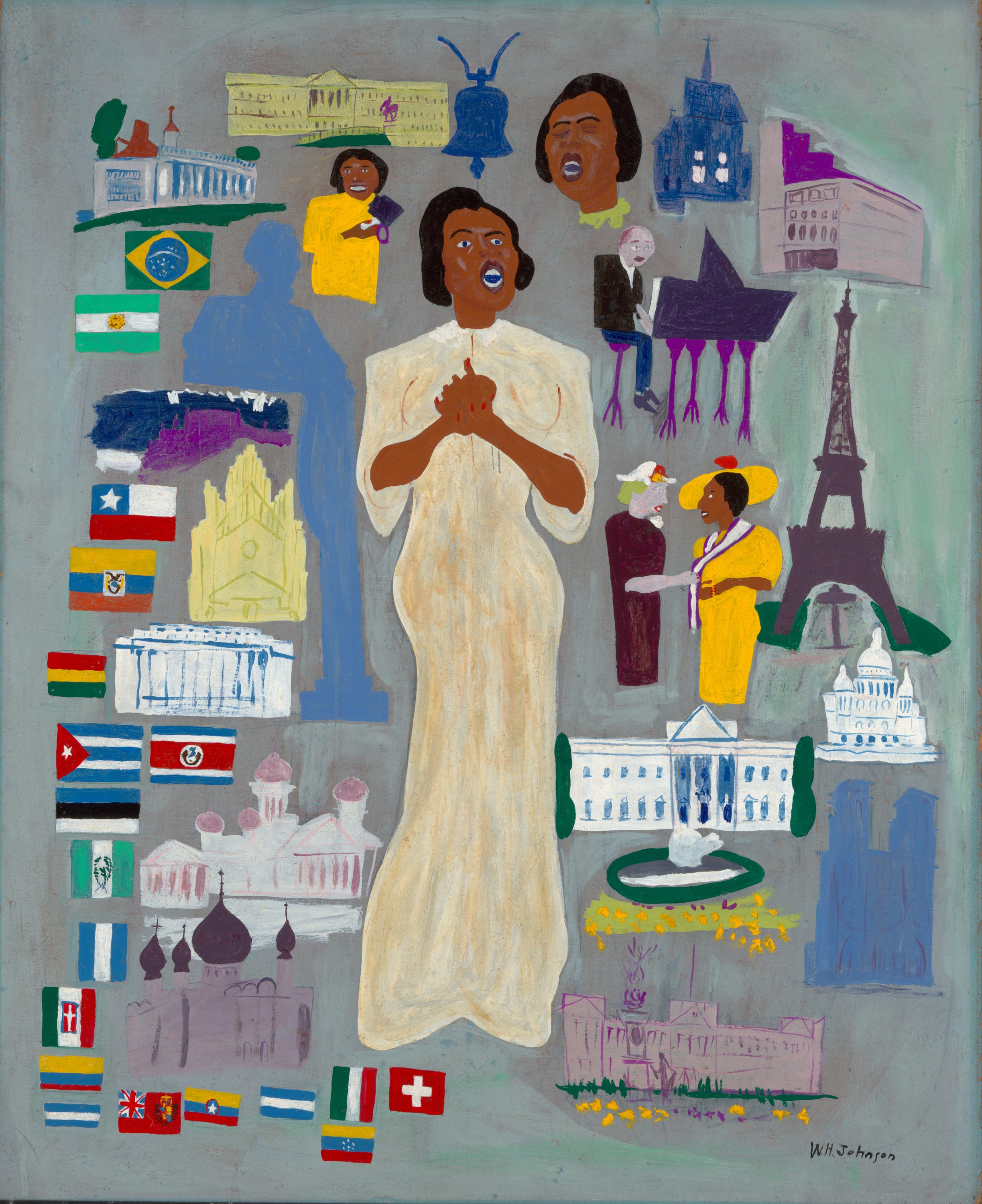
Marian Anderson is the third portrait of the famed singer (American, 1897-1993) painted by Johnson. In the two earlier portraits, he depicted her in front of the Lincoln Memorial in reference to a famous and painful incident of racism. Because she was Black, Anderson was barred from singing in Washington, DC’s Constitution Hall by the Daughters of the American Revolution. In response to widespread protests, including from the First Lady, Eleanor Roosevelt, Anderson was invited to sing from the steps of the Lincoln Memorial. Over 75,000 people, many African American, attended the concert.
I said yes, but the yes did not come easily or quickly. ... As I thought further, I could see that my significance as an individual was small in this affair. I had become, whether I liked it or not, a symbol, representing my people. – Marian Anderson
In this final portrait of Anderson, Johnson includes a small Lincoln Memorial, to the left of the large central figure, and a large blue silhouette of Abraham Lincoln, also to the left. To the right, Eleanor Roosevelt presents the NAACP’s Spingarn Medal to Anderson, an event which occurred two months after the concert. Most of this painting is dedicated to Anderson’s international tours, through recognizable national monuments like the Eiffel Tower, Moscow’s St. Basil’s Cathedral and Saint Peter’s in Rome. An array of national flags, from Brazil’s at the top to Switzerland’s at the bottom, attests to the singer’s fame and popularity throughout the world.
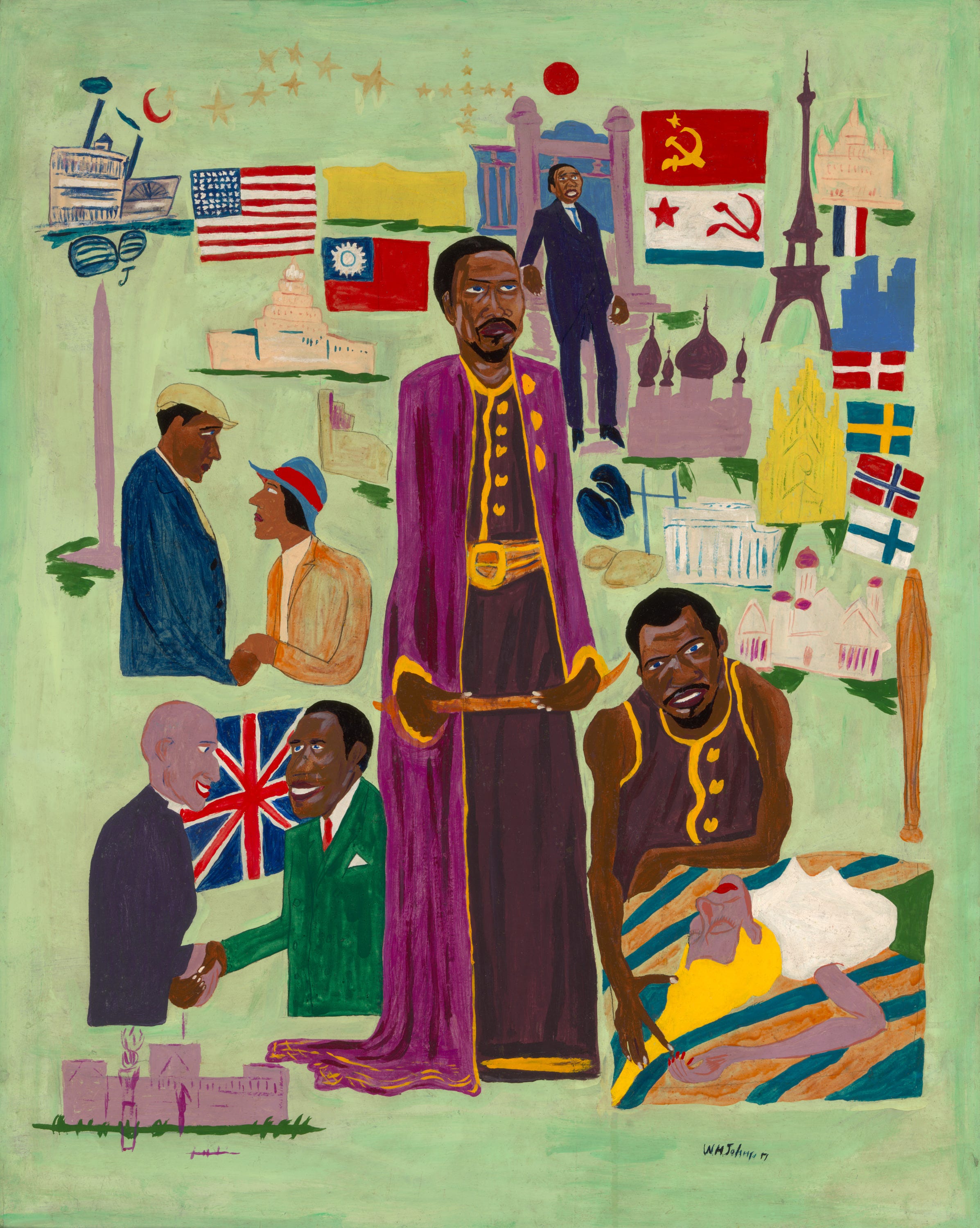
Paul Robeson’s Relations honors another performer, one who was especially important to the artist. Actor and singer Paul Robeson (American, 1898-1976) was a collector of Johnson’s paintings. The two had met in 1935 in Copenhagen, Denmark. In 1930, Johnson had married Danish artist Holcha Krake (1885-1944) and the couple lived in Denmark through most of the 1930s. Robeson was an international star of stage and screen and a campaigner for Civil Rights. Johnson shows Robeson in costume for the title role in Shakespeare’s Othello; the rich purples of his outfit stand out from the pale green background. A paddlewheel riverboat in the upper left refers to the artist’s famous role as Joe in Show Boat; other vignettes refer to his marriage, his professional success in London, and his performances as Othello with white actress Peggy Ashcroft as Desdemona. Once again famous monuments and flags identify places where Robeson traveled to perform.
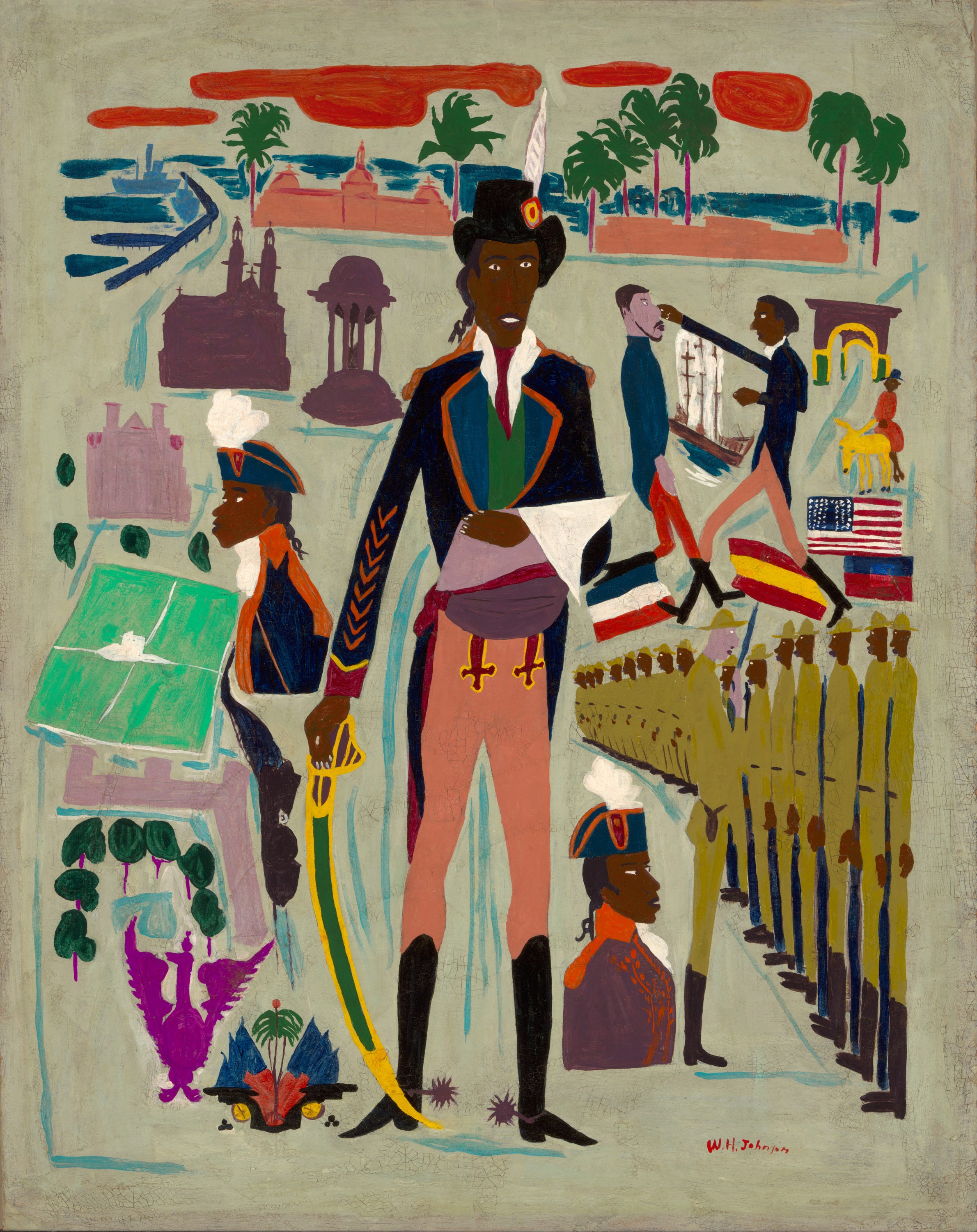
In addition, to Black American role models, Johnson’s Fighters for Freedom includes international figures like Mahatma Gandhi, the Allied leaders during World War Two, and Ethiopian emperor Haile Selassie. This painting depicts a leader of the Haitian revolution, François-Dominique Toussaint L’Ouverture (1743-1803). The large central figure shows L’Ouverture as a general in uniform, holding papers that represent the Haitian constitution he wrote. L’Ouverture was an important symbol to equality-seeking peoples, especially Blacks in the Americas. He was a martyr to the fight for freedom, having died in a French prison after Napoleon Bonaparte sent troops to capture him and reinstate slavery. In addition to L’Ouverture, Johnson celebrates the Republic of Haiti, seen as the tropical landscape at the top of the composition. Haiti was the second country to declare independence from a colonial power (after the United States) and the first country in the Americas to outlaw slavery.
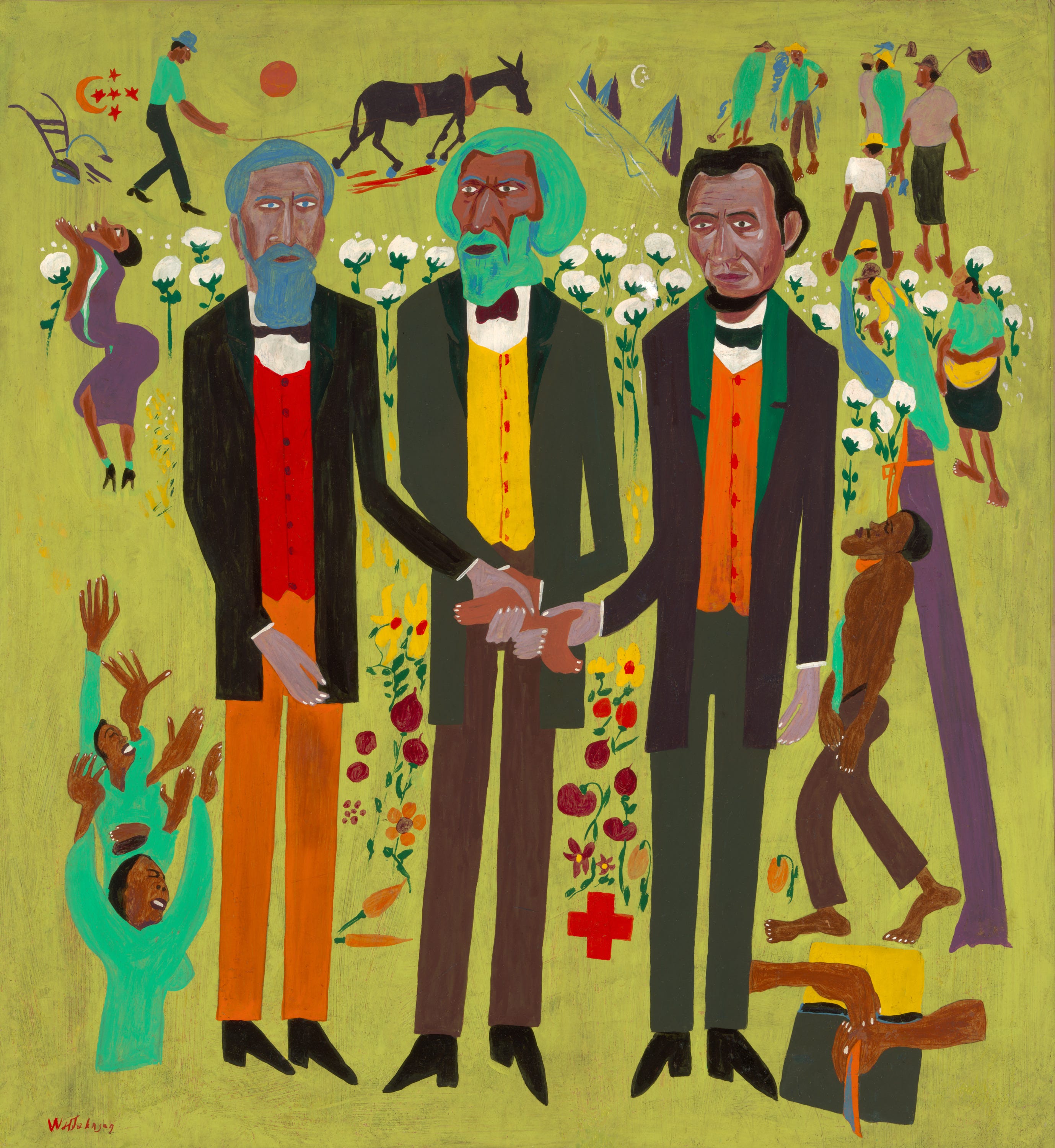
In addition to the icon-like heroic figures like those above, Johnson painted narrative scenes of important events related to the struggle for freedom. These include the inauguration of George Washington, Lincoln at Gettysburg, and various meetings of the WW2 Allied leaders. In this example, Johnson imagines a meeting between three important figures in the abolition of slavery, John Brown (American, 1800-1859), Fredrick Douglass (American, 1817-1895), and Abraham Lincoln (American, 1809-1865). The three large figures are surrounded by growing cotton, scenes of enslaved laborers, and, at left, joyous figures celebrating emancipation. Though the three men did not always agree with one another, for Johnson, they represented progress toward and achievement of the abolition of slavery.
In spite of the great achievement of the Fighters for Freedom series, the decade of the 1940s was difficult for Johnson. Though the artist and his wife escaped the growing power of Nazi Germany by returning to the States in 1938, the couple’s brother-in-law, artist Christoph Voll (German, 1897-1939), lost his teaching position and was targeted by the Nazi regime as a so-called degenerate artist. Voll died, aged 42, in the midst of this harassment. In 1942, a studio fire destroyed Johnson’s many paintings. Worst of all, Holcha died of cancer in 1944. Johnson kept painting, producing most of the Fighters for Freedom series, but his productivity steadily declined. In 1946, Johnson returned to Denmark in hopes of regaining the peace and happiness he’d felt there in the early years of his marriage. Unfortunately, the artist was suffering from undiagnosed syphilis; his erratic behavior increased and his physical health diminished. In 1947, Johnson was sent back to New York by the US Embassy in Denmark. No longer considered mentally competent, a guardian was appointed and his art was put into storage. Johnson spent the last 23 years of his life in a state hospital for the mentally ill. In 1956, his artworks were rescued from being discarded by the Harmon Foundation, which had awarded Johnson a gold medal in 1929 and was known for supporting African American artists. In 1967, the Foundation donated their Johnson collection to the Smithsonian American Art Museum, which now holds over 1000 of the artist’s works.
Fighters for Freedom was Johnson’s tribute to all of the individuals he celebrated in these paintings but also to the determined survival of so many whose names are not recorded. Today, the series testifies to the artist’s own determination and creativity.
If it is to be, it is up to me. – William H. Johnson
Exhibition:
“Fighters for Freedom: William H. Johnson Picturing Justice” through September 13, 2026, at Dayton Art Institute, 456 Belmonte Park North, Dayton, Ohio LINK: https://www.daytonartinstitute.org/do-see/exhibitions/2026/06/27/fighters-for-freedom-william-h-johnson-picturing-justice
Thanks for reading and subscribing. Your likes, comments, and shares are much appreciated. I’ll be back next week with a new topic.
This is a great post of William H. Johnson's work. I was awed by paintings. I will try to get to the Smithsonian to see these works. Thank you.
Thanks for posting this. I was not familiar with William H. Johnson's art. I'm interested in exploring his work.