
Chance Encounters, Edition 78
Betye Saar: "Artists don’t retire"

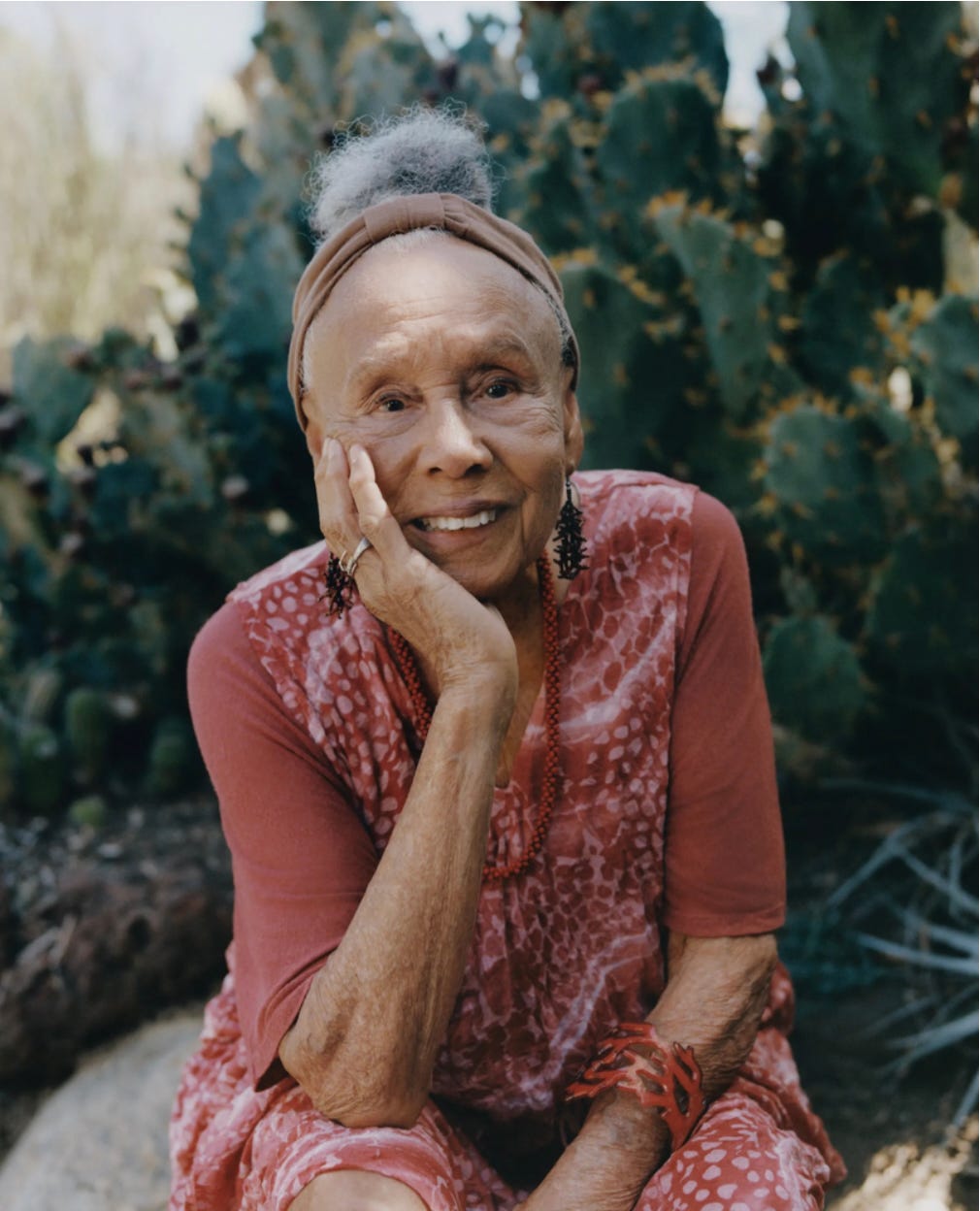
On July 30, American artist Betye Saar will celebrate her 100th birthday. In honor of the occasion, I’ve selected some works from across her long career to explore the themes that Saar has expressed in her art.
It may not be possible to convey to someone else the mysterious transforming gifts by which dreams, memory, and experience become art. But I like to think that I can try. -- Betye Saar
Betye Saar was born in Los Angeles and raised in various LA neighborhoods as well as in Pasadena. Though she never imagined that she could be an artist, during childhood she collected small objects which she transformed into dolls, toys, and gifts for her family. Growing up during the Great Depression, Saar absorbed the lesson that everything could be reused, repaired, or refashioned. Another important influence was visiting her grandmother in the Watts neighborhood where Saar saw the Watts Towers under construction by Sabato (also known as Simon or Sam) Rodia (Italian-American, 1879/1886-1965). The Towers were built from steel rebar covered with wire mesh embedded in concrete. Many surfaces are covered with embedded glass and tile, with additional found objects attached as decoration. Saar has said that seeing the Watts Towers being built taught her that anything can be art.
The artist graduated from University of California, Los Angeles in 1947 with a degree in Design and a minor in Sociology. Like many women of the time, Saar was encouraged to choose Design over Fine Arts; she originally thought she might become an interior designer. However, she proceeded to graduate studies at several California institutions with planning to be a teacher. In 1952, she married ceramicist Richard Saar (American, 1924-2004) and the two had three daughters: Tracye, a writer; Alison, and Lezley, both visual artists. The family moved to the Laurel Canyon neighborhood, famous for its hippie culture, and Saar describes herself and her husband as “hippie-ish as hippie could be.” The couple divorced in 1968 but the artist retained the Laurel Canyon home where she still lives and works.
I loved making prints. The move into fine art, it was liberating. It gave me the freedom to experiment. – Betye Saar
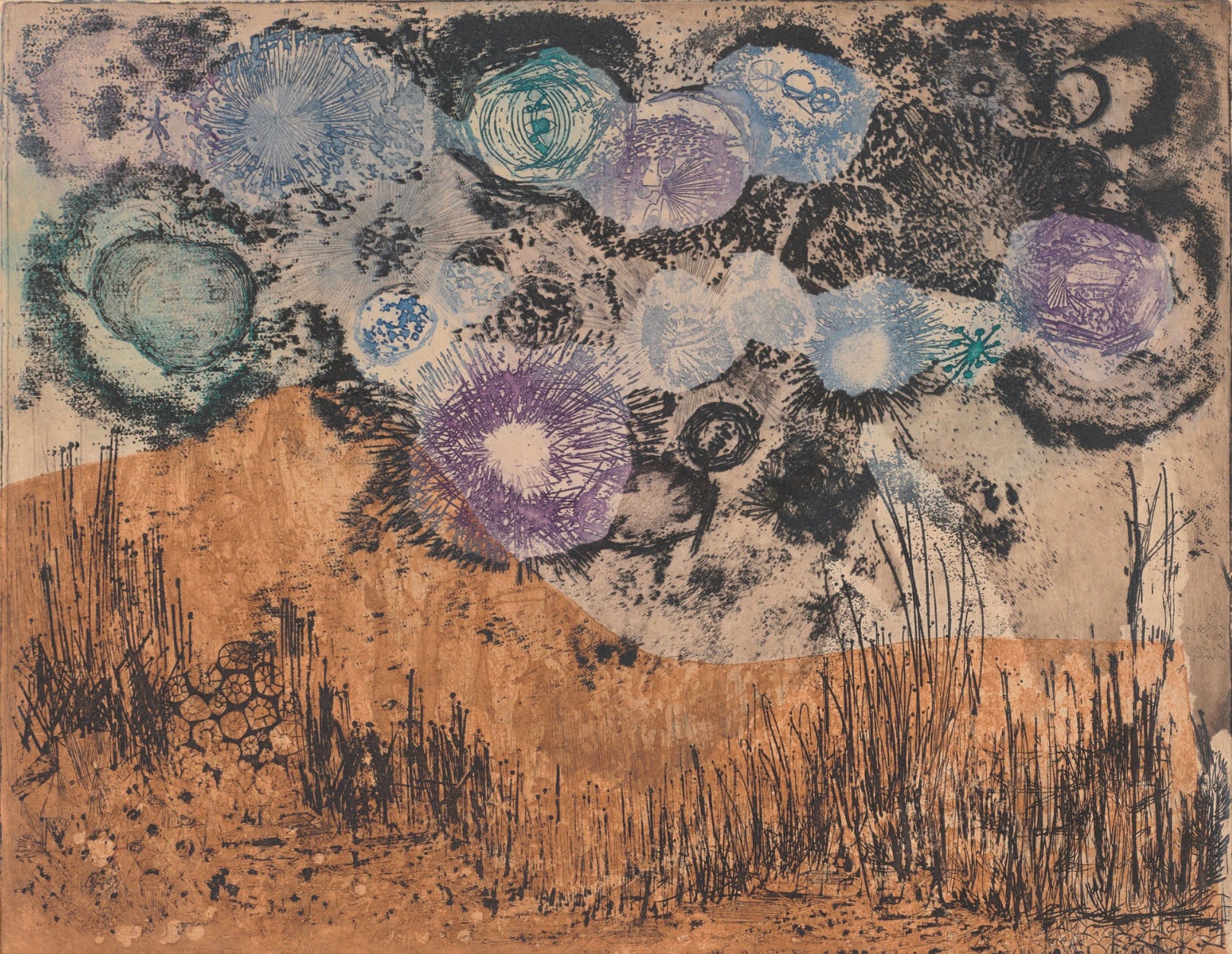
During her graduate studies, Saar enrolled in an elective printmaking class and decided, at age 35, that she could be an artist. Her etchings were embellished with marks made by adding marks made by found objects, giving her prints the appearance of a collage. In Amid Hallucinatory Moons, a detail produced by a found object can be seen just to the right of center where three letters are seen upside down in a circle. This print also demonstrates Saar’s interest in cosmology and mysticism, subjects which continue to fascinate the artist today.
In 1967, Saar visited an exhibition showing the art of Joseph Cornell (American, 1903-1972) at the Pasadena Art Museum. As I described in Chance Encounters 69, Cornell created small glass-fronted boxes with layered, open-ended meanings deriving from the combination of items they contained. From looking at Cornell’s work, Saar learned that objects have meanings beyond their physical appearance. A life-long collector of found images and objects herself, the artist was inspired to begin creating her own assemblages, first by inserting images behind the panes of found windows and then moving onto more complex groupings.
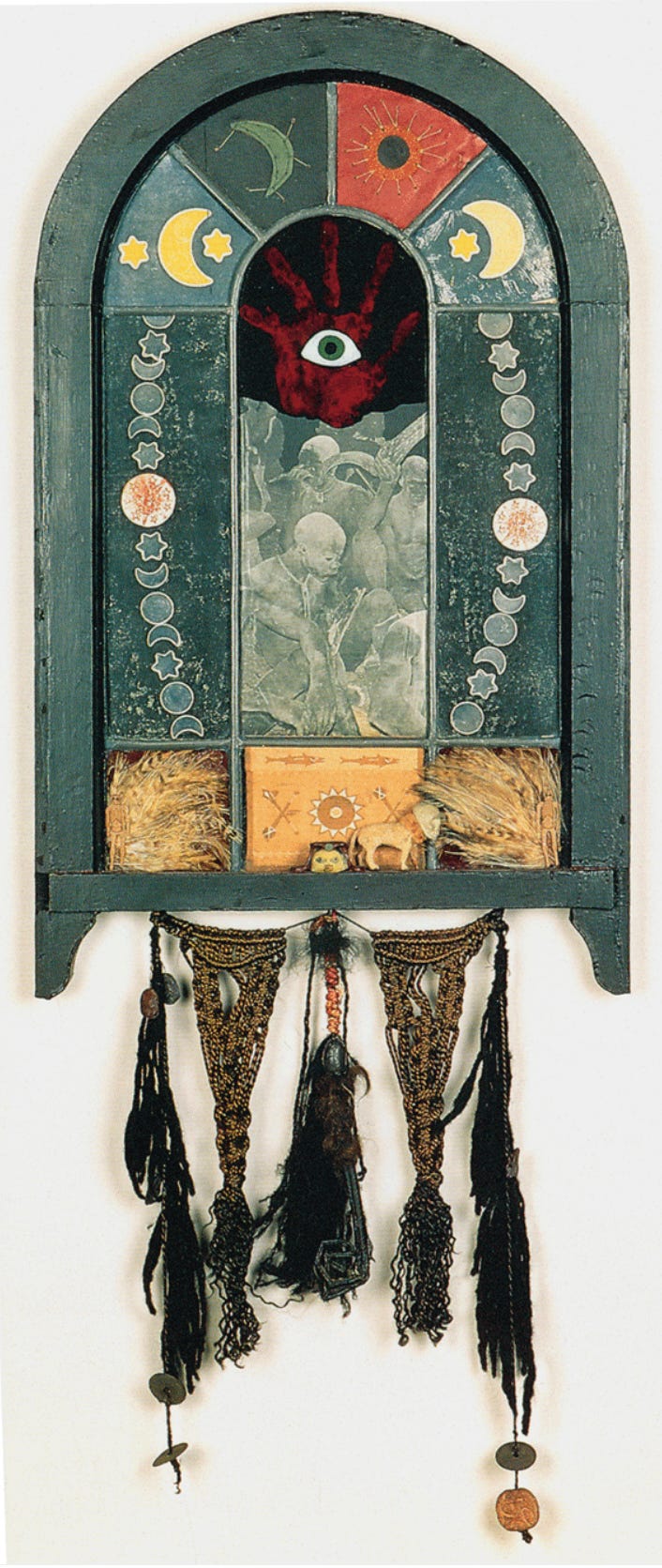
Nine Mojo Secrets from 1971 is an example of the early window works. Sun, moon, and stars frame the central window pane which contains a red palm print containing an all-seeing eye, and an image of an African religious ceremony sourced from a National Geographic magazine. The lowest panes contain wheat, feathers, shells, a lion figurine, and a picture with Native American symbols. Suspended from the bottom of the frame are macramé swags into which found objects are tied, including a chicken’s foot. In addition to Cornell’s influence, Saar was inspired by a 1970 visit to the Field Museum of Natural History in Chicago. One artifact she saw there was an African chief’s robe into which hair from his community members had been incorporated to increase its power. The two concepts that the artist drew from this object are that there is a “power of accretion” (more objects means more power) and things that had once been living have a unique power. Saar has said that her “Mojo” works usually contain some secret elements, following the tradition of African fetishes in which hidden elements are thought to project power. In this work and many others, the artist combines images and ideas from various cultures because she sees many spiritual behaviors as universal.
I think the chanciest thing is to put spirituality in art, because people don’t understand it. … But if there’s going to be any universal consciousness-raising you have to deal with it, even though people will ridicule you. – Betye Saar
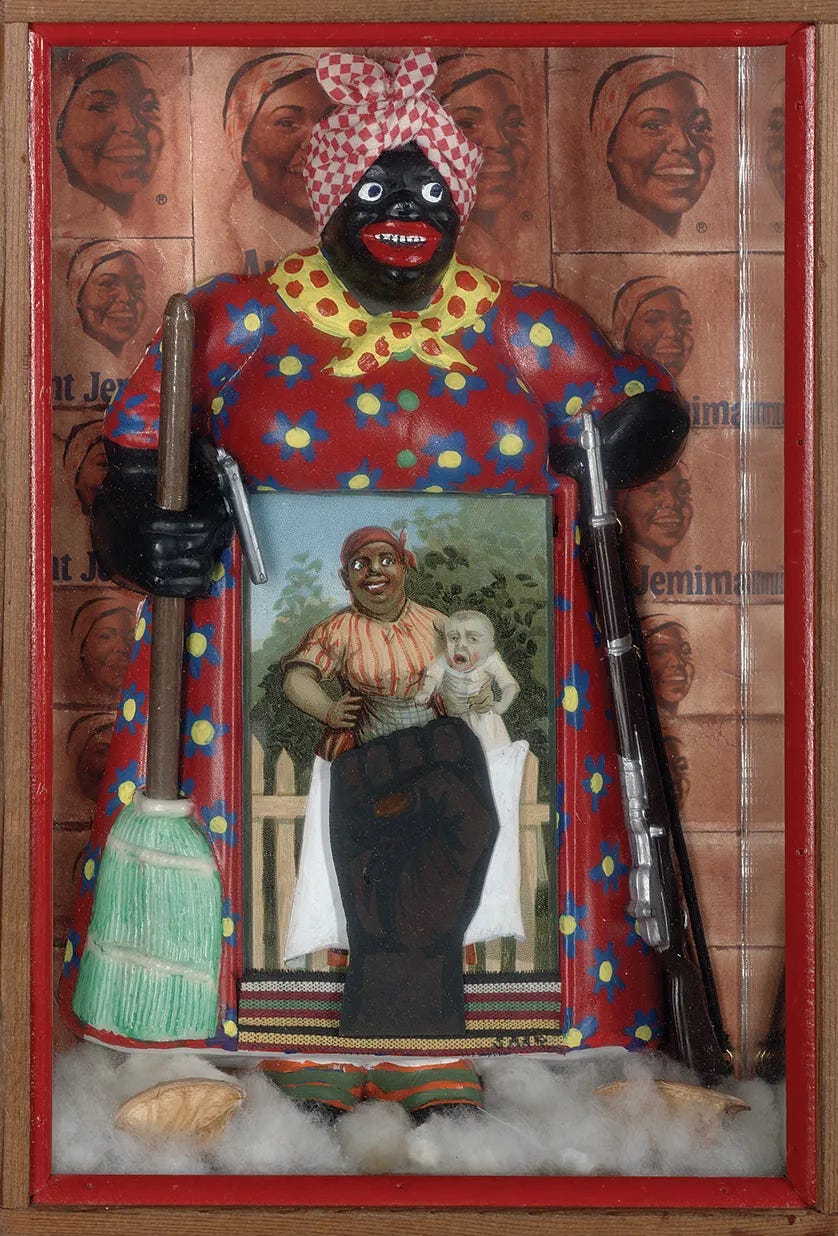
The Liberation of Aunt Jemima, Saar’s first explicitly political work, was created in after a 1972 call for images of Black heroes made by the Rainbow Sign Cultural Center in Berkeley, California. It was also a response to the artist’s distress and anger over the 1965 Watts Riots and the 1968 assassination of Martin Luther King, Jr. In this work, Saar reclaims a derogatory stereotype, the “Mammy” character, and transforms it into a heroic character. Introduced into popular culture in the late 1880s, the “Mammy” was usually depicted as a fat black woman wearing a headscarf and bright clothing and caring for children or doing other household chores. The character was an idealized symbol of the Southern Black kitchen servant. “Aunt Jemima” was a derivation of the “Mammy” stereotype, created by a pancake mix company in 1890. (Though the features were updated many times, the character was not retired until 2021, when the brand was renamed Pearl Milling Company.) Aunt Jemima’s image wallpapers the back of the assemblage.
In a way, it's like, slavery was over, but they will keep you a slave by making you a salt-shaker. I said to myself, if Black people only see things like this reproduced, how can they aspire to anything else? – Betye Saar
The original figure held the broom but Saar has added a hand grenade (wedged behind the broomstick) and a rifle. All of the materials in this assemblage were found at flea markets during the 1960s. This casual acceptance of racist stereotypes was not limited to the Jim Crow South; these objects were found in every state and around the world. This “Mammy” was intended to hold a notepad but that has been replaced with a drawing of another holding an infant. The drawing is partially obscured by a Black Power fist on which red-painted fingernails are visible, making its female identity clear. Political activist and author Angela Davis (American, b. 1944) has described this artwork as sparking the beginning the Black Women’s Movement.
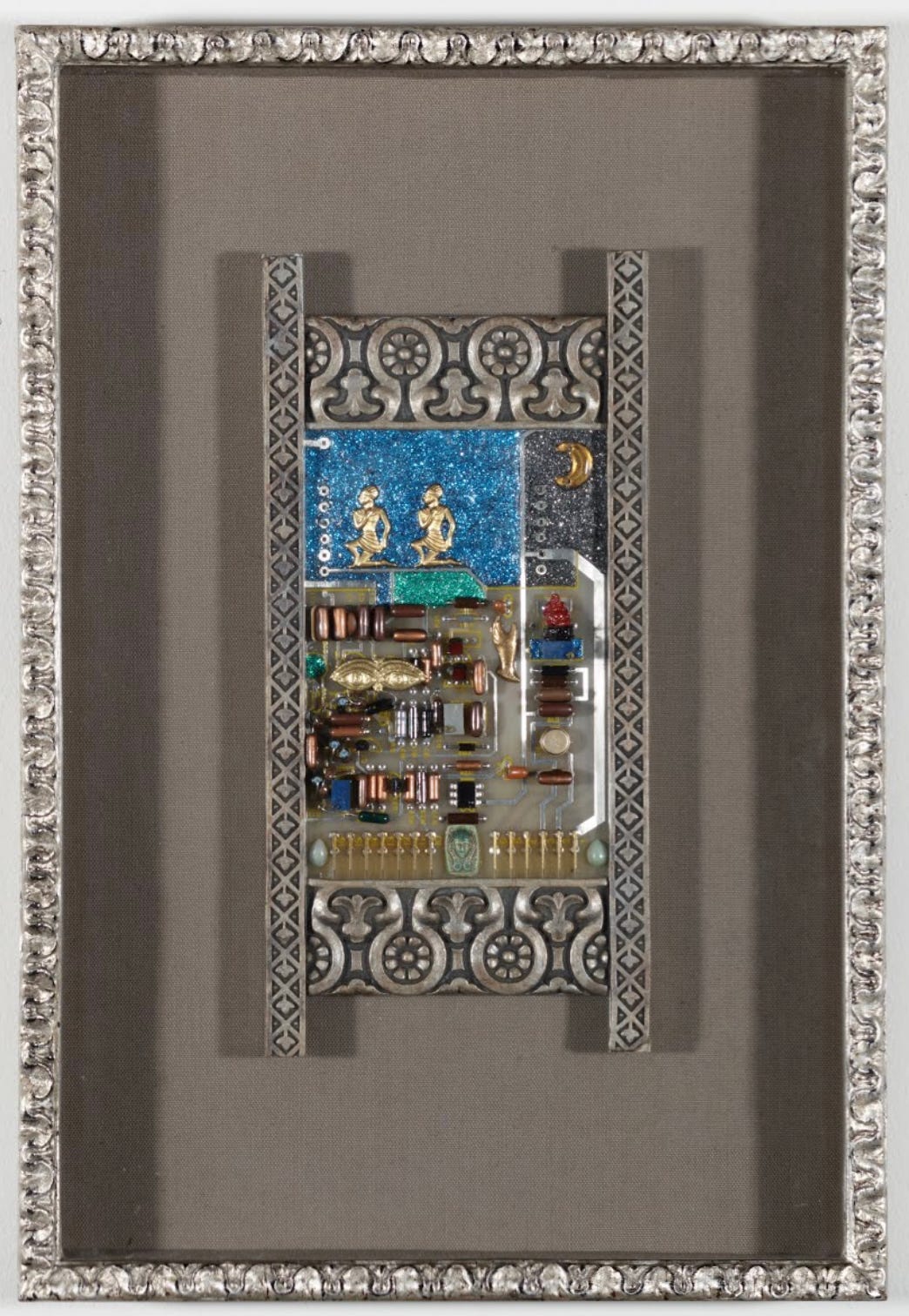
In the late 1980s, Saar became interested in the intersection of traditional spirituality and the growing fascination with technology. As a result of this new interest, she served as artist-in-residence at Massachusetts Institute of Technology. Cryptic Confessions, The Question is an example of the works from this period, which ranged from the monumental Mojotech, to intimate compositions like this one. Here, the artist combined her typical found objects with computer components. On the sparkly blue ground are two gold figures of kneeling Africans; a pair of golden eyes stare at the viewer from just below that section. A crescent moon, upper right, reminds us of Saar’s interest in cosmology and a small plaque with a face between hands is placed near the bottom of the composition. An ornamental silver frame set within another shadow box frame suggests that we are looking at a precious object, an icon worthy of our close attention. Commentators have wondered if Saar intends the inclusion of technological components as a critique of growing faith in and obsession with technology but the artist’s statements about this series of works indicate this is not the case.
I am intrigued with combining the remnant of memories, fragments of relics and ordinary objects, with the components of technology. It's a way of delving into the past and reaching into the future simultaneously. – Betye Saar
I keep thinking of giving up political subjects, but you can’t. Because racism is still here. Worse than ever. – Betye Saar
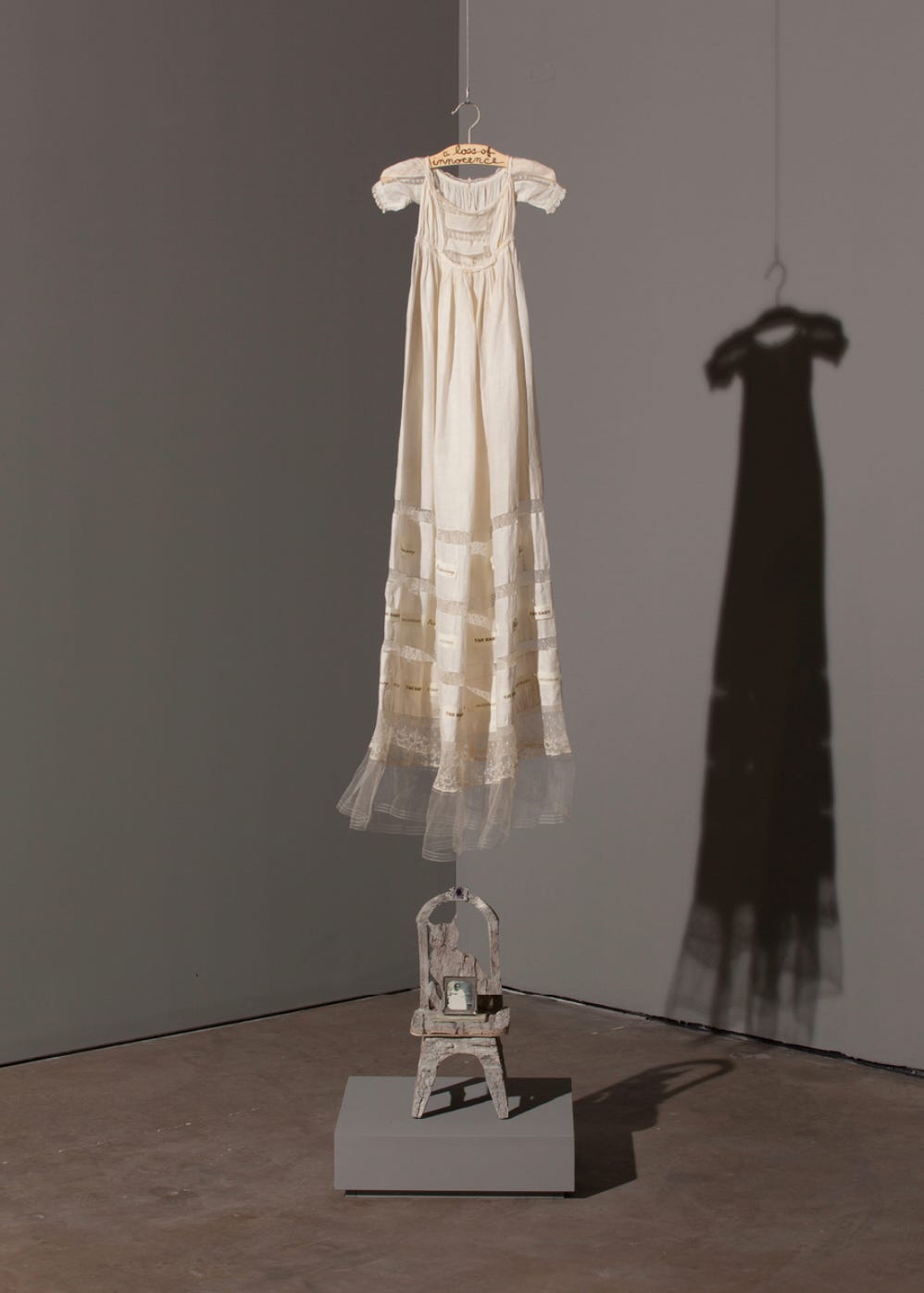
In 1998, Saar created A Loss of Innocence, an installation comprised of a beautiful christening gown hanging from a wooden hanger above a toy chair holding a framed photograph of a child. At first glance, this might appear to be a sentimental consideration of a child’s progress from infancy. However, a closer look at the skirt of the gown reveals a much darker meaning.
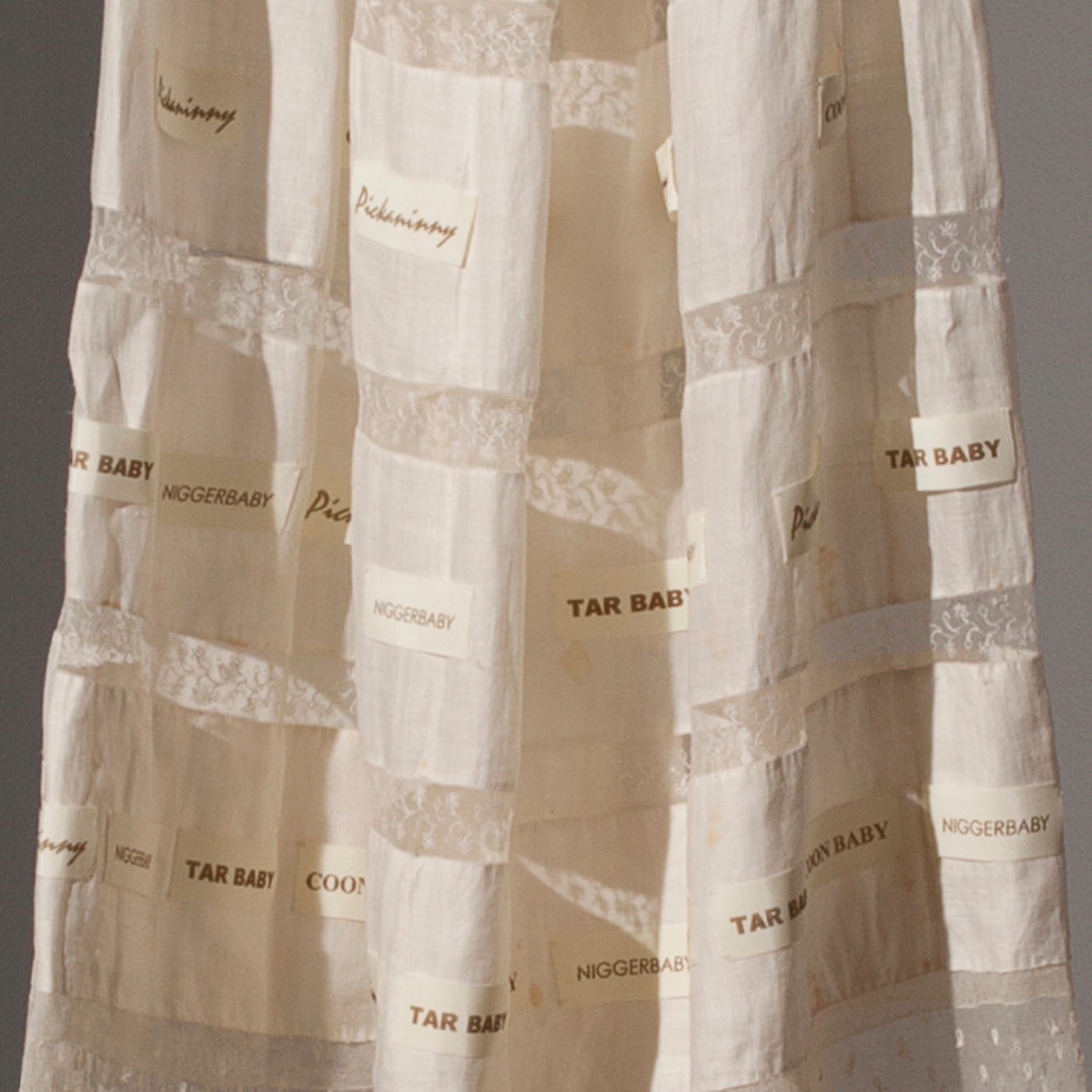
Printed on tape between the bands of lace are the racist taunts Black children could be faced with as they moved from their families into the wider world. “Tar Baby,” “Pickaninny,” “Coon Baby,” and “N****rbaby” circle the skirt again and again. As we step back from the detail, the dark shadow cast by the hanging gown suddenly reminds us of a lynched body hanging from an unseen tree. The christening gown, which should be a symbol of the hope a new baby brings, becomes a reminder of the dark reality of life for generations of Black Americans.
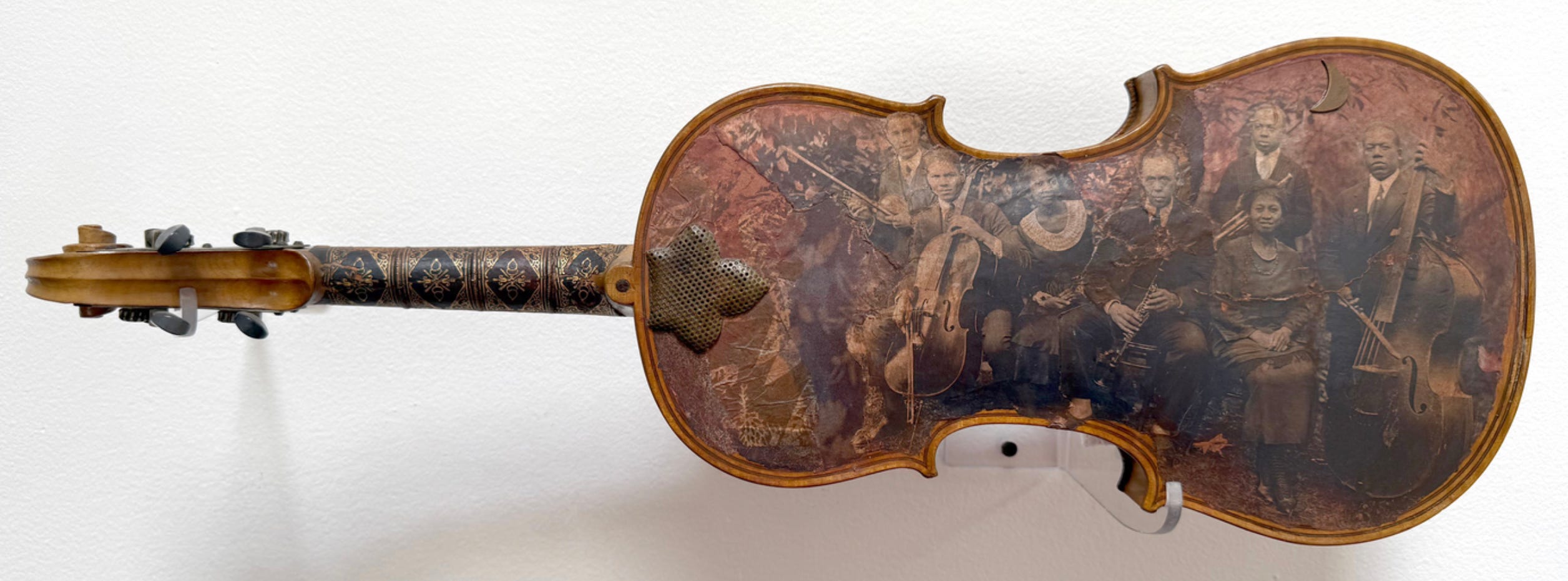
Many of Saar’s works are not confined by window frames or shadow boxes. In The “Band” at the Libya, a vintage photograph showing a group of Black musicians has been glued to the back of a violin. Beyond the torn edges of the photograph a swirling red background is visible. The violin’s neck is covered with what appears to be tooled leather. The formal outfits in the photograph and leather contrast with the torn and rubbed photograph, emphasizing that we are experiencing an object, and a moment, from the past. Saar’s works from the 21st century often create a sense of mystery because of her creative integration of disparate elements and less explicit meanings.
The objects that I use, because they’re old (or used, at least), bring their own story; they bring their past with them. I have no idea what that history is. If the object is from my home or my family, I can guess. But I like the idea of not knowing, even though the story’s still there. – Betye Saar
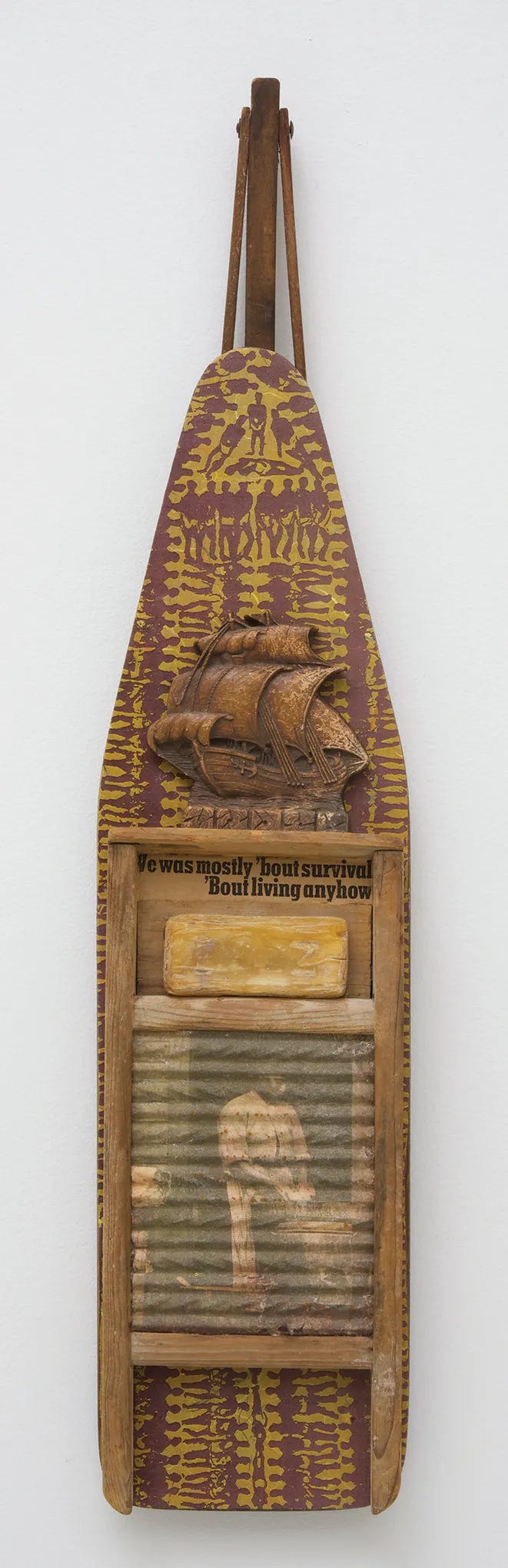
Saar created a series of washboard-based works for a 2018 exhibition called Keepin’ It Clean, inspired by the Black Lives Matter movement. In We Was Mostly ’Bout Survival, the artist combined the washboard with an old wooden ironing board. The ironing board is painted with the well-known bird’s eye view of the hold of the slave ship Brookes, a recurring motif in Saar’s work, and one which is familiar to many as symbolizing the brutal conditions endured by African captives. A three-dimensional wooden sculpture of a ship under sails reinforces the reference to the slave trade. The attached washboard is printed with an image of a Black woman doing laundry, the bar of soap above emphasizing the work being done. Race and gender issues continue to challenge this country and draw Saar’s attention, though more than half a century has passed since the artist first tackled these themes in her art.
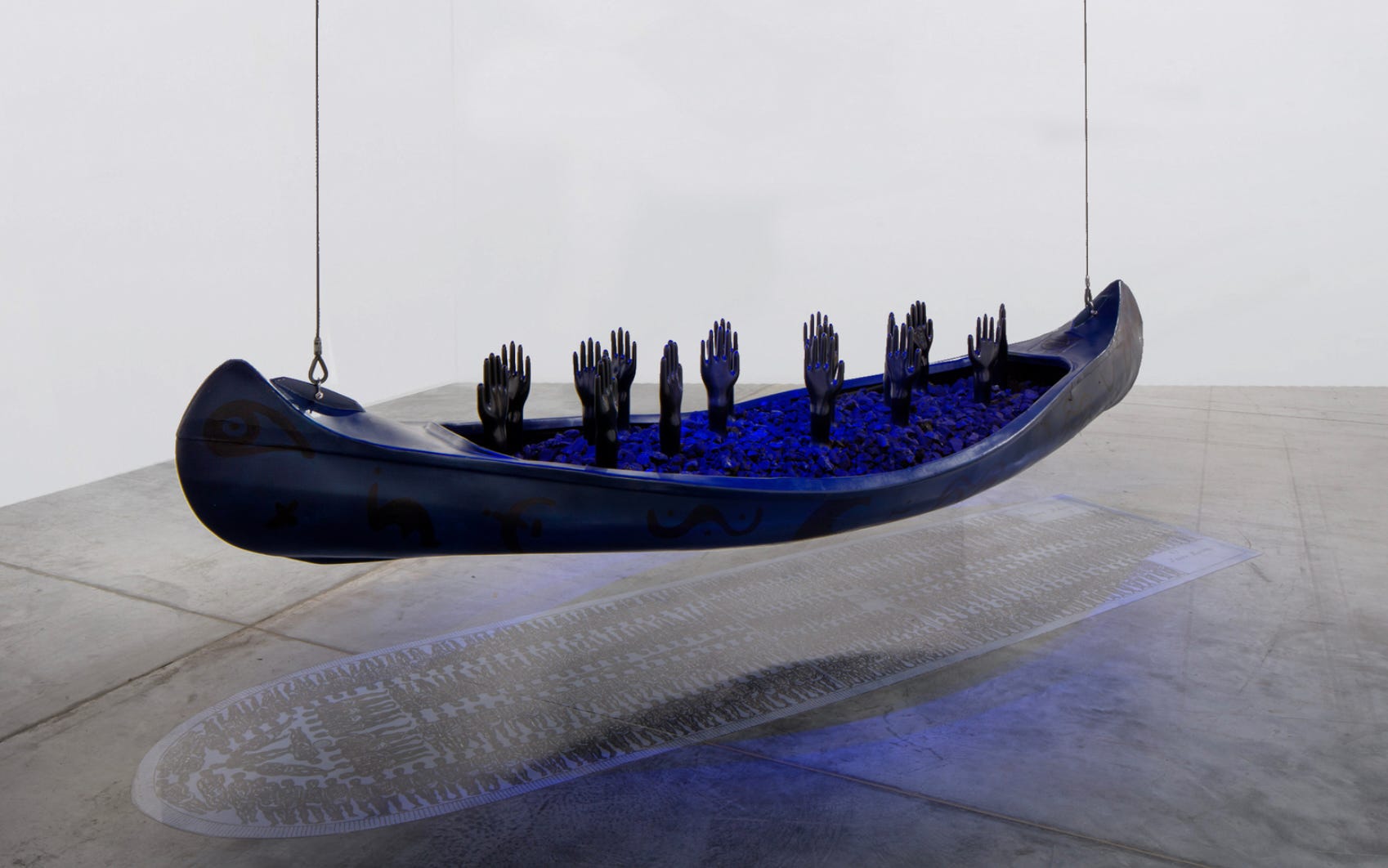
Ships and boats are common images in Saar’s work, and I close with a large canoe-shaped work. The artist had begun creating larger works in the 1980s, though she never stopped making more intimate works like Cryptic Confessions (above). This canoe is filled with blue glass and reaching hands; a light above the sculpture shines through the glass, projecting the plan of the Brookes’ hold, also seen in the previous work. The outstretched hands in Gliding Into Midnight speak of drowning people and combined with the slave ship plan and dark colors create the effect of a memorial to those lost in the Middle Passage, the voyage across the Atlantic Ocean from Africa.
To me the trick is to seduce the viewer. If you can get the viewer to look at a work of art, then you might be able to give them some sort of message. – Betye Saar
In a career that has stretched over more than 60 years, Betye Saar has explored what it means to be Black, female, and spiritual. By reusing Black stereotypes to call out racism and to reclaim the power of Black images, the artist has expanded the options for expressing Black identity. The artist has also challenged and expanded notions of what it means to be female, especially pushing against the limited image of what “women’s work” means. Saar has provided a model for young artists, female and male, black and white. Engaged with a variety of religious cultures within her family and community in her youth, the artist expanded her own knowledge and understanding of spirituality by exploring African, Caribbean, and Oceanic traditions and shared that in her art.
When I was young there were things that I wanted to say with my art. Now, approaching 100, that’s not so true anymore. … My thing, after all this time, is just to create art. –Betye Saar
Exhibitions dedicated to Saar:
Let’s Get It On: The Wearable Art of Betye Saar, through August 22, 2026, at Roberts Projects, 442 South La Brea Avenue, Los Angeles, California, USA. LINK: https://www.robertsprojectsla.com/exhibitions/lets-get-it-on-the-wearable-art-of-betye-saar
Betye Saar: Drifting Toward Twilight, through November 30, 2027, at The Huntington, 1151 Oxford Road, San Marino, California, USA. LINK: https://www.huntington.org/exhibitions/betye-saar-drifting-toward-twilight
Group Exhibitions including Saar:
Constellations: Celebrating the Legacies of Betye Saar, through September 13, 2026, at the Palmer Museum of Art, The Pennsylvania State University, 650 Bigler Road, State College, Pennsylvania, USA. LINK: https://palmermuseum.psu.edu/exhibition/constellations-celebrating-the-legacies-of-betye-saar/
The Expanding Field: MOCA’s Collection from the 1940s to 1970s, through September 20, 2026, at MOCA Grand Avenue, 250 South Grand Avenue, Los Angeles, California, USA. LINK: https://www.moca.org/exhibition/the-expanding-field
Likes, comments, and shares are very much appreciated. Thank you for reading and subscribing. If you aren’t a subscriber yet, remember our subscriptions are free.
She is a true artist and unlike some art, each of hers coveys a story that is reasonable visible.