
Chance Encounters, Edition 65
Man Ray: To Mystify and Inspire

In whatever form my work is finally presented… it is designed to amuse, annoy, bewilder, mystify, and inspire reflection… -- Man Ray, quoted by Cecil Beaton in “The Magic Image,” 1975.
Man Ray (American, 1890-1976) was a central figure in both the Dada and Surrealist movements and created an enormous body of work including paintings, collages, assemblages, sculptures, and photographs. In every medium he chose, the artist was an experimenter and innovator, creating techniques and imagery that still inspires artists and viewers today.
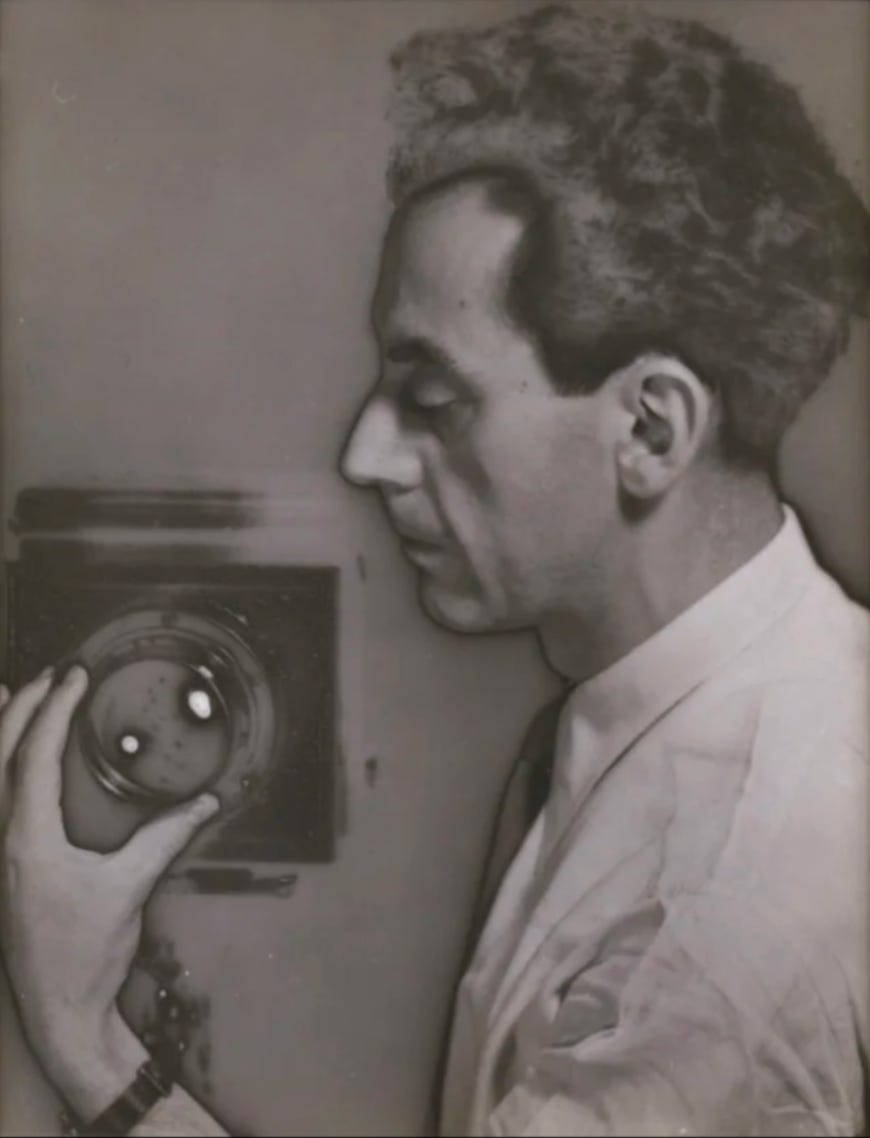
Self-portrait with Camera (1930) is an example of one of Man Ray’s photographic innovations. The technique used is called solarization, in which dark and light tones are reversed by extreme overexposure. Photographers in the 19th century, such as Louis Daguerre and J.W.F. Herschel observed the solarization effect, but most photographers sought to avoid it as their goal was accurate recording of the images before their lenses. In the late 1920s, Man Ray and his assistant and romantic partner Lee Miller (American, 1907-1977) accidentally rediscovered solarization while developing film. Both artists used this deliberate solarization, especially in portraiture. The softening of edges and slight distortion of features fit with the Surrealist ideal of irrational combinations of positive and negative or the real and the dream-like. In Man Ray’s self-portrait, the camera becomes a mysterious object that is both absent and present and contrasts with the more solid-looking head and hand of the artist.
Man Ray was born in Philadelphia, Pennsylvania to Russian-Jewish immigrant parents. His name at birth was Emmanuel Radnitzky, but the family changed the surname to Ray in the first decade of the 20th century to avoid the rampant antisemitism of the era. The young artist was called Manny which he soon shortened to Man. Eventually he identified himself as “Man Ray,” using the full name at all times. When he married his second wife in 1946, she took the name Juliet Man Ray. In his later life, the artist rarely spoke of his early life and often refused to admit that he had ever had any other name.
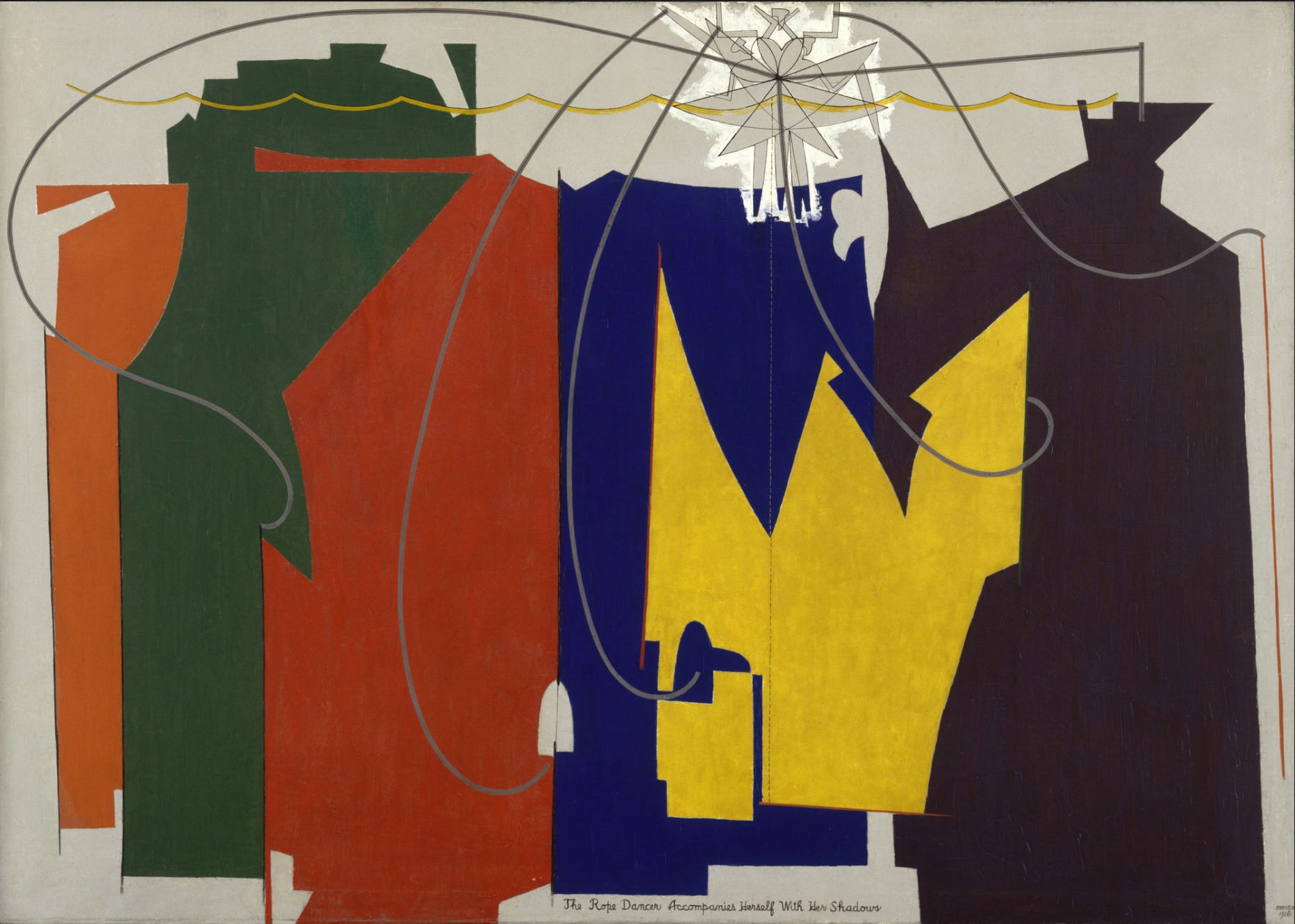
Despite the variety and quantity of his work in other media, Man Ray considered himself a painter throughout his career. After finishing high school, he turned down a scholarship to study architecture to focus on developing his painting skills. His family allowed him to turn his room into a painting studio and Man Ray set about learning his craft. Though the aspiring painter studied at several New York City art schools, his experiences visiting exhibitions at museums and galleries was most influential. In addition to the avant garde art he saw at Alfred Steiglitz’s 291 gallery, the artist was deeply impressed by the Armory Show of 1913. This highly controversial exhibition was the first time many Americans encountered European avant-garde styles like Fauvism and Cubism. Over the next few years, Man Ray created many paintings inspired by Cubism, culminating in one of the largest works of his career, The Rope Dancer Accompanies Herself with Her Shadows (1916). The brightly colored irregular shapes suggest a dancer’s costume in motion, an effect likely influenced by the artist’s growing friendship with Marcel Duchamp (French-American, 1887-1968), whose own interest in depicting motion in painting was demonstrated by one of the most reviled paintings at the Armory Show, Nude Descending a Staircase, No. 2 (1912).
To express what I feel I use the medium best suited to express that idea, which is also always the most economical one. -- Man Ray, quoted in The Rigour of Imagination, 1977, by Arturo Schwarz
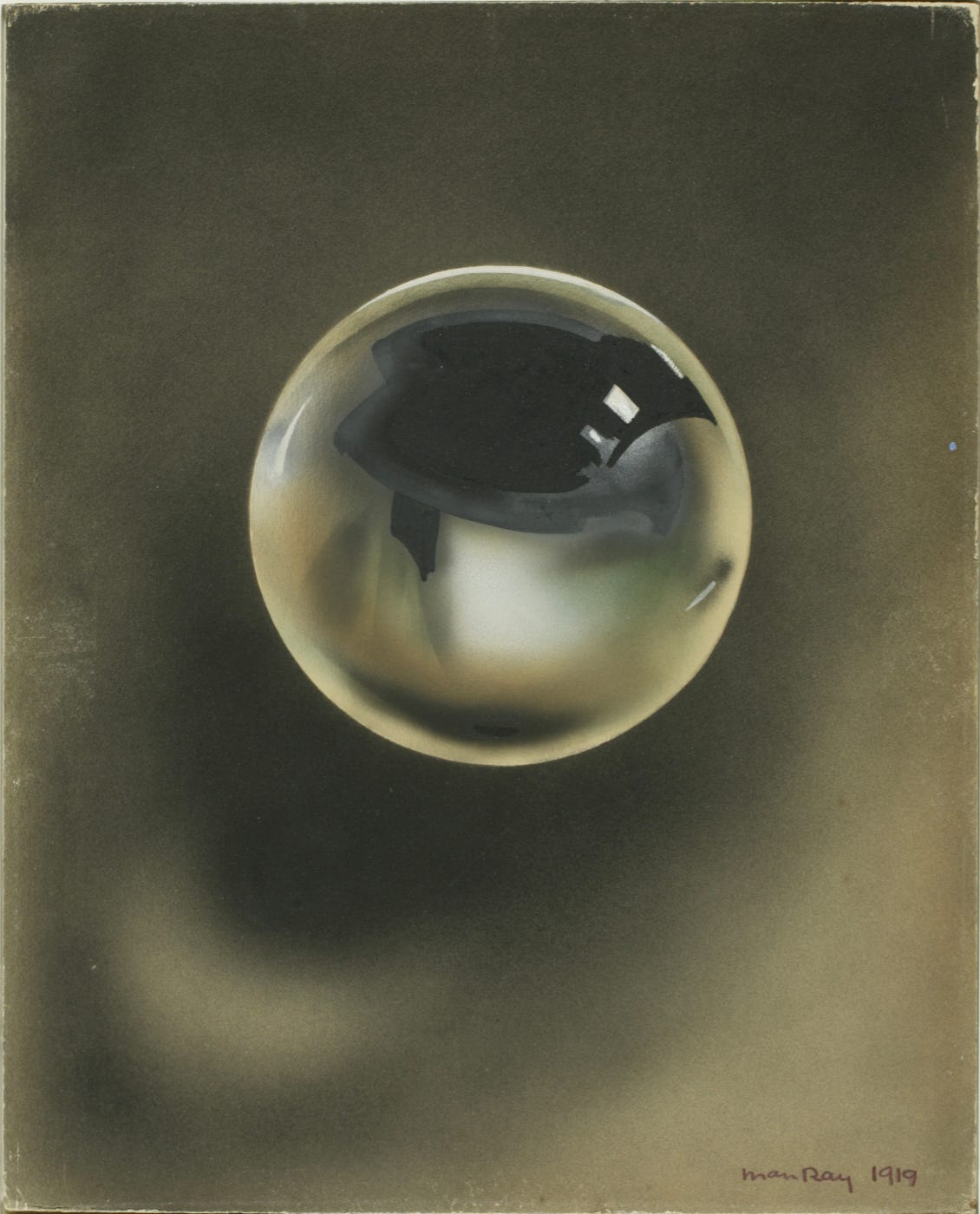
In 1919, Man Ray began to explore new, often mechanical means of creation as he became more involved with the philosophies of the Dada movement. Dada was an international movement which began in the face of World War One first in Switzerland, spreading throughout Europe, as well as to Asia and the United States. The young artists of Dada wished to overthrow tradition in all aspects of society. Mechanical artmaking suited the Dada rejection of conventional behavior. In painting, Man Ray turned to airbrushing as a means of applying paint. He dubbed such works “aerographs.” Though The Eye That Sees Everything (1919) was not made using only airbrush, it shows the artist’s experience with his new technique in the misty background. In contrast, the solidity of the central orb looks almost photographic, a reminder that Man Ray was beginning to develop his skills in that medium during this period as well.
Man Ray and Duchamp joined with Katharine Dreier, an artist, patron, and social reformer, to form the Société Anonyme in 1920, the first American museum of modern art. The two men also attempted to establish a publication, New York Dada, in the same year, but they were only able to put out one issue. Man Ray left for Paris in 1921, frustrated with repeated failures to establish an avant garde artistic community in the United States.
Dada cannot live in New York. All New York is dada, and will not tolerate a rival. – Man Ray
I never knew what I was doing until I was done. – Man Ray
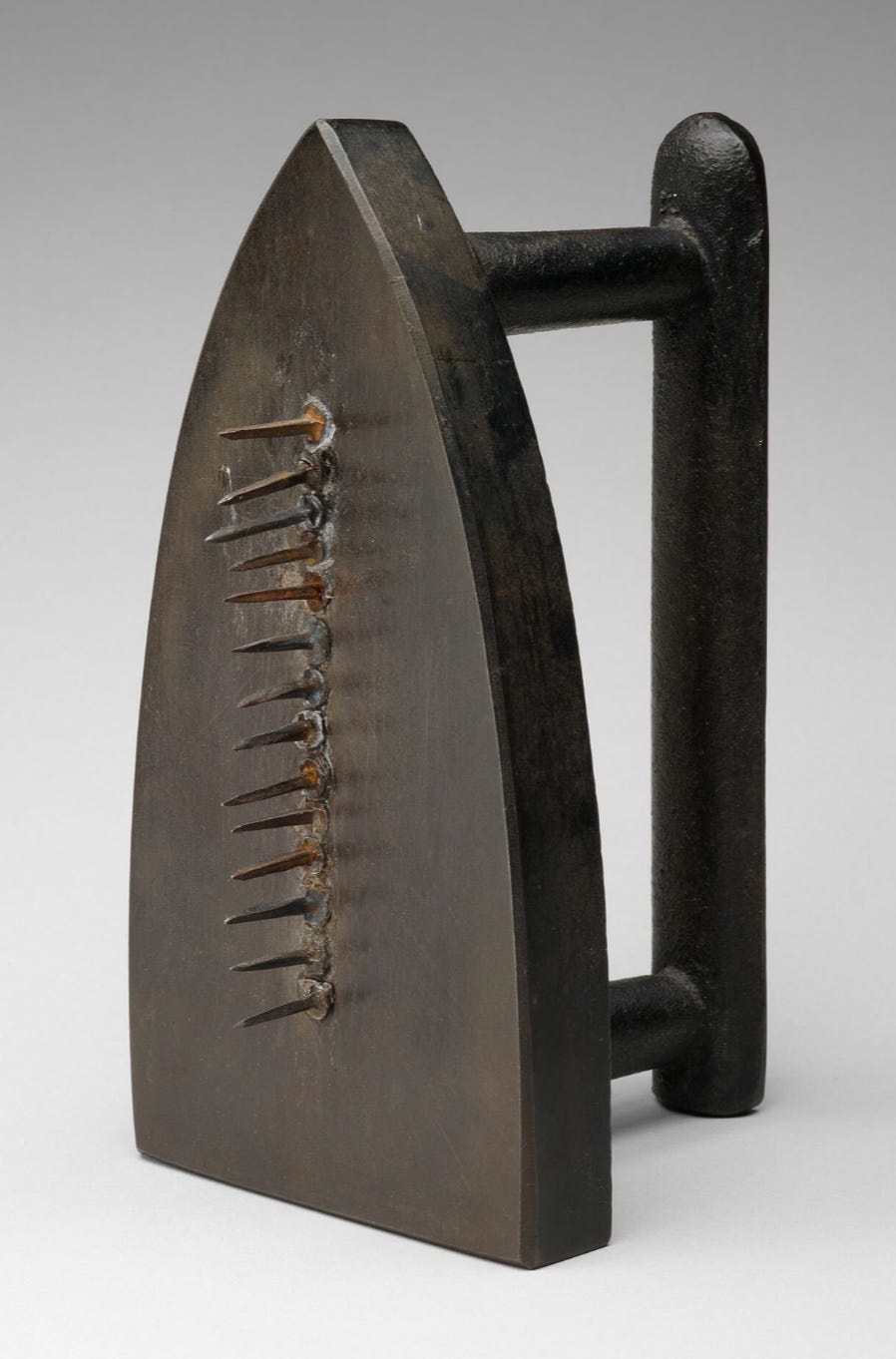
Following the lead of his friend Duchamp and his “readymades,” Man Ray began to create works from found objects. Unlike Duchamp who limited alterations to the original manufactured goods, Man Ray mixed materials together to create thought-provoking results. Gift, which was first produced in 1921, consists of 14 iron tacks glued to the flat surface of a flat iron, which would be set on a stove to heat before pressing clothes. The work is an example of Dada playfulness; an iron might be a typical wedding shower present while other gifts are useless objects that may gather dust for years. This Gift combines the two – an iron that has become useless by the addition of the tacks. The creation of the work was, according to Man Ray, a purely spur-of-the-moment event. He was preparing to open an exhibition in an unheated Paris gallery when he complained to the composer Erik Satie that he was cold. Satie led him to a nearby bar where they drank several hot toddies. As they walked away, Man Ray saw an iron for sale at a shop and enlisted Satie’s help in purchasing glue and tacks. (The American didn’t speak French yet.) He created Gift and exhibited it in the show. The artist intended to give the original work to a friend who had supported his career, but it was stolen from the gallery. Authorized copies were created in 1963; this example is in the collection of the Art Institute of Chicago.
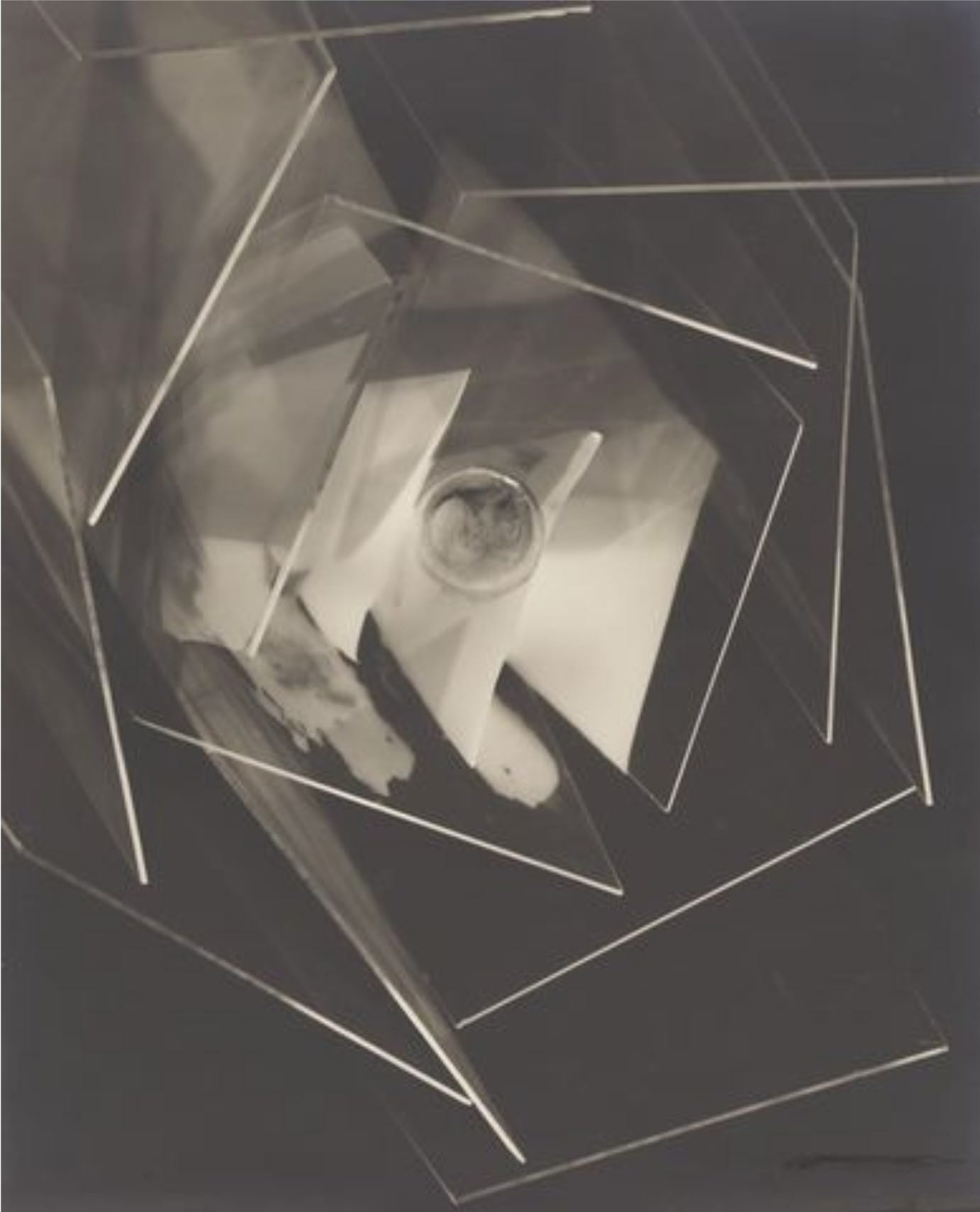
Before my eyes an image began to form, not quite a simple silhouette of the objects as in a straight photograph, but distorted and refracted … In the morning I examined the results, pinning a couple of the Rayographs—as I decided to call them—on the wall. They looked startlingly new and mysterious. – Man Ray
Man Ray’s most famous artistic innovation was, like solarization, a rediscovery of an old idea, the photogram, which became in this artist’s hands the Rayograph. One of the inventors of photography, Henry Fox Talbot, had experimented with what he called photogenic drawings, created by placing objects in light sensitive paper and letting sunlight develop patterns of light and dark. Man Ray had been working with photography for some time; he first adopted it to document his creations in other media. Portrait and fashion photography often paid the artist’s bills in France; in Paris between the world wars, Man Ray photographed nearly every major member of avant garde circles from Pablo Picasso to Peggy Guggenheim. One of the leaders of the Dada movement, the Romanian-French poet Tristan Tzara, told Man Ray about the photogram technique as used by the German New Objectivity artist Christian Schad. The method appealed to Man Ray’s interests in experimentation and in subversive uses of objects and media. Rayographs, like Planes, are abstract images utilizing consumer goods (both the photographic paper and the objects laid on it); for the artist, they seemed to create a dream reality of which he was the master. This example is made from sheets of glass and what looks like paperboard. To me, it looks like a house of cards falling apart or a stylized flower expanding outward. It might look like something different to another viewer or to me on another day. Ambiguity of meaning is found in much of Man Ray’s art across media, but it is particularly present in the Rayographs because the artist had only limited control over the result. He couldn’t be certain how his movements of objects and light sources would affect the final appearance. That may have been an appealing feature to the artist who spoke of photographing ideas and dreams rather than objects.
Return to Reason (Le Retour à la Raison), 1923
In 1923, Man Ray created the first of several films in a style dubbed Cinéma Pur for its focus on vision and movement. The first of his films is shared here; it is a moving Rayograph in many parts. It also incorporates the artist’s favorite model and lover of the early 1920s, the French singer, artist’s model, and painter Alice Prin, popularly known as Kiki de Montparnasse. Three additional films and collaborations with Marcel Duchamp and Fernand Leger rounded out Man Ray’s filmmaking work.
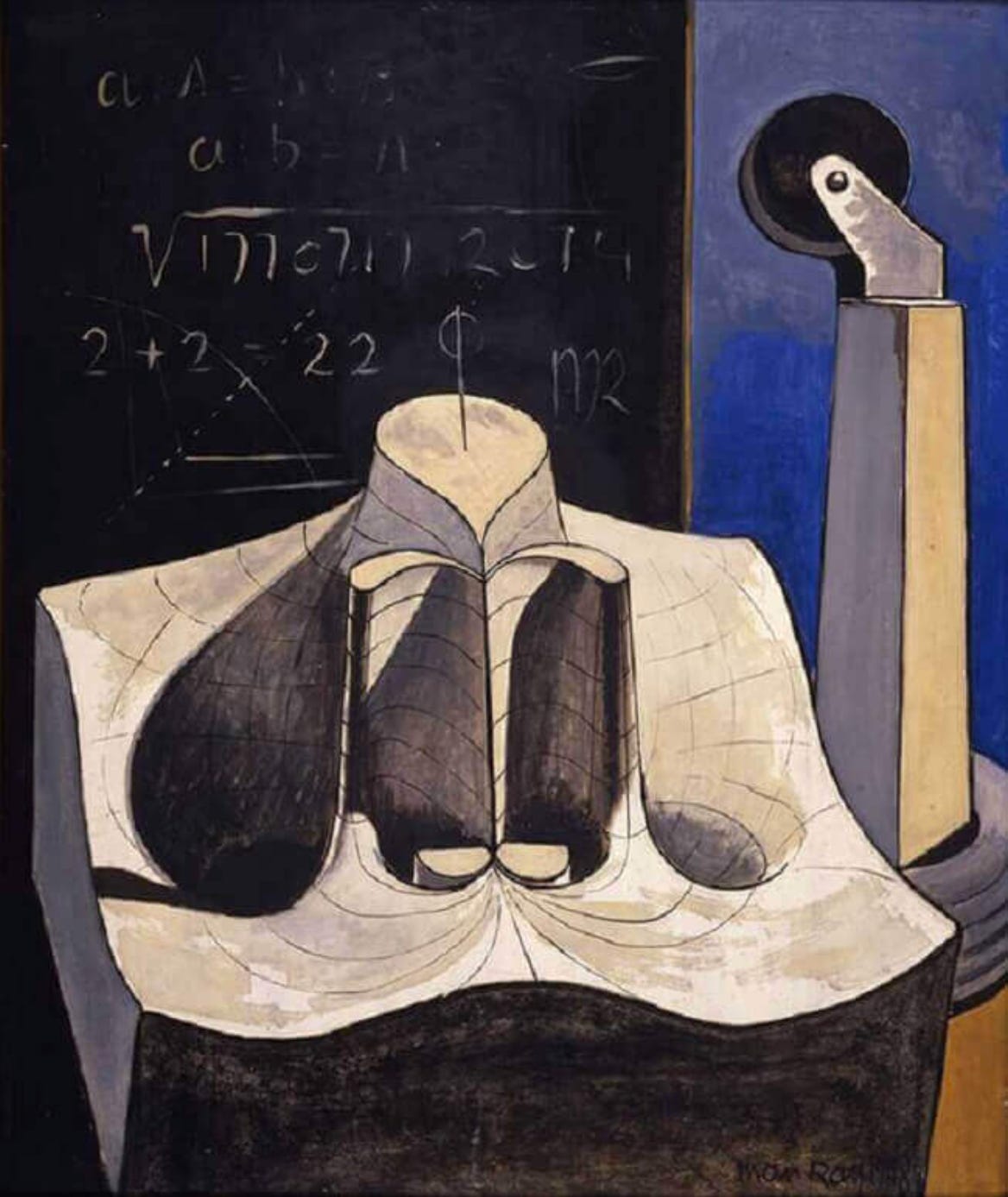
Man Ray was forced to return to the United States by World War Two; he settled in Los Angeles and focused on painting. It was at this time that the artist married his second wife Juliet Browner, in a double ceremony with Duchamp and Surrealist artist Dorothea Tanning. In 1948, Man Ray exhibited his new series of paintings Shakespearian Equations in Los Angeles. The paintings, the titles of which refer to Shakespeare’s plays and characters, are based on a series of mathematical models from the Institut Henri Poincaré in Paris. Surrealist Max Ernst had introduced these objects to Man Ray who photographed them in the mid 1930s. At the time, he was probably just documenting them as curious objects, a practice of many Dada and Surrealist artists. A decade later he incorporated the peculiar shapes into the Shakespearean Equations paintings. Man Ray had no understanding of the complex mathematical formulas the models represent and in Julius Caesar, he explicitly defies the logic of math with the nonsensical equation 2 + 2 = 22 on the blackboard in the background. By taking the strangely shaped object making it the “main character” in this painting, Man Ray is using a popular Surrealist trope, humanizing an inanimate object. (See Chance Encounters 26 and subsequent editions celebrating last year’s centennial of Surrealism for the movement’s philosophy and practices.) The artist returned to Paris in 1951 where he continued his diverse production, sometimes reworking old works in new ways, and overseeing the replication of early works which had disappeared or were in demand.
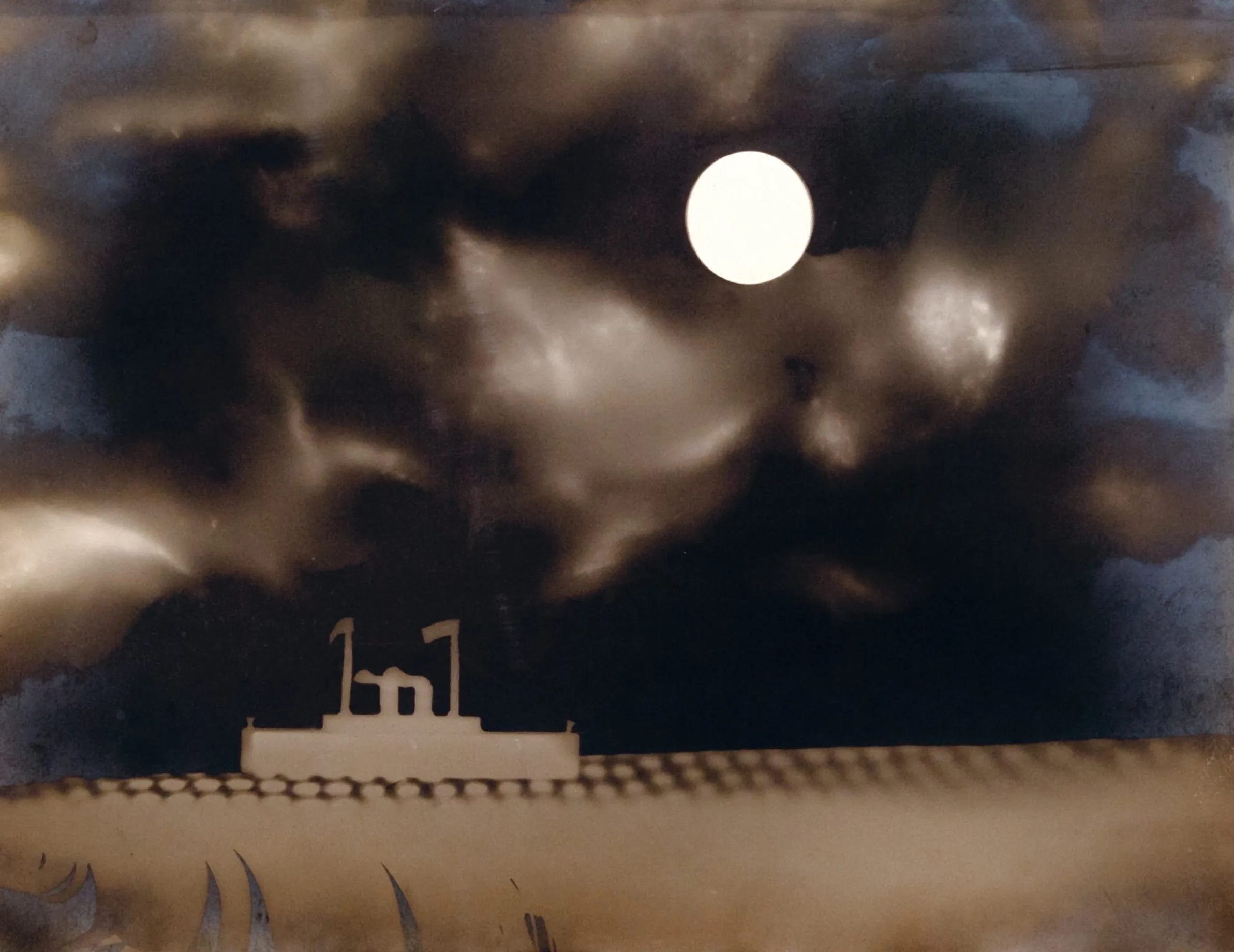
Of course, there will always be those who look only at technique, who ask “how,” while others of a more curious nature will ask “why.” Personally, I have always preferred inspiration to information. – Man Ray, quoted in Photographers on Photography: A Critical Anthology,” 1966, by Nathan Lyons
As he became more experienced with his Rayograph technique, he began to use it to construct more recognizable pictorial scenes. Marine created around 1925 is an example. One feels tempted to ask, as always with the Rayographs, what objects and techniques created the effects, but the artist warns us against such mundane questions, reminding us that it is the “why” that concerned him. Man Ray was an explorer and a visionary; he concerned himself with “how” because it was necessary to realize his dreams, but it was the dream and its ambiguities which were of primary importance for the artist.
Man Ray is the subject of a current exhibition at the Metropolitan Museum of Art in New York City which focuses on the Rayographs and their place in the artist’s larger career. Man Ray: When Objects Dream continues through February 1, 2026. https://www.metmuseum.org/exhibitions/man-ray-when-objects-dream
Thank you for reading, liking, commenting, and subscribing. I’ll return soon with more art to share.
His work was extremely experimental for the early 1900’s and right in the vein of the mysticism of the surrealists. He is a classic. I appreciate your detailed descriptions.
You are correct. He both annoyed and bewildered me :-)