
Chance Encounters, Edition 66
A Few of My Favorite Things

Postmodern Jukebox, featuring Robyn Adele Anderson (vocals). Mike Cottone (trumpet), Adam Kubota (bass), Chip Thomas (drums), Scott Bradlee (piano and arrangement).
Welcome to I Require Art’s last post of 2025. Thank you all for reading, sharing, and subscribing to our Substack. Your support keeps us going.
Only through art can we get outside of ourselves and know another's view of the universe which is not the same as ours and see landscapes which would otherwise have remained unknown to us, like the landscapes of the moon. – Marcel Proust, In Search of Lost Time, volume 6
I’m doing something a little more personal this week, focusing on works by some of my all-time favorite artists. I decided to choose a group of artists whose works I would go out of my way to experience in person; in several cases I already have gone out of my way to see their art.
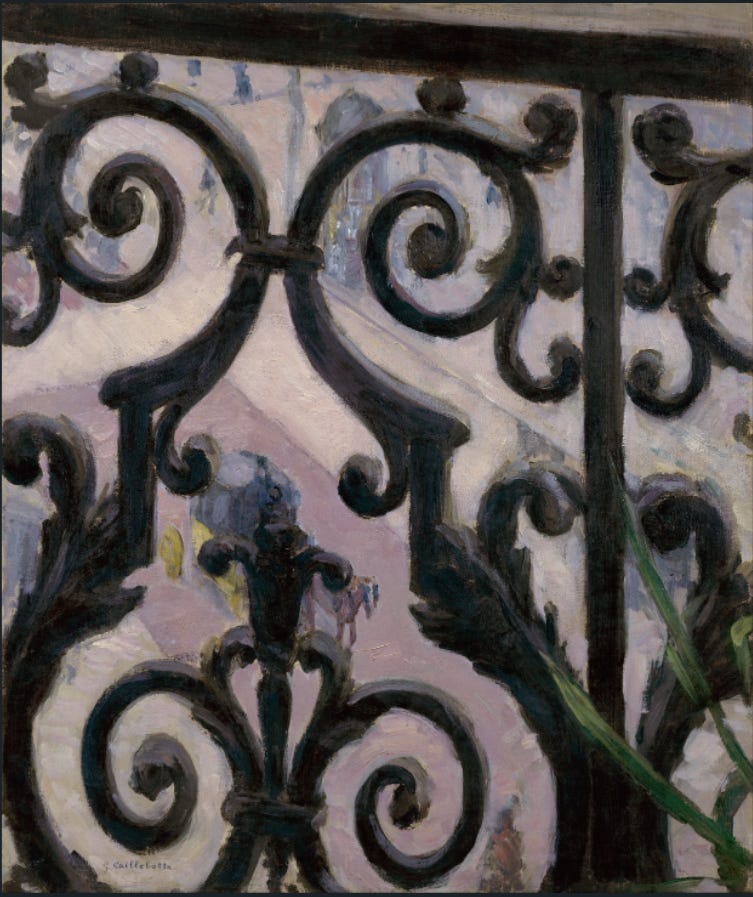
When someone asks about my favorite artist, I usually answer “Gustave Caillebotte” (French, 1848-1894). (To learn more about this artist, see Chance Encounters 42.) I can remember seeing slides of his paintings in a darkened lecture hall as an undergraduate and thinking that his blend of Realism and Impressionism was very appealing. The first time I saw his Paris Street, Rainy Day (1877), at the Art Institute of Chicago, I was smitten. For me, a visit to the Art Institute isn’t complete without a visit to my old friend and I have returned twice to see special exhibitions of the artist’s work. The example I have included here, View Seen Through a Balcony (1880), demonstrates one of my favorite characteristics of Caillebotte’s work, his manipulation of point of view or vantage point. From the sense that the foreground figures in Paris Street are about to bump into you to this view through a wrought iron railing, the artist delighted in creating unexpected angles enabling the viewer to experience his world.
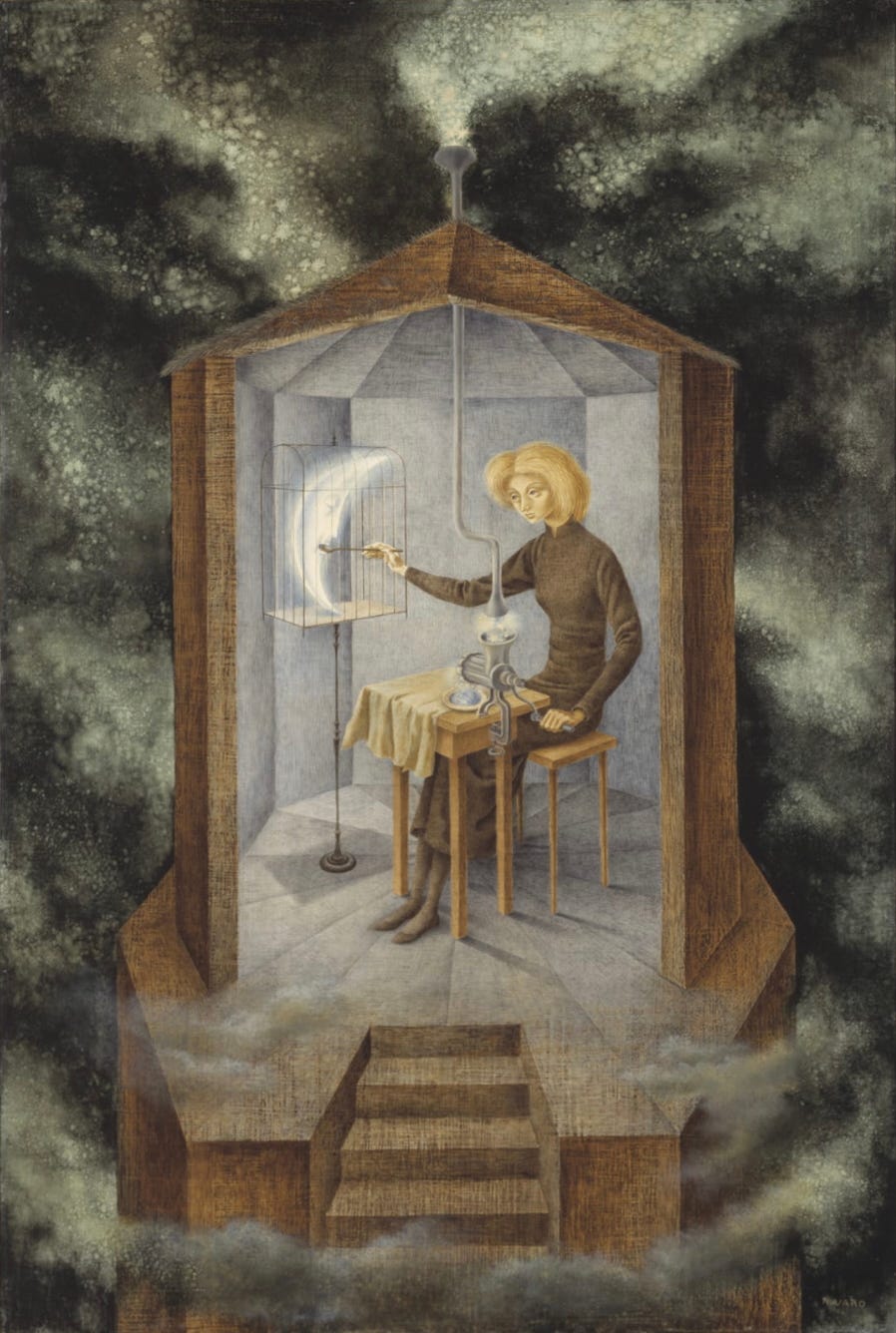
When I was student, in fact, for many years after I was a student, Surrealism meant Salvador Dalí, André Breton, and other men. These were the artists in the textbooks that I learned, and later, taught from. One day, while scrolling through Facebook, I came across a painting by Remedios Varo (Spanish-Mexican, 1908-1963). The precision of her paint application, the almond-eyed craftswomen and sorceresses, and the mysterious activities she depicted appealed strongly to me. The more I saw, the more I loved her work, culminating in making a trip specifically to view the exhibition Remedios Varo: Science Fictions at the Art Institute of Chicago in Summer 2023. (See Chance Encounters 14.) Viewing the artist’s paintings in person increased my admiration for her work. Star Maker (1958) shows a seated woman in a tower room, feeding a caged crescent moon. The moon’s light is being processed through something very like a meat-grinder and a tube which extends from the grinder spews clouds of stars above the tower roof. Varo’s precise and colorful technique reminds me of the images in Medieval manuscripts but the subject matter suggests the highly personal, often obscure symbolism of a Surrealist. Remedios Varo’s fantastical paintings continue to fascinate me and make me wish I could actually enter the worlds the artist created. In the case of Star Maker, I would like to climb to that tower room and rescue the moon.
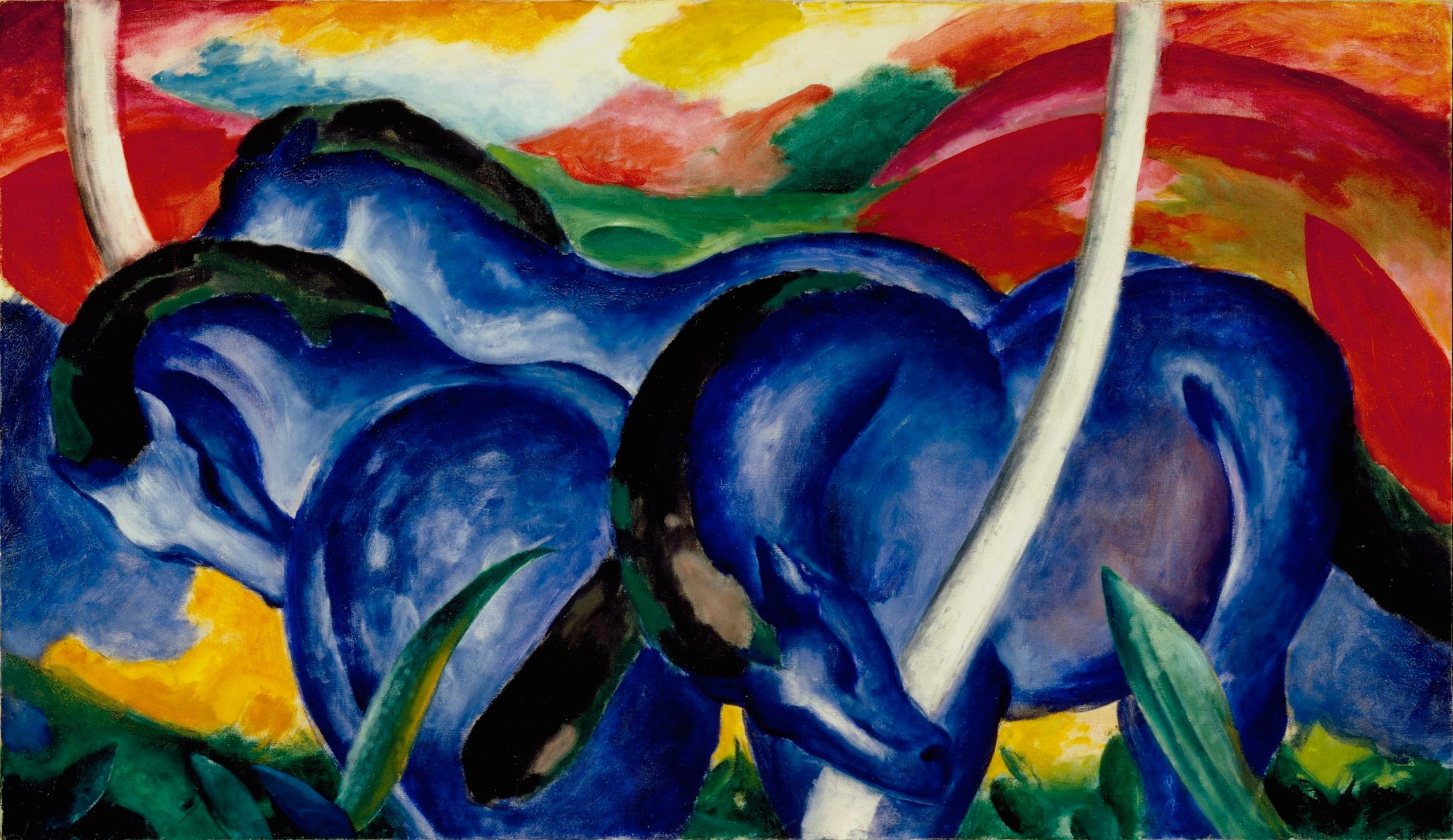
I’ve never had the opportunity to visit an exhibition devoted to the German Expressionist painter Franz Marc (1880-1916), though I have seen several examples of his work in person, including The Great Blue Horses (1911). I have encountered this work in person twice and on both occasions, it quite literally took my breath away. Marc was associated with man avant-garde artists in the first decade of the 20th century; he was a cofounder of the influential group Der Blaue Reiter (The Blue Rider) which exhibited progressive art in the years just before World War One. In The Great Blue Horses, the richness of color and density of shapes are powerful and moving even without knowing the artist’s intentions or his tragic life story. Marc’s art emphasized images of animals and he developed a personal color symbolism. Blue signified the masculine and yellow feminine. Red symbolized violence. Even without knowing the key to his color choices, the beautiful blue horses appear crowded between the grayish white tree trunks, and threatened by the red tones spreading through the landscape. Marc feared for the fate of nature as he witnessed increasing industrialization and human disregard for nature in the beginning of the 20th century. The Blue Rider group disbanded with the advent of WW1 as the young German artists were drafted into the military and the non-German artists fled to neutral Switzerland or their own homelands. Marc was killed in the Battle of Verdun in 1916.
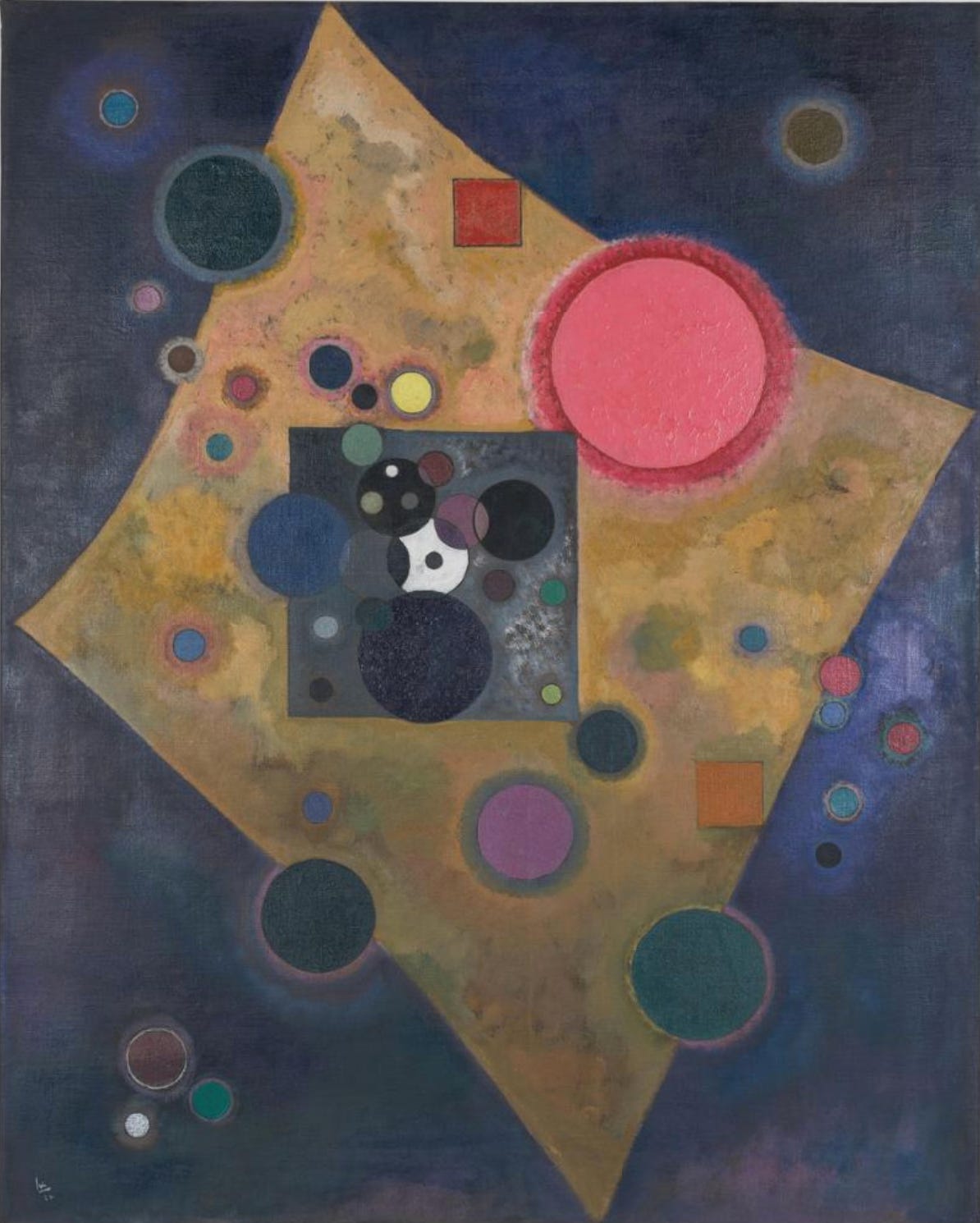
Marc’s friend and co-founder of The Blue Rider, Wassily Kandinsky (Russian-French, 1866-1944) is one of the artists credited with inventing non-representational art and he was the first to publish a theory of abstraction. Kandinsky believed, and I think many of his works demonstrate, that color and shape could convey an internal or spiritual reality as well as, or even better than, figural art. Kandinsky’s works were incredibly inventive and varied and have been influential up to the present day. You can learn more about him in Chance Encounters 24. Accent in Rose (1926) is among my favorites by Kandinsky. I often find myself meditating on the circles which seem to have passed through the door-like dark square and drift toward me. Circles often represented spirits or souls to Kandinsky and the artist was influenced by the esoteric religious movement Theosophy. Such facts deepen my understanding and appreciation of Kandinsky’s art, but this painting cast its spell on me before I knew much about the artist. I’ve never seen this painting in person, nor have I seen a Kandinsky exhibition, but those experiences are on my Art Bucket List, though I may need several lifetimes to complete that ever-growing wishlist.
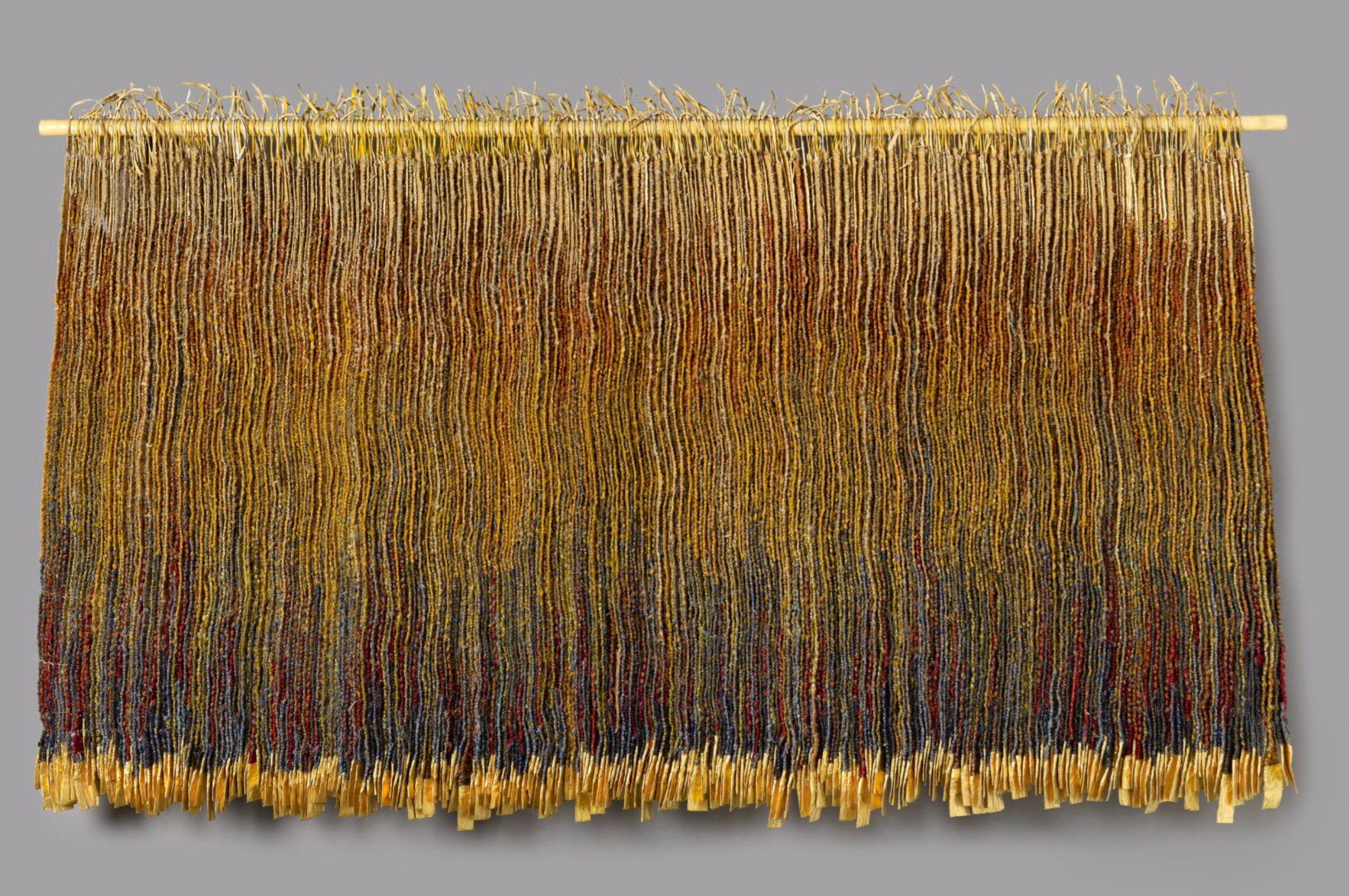
One of the joys of creating these Substack posts is that I get to spend plenty of time searching for topics. One of my favorite things is visiting gallery and museum websites to see what’s up. I discovered the textile works of Olga de Amaral (Colombian, b. 1932) when I created a Viewing Room about her work when it was included in the Venice Biennale in 2024 and she had other exhibitions scheduled. De Amaral was a pioneer of abstraction in South America as well as instrumental in demonstrating that fiber art could equal painting and sculpture in expressive power. The luscious materials and textures of the artist’s creations attracted me first. Who could resist the warm reds and cool blues combined with the glitter of gold leaf in Earth and Gold 2? The sensual pleasure of the materials is one of de Amaral’s interests but she also considers the connection of materials to nature and history. Gold especially has many connections to the history of Colombia, where the artist still lives. Experiencing de Amaral’s works in person is another item on my Art Bucket List.
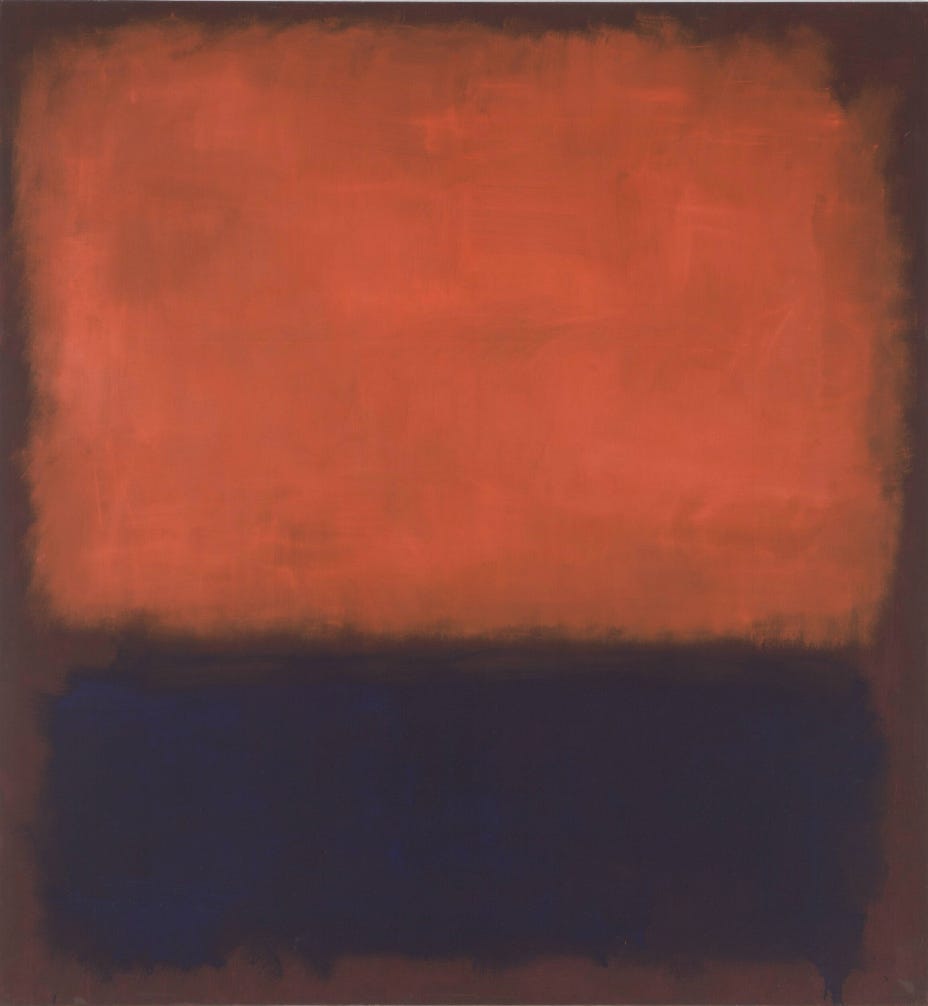
When I first began to look at Abstract Expressionism, I wasn’t sure that I knew how to approach these works. Then, as a museum intern I was tasked with giving a talk on works by most of the movement’s leading artists. Reading about the subject helped me feel that I understood the works on an intellectual level, but only spending a lot of time looking allowed me to develop the love I have for Abstract Expressionism today. Mark Rothko (Latvian-American, 1903-1970) is my favorite painter in this group; his work contains a blend of boldness and subtlety that I find thrilling. I wrote about Mark Rothko in Chance Encounters 10, but there I focused on his development and art historical importance. Here I want to share how his work moves me. I had seen and appreciated several paintings by Rothko before encountering No.14 (1960) in a room full of the artist’s paintings at the San Francisco Museum of Modern Art. It’s a wonder that I could be persuaded to leave that gallery. Even in reproduction, one can see the brushy, atmospheric edges of the rectangles of color in this painting. These painterly edges make the colors appear to hover in front of the warm brownish background, while the weight of the blue-violet contrasts with the less dense orange. This large work (9.5 x 8.8 feet) dwarfs the observer and creates an atmosphere that will absorb the viewer if they will allow it. Rothko’s art is a source of joy and my refuge when petty annoyances threaten overwhelm me.
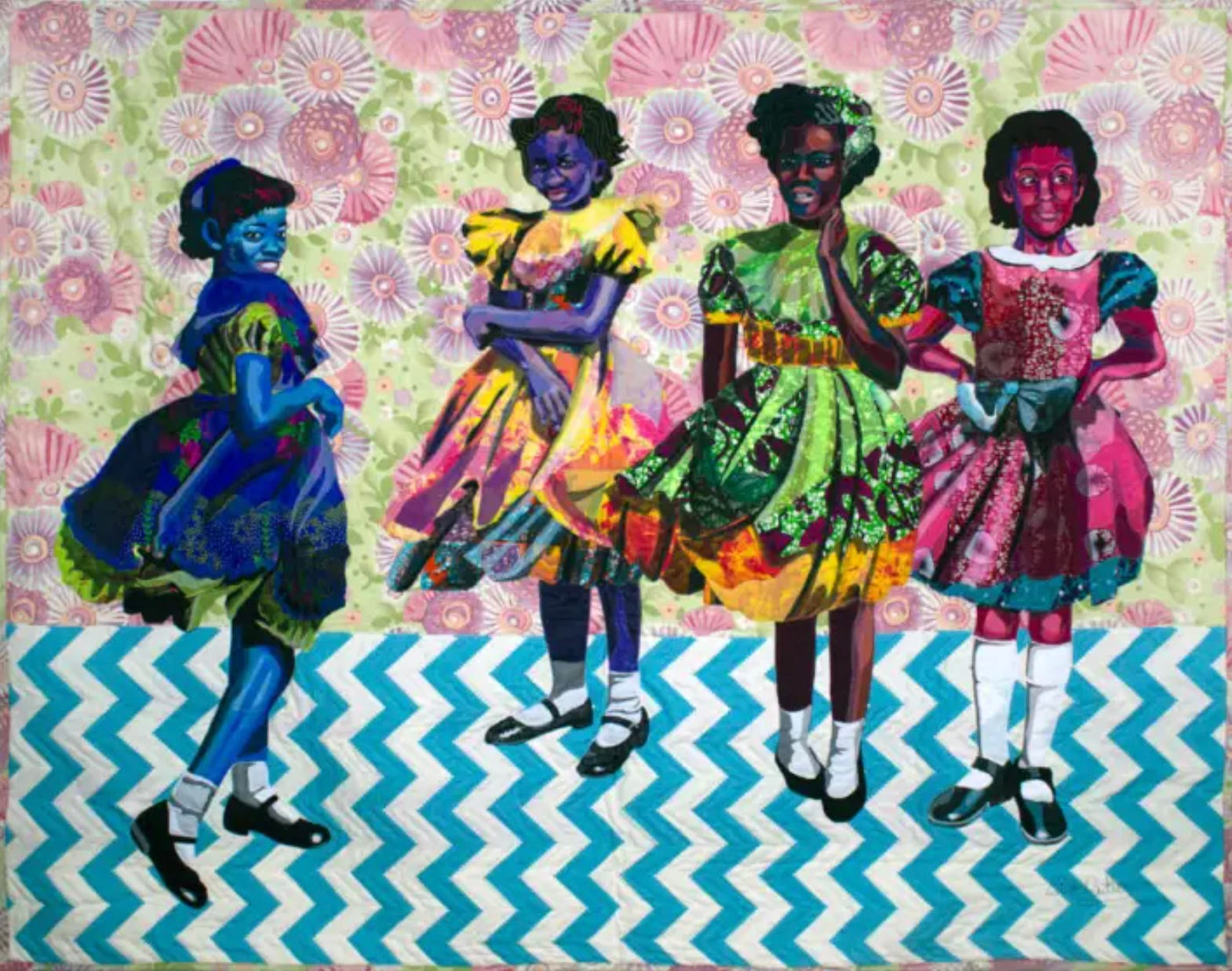
Another artist whose work I first encountered online was Bisa Butler (American, b. 1973). In fact, I was so taken with her work that I made another trek to the Art Institute of Chicago to view their large exhibition of her work in 2021. I expected to enjoy the exhibition but enjoy is too mild a word for my reaction. I was alternately stunned and enthralled by Butler’s vivid quilts. The artist explores famous and unknown Black Americans in her works by finding photographs which she translates into quilts. Four Little Girls, September 15, 1963 (2018) honors the four children murdered in the bombing of the 16th Street Baptist Church in Birmingham, Alabama. Butler celebrates these girls by capturing the lively personalities and energy of the teens through the bright fabrics and patterns she employs in the quilt.
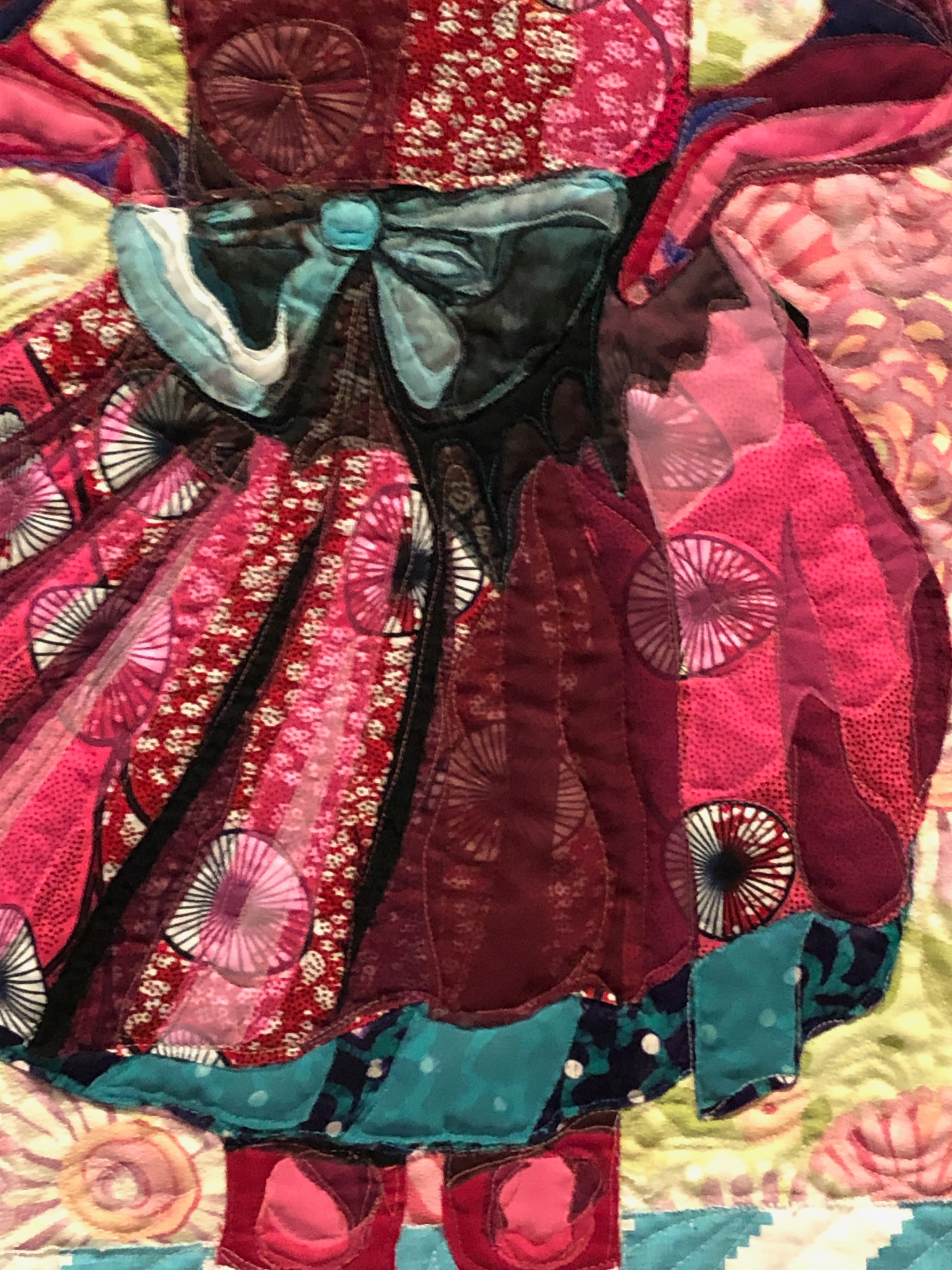
Each child has a different color dress, pose, and facial expression. In addition to the impact of the quilt overall, the artist’s intricate use of her materials make the details as compelling to explore as the whole. This photograph shows part of the girl on the right; chiffon in bright and pale pinks and maroon creates highlights and shadows where it has been applied over the patterned fabric of the skirt. Every one of Butler’s quilts has thoughtfully chosen and applied fabrics, building complex imagery and meanings to celebrate the history of African-Americans in the United States. I hope I get a chance to see her work in person again.
I hope you have enjoyed this look at a few of my favorite things. Thank you again for your likes, comments, and shares. We appreciate the time and attention you give to I Require Art. Our next post will be published on January 10, 2026. Best wishes to all for a Happy New Year.
Thanks for sharing your favorites! What wonderful, diverse taste you have. I enjoy all your posts, but this personal one is very special. It feels like a Christmas gift. Happy holidays!
Thank you so, so much for giving us the gift of seeing all these works through your eyes. That Caillebotte, new to me, is enthralling. I love the way you described the Rothko, making the colors appear to hover. I remember the first time I saw a painting by Marc (I think it was in Munich), and your description here brings back recollection of that experience full force. Well, indeed, in your commentary offered for each painting, you offer so many ways to “see.” May you have a joyful holiday and New Year. I look forward to “seeing” you here on your return in 2026.