
Chance Encounters, Edition 72
Photorealism: More Than A Photograph

Always the best time to paint is when people decide that painting is dead because the traditions and conventions are up for grabs. – Chuck Close (American, 1940-2021)
The Photorealism movement developed in the late 1960s and early 1970s when a dozen or so young, mostly American, artists began, independently, to explore the possibilities of the photographic image as both a source and a subject for their paintings. The term photorealist has also been applied to any artist who copies photographs into their work. Other terms applied to this approach are Super-Realism, New Realism, Sharp-Focus Realism, and Hyperrealism.
At the time that Photorealism began to develop the art world was dominated by two very different movements, the highly self-expressive Abstract Expressionism and Pop Art which emphasized images derived from mass media and popular culture. Like Pop, Photorealism was a rejection of abstraction and emotionalism. Also like the Pop artists, the Photorealists were responding to a world that was filled with photographic images. While Pop artists often responded to their subjects with humor or irony, the Photorealists saw themselves as reclaiming and uplifting familiar, lifelike imagery.
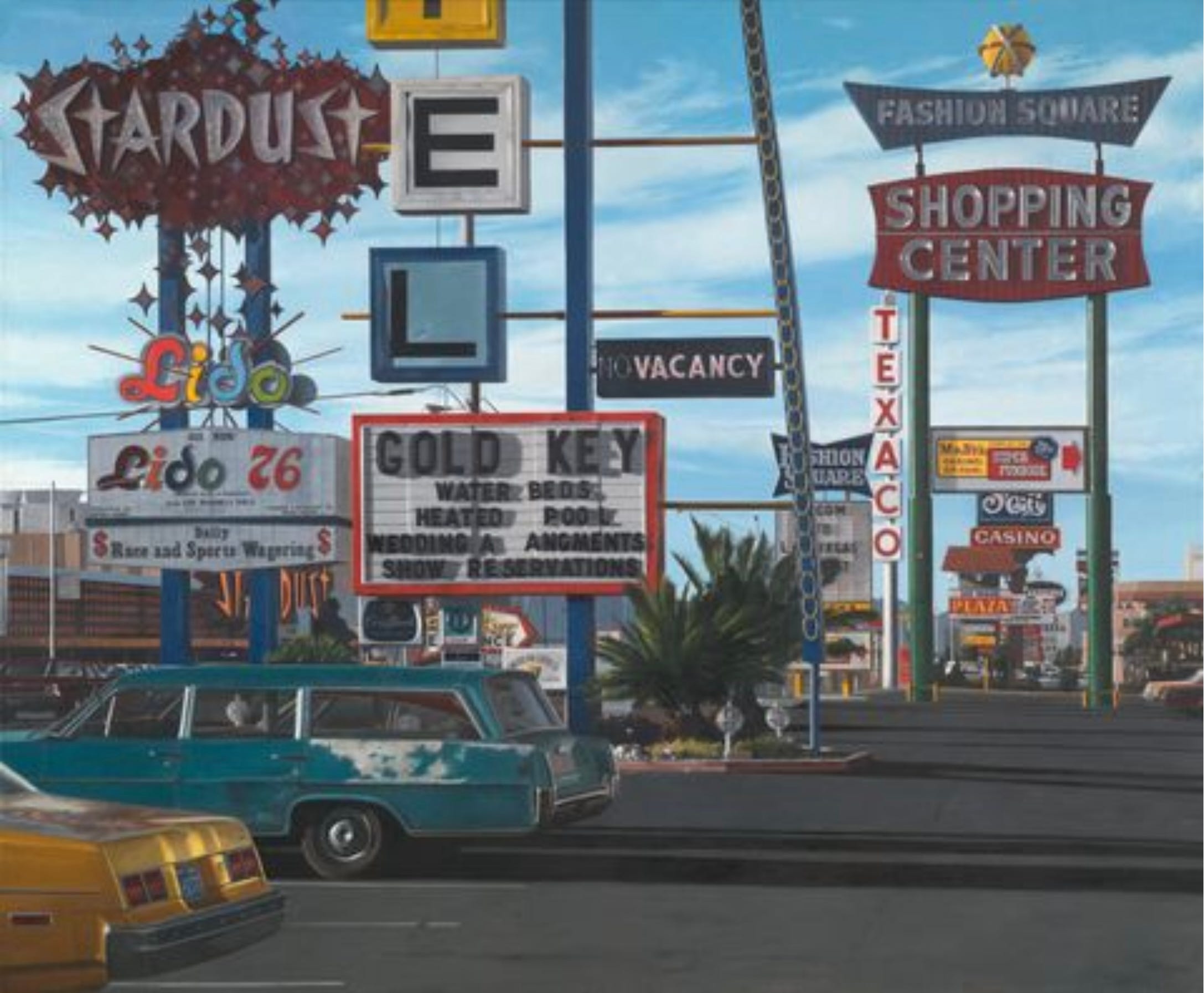
John Baeder (American, b. 1938) is best known for his paintings of roadside diners and motels. As a child, Baeder began taking photographs of old cars and abandoned relics. The gold and green cars in the foreground of Stardust Motel attest that cars continued to interest the artist as an adult. They frequently play a role in the scenes he recorded. Baeder became intrigued by roadside businesses as a college student traveling between Atlanta, Georgia and Auburn University in Alabama. After college, the artist pursued a career in advertising, first in Atlanta, then in New York City. Only after a decade did he pursue painting full time. Works like Stardust Motel, reproduced above, often strike a nostalgic response in 21st century viewers, since many such places have disappeared from the landscape in recent decades. In his paintings, Baeder captured this colorful world based on his own photographs or on postcards of American roadside businesses which he collects.
The name Photorealism was coined by Louis K. Meisel who still exhibits past and present Photorealism at the eponymous gallery that promoted the movement’s founding artists. Meisel identified these defining characteristics of the movement: the artist uses the camera and photograph to gather information; they use a mechanical or semi-mechanical means to transfer the information to the canvas; and the artist is technically proficient in making the finished work appear photographic. The gallery’s support was especially important to the artists of this movement as their contemporaries often disdained their works because they were copied from photographs. Yet artists have used visual devices since the 15th century. Prominent 19th century artists used photographs to capture models and other subjects. The great Romantic painter Eugène Delacroix (French, 1798-1863) photographed models as both a cost-saving device and a means of capturing poses realistically. The difference, of course, is that earlier artists were reticent about admitting their use of photographs, while the Photorealists announced their techniques openly.
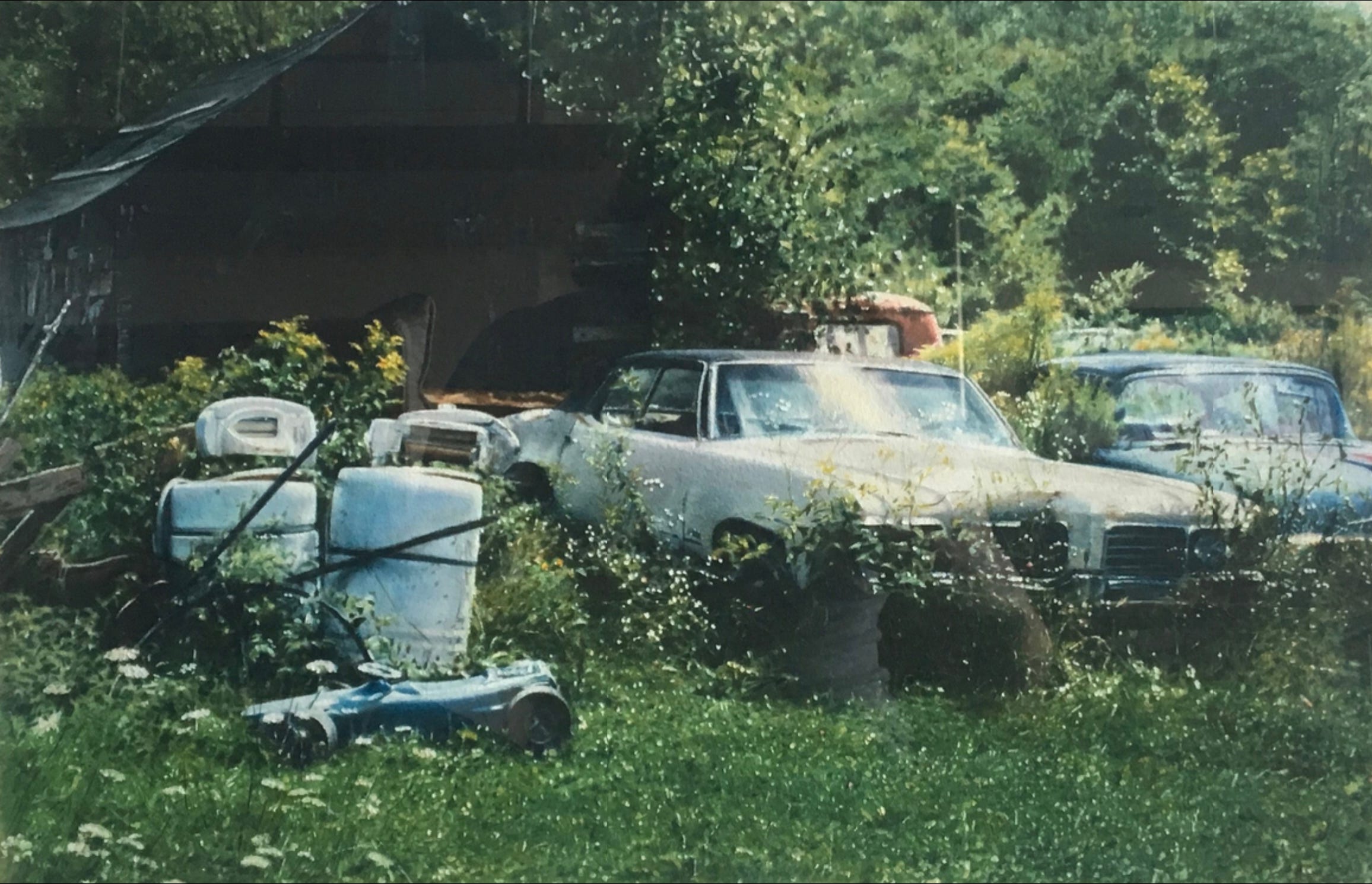
John Salt (British, 1937-2021) began capturing wrecked or abandoned cars, usually in American landscapes in spite of his English origins. Salt studied at the Birmingham (UK) School of Art and the Slade School of Art in London before coming to the United States to study at the Maryland institute College of Art in Baltimore. Feeling frustrated by the idea of choosing one of the prevailing styles which had been developed by others, the artist was encouraged to seek his own path by the graduate school director Grace Hartigan (American, 1922-2008). About the same time, Salt encountered a book of photographs in a documentary style. The artist realized that using such imagery would free him from having to choose a style. After creating some paintings based on the photographs he’d found in the book, Salt began to create his own photographs which he then copied in his paintings. Two Cars in a Field is much smaller than the other works in this edition and it is the only watercolor painting included here. This painting reminds me of familiar sights along American backroads. The black-painted barn and the cars surrounded by rampant weeds are reminiscent of tobacco barns in rural Kentucky. Salt’s work contrasts the immaculately applied paint with the disheveled landscape and deteriorating machinery.
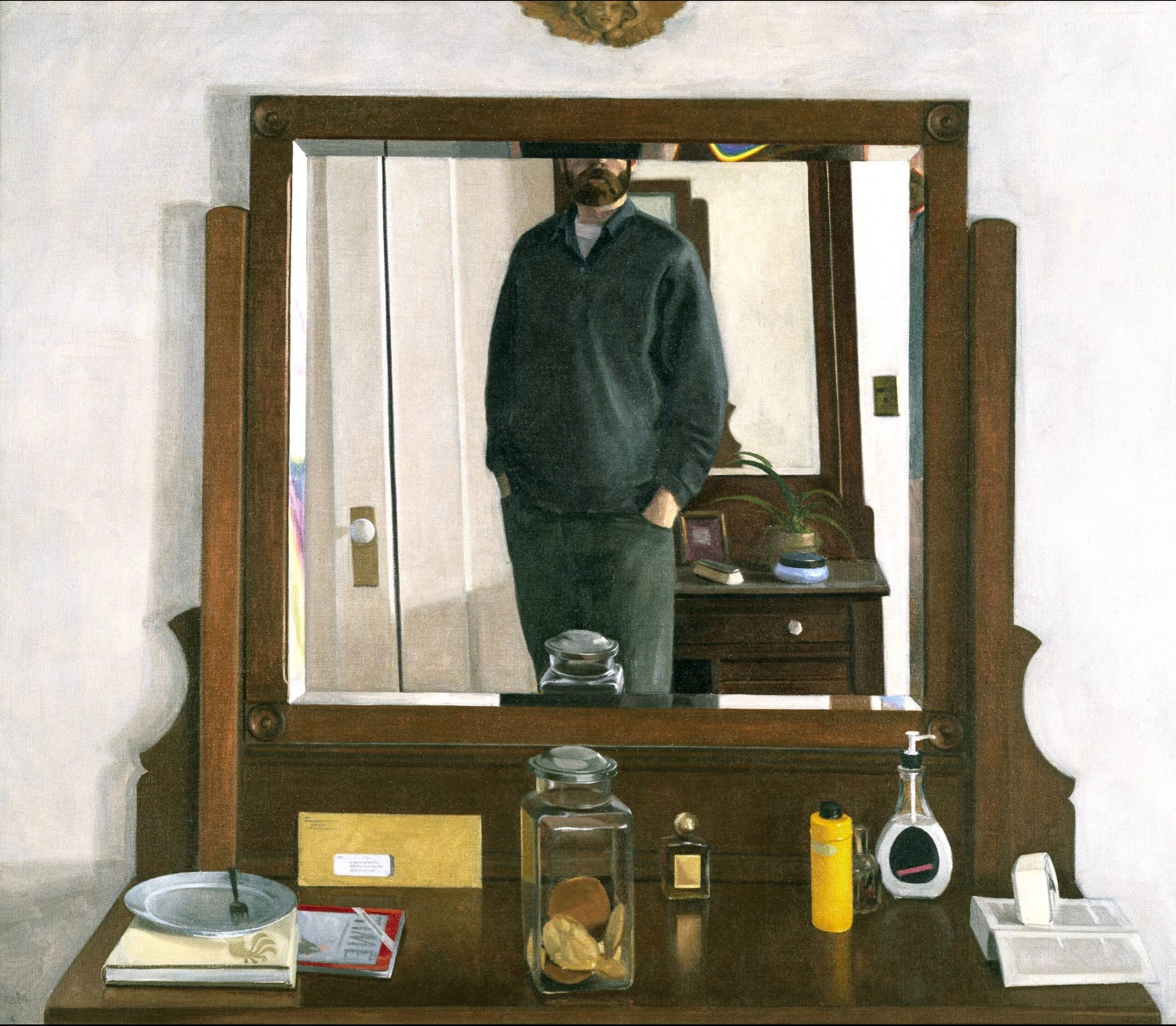
In most of his paintings, Robert Bechtle (American, 1932-2020) also captured automobiles he encountered in the San Francisco area where he spent most of his life. Cookie Jar shows a mundane interior scene of a man standing between two tables supporting mirrors; he is only seen in reflection, from his mouth to his knees.
My interest in these subjects has nothing to do with satire or social comment. I paint them because they are part of what I know and as such I have an affection for them; I am interested in their commonness and in the challenge of making art from such ordinary fare. –Robert Bechtle
Though the painting emphasizes the tables, mirrors, and man, the title refers only to the glass jar, one of several objects on the table in front of the man. Bechtle took his own photographs and copied them by projecting a 35mm slide onto the canvas. He felt that the camera made the image feel impartial by removing emotion from the situation. The photographic quality of the image is readily apparent yet no camera is visible. Playing with reflections and challenging the viewer’s understanding of space are long-time artistic devices given a new twist by Bechtle’s use of them in a Photorealist painting.
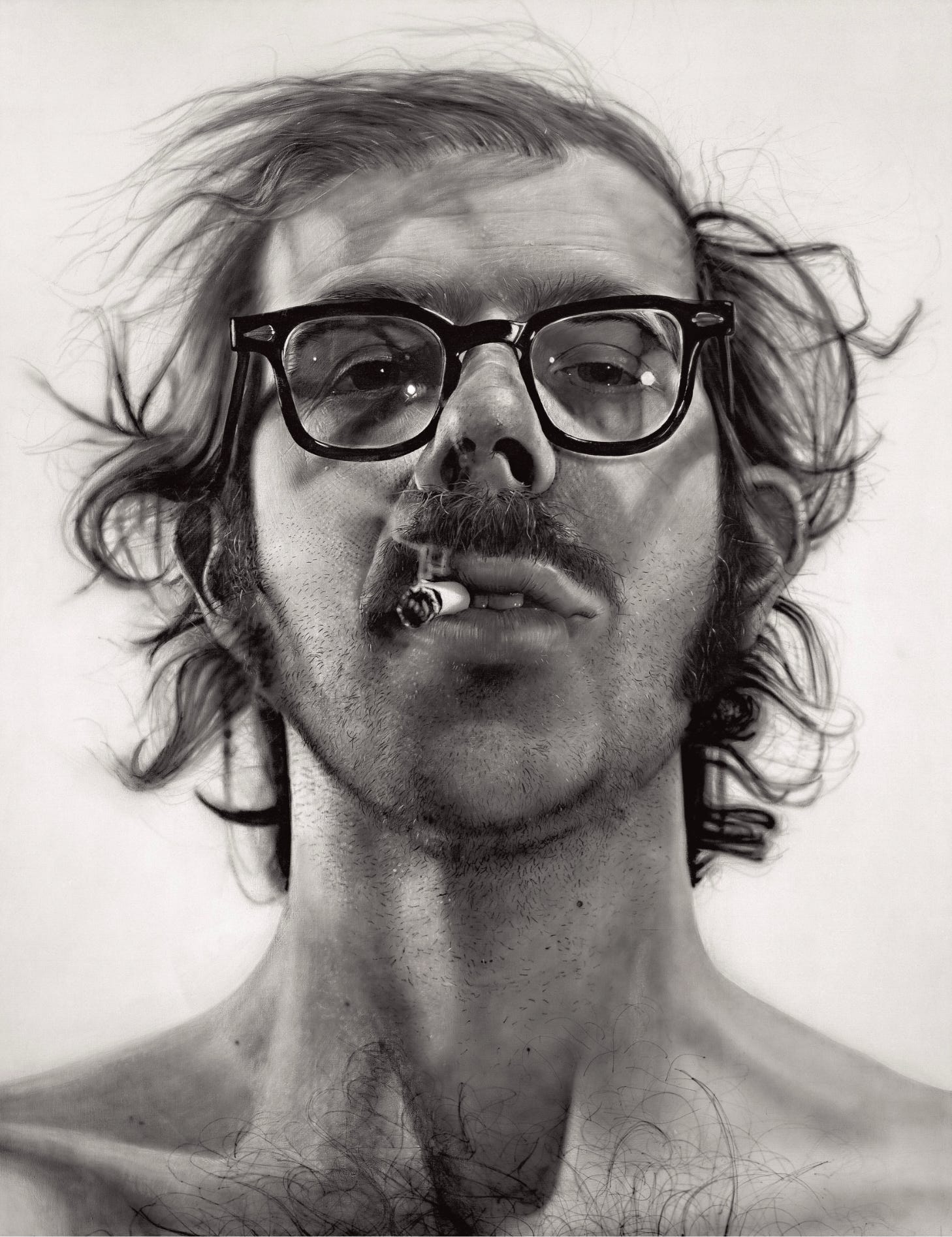
One of the best known Photorealists is portraitist Chuck Close (American, 1940-2021). Close established his studio in New York in 1967. From that time, the artist pioneered and mastered a wide variety of artmaking materials, tools, and techniques, including ink, handmade paper, airbrush, fingerpainting, Polaroid and daguerreotype photography, and multiple printmaking methods. Close even adapted his images to jacquard tapestry. The artist’s early works were, like Big Self-Portrait, large scale images based on black and white photographs. Close would apply a grid to the photograph and then transfer the image to a gridded canvas. In this way he could reduce or enlarge this image as he wished. The same original photograph could be reused in different media and at different scales if the artist wished. Big Self-Portrait was one of the first works to be created using the grid technique. Paint was applied using an airbrush, with a rag, razor blade and an eraser mounted on a power drill as additional tools; Close took four months to complete the work. The resulting nine foot by seven foot portrait confronts the viewer with a level of detail that borders on horrifying. The Walker Art Center in Minneapolis acquired this painting in 1969, establishing Close as a force in the art of his time and Photorealism as an accepted style among collectors and museums of avant garde art.
In 1988, Close suffered spinal artery collapse which, after months of physical therapy, left the artist with some control of his arms but little ability to stand or walk. This event caused a shift in Close’s technique. He still used gridded photographs, but now each grid was filled with abstract patches and patterns of color or tone that from a distance looks photographically real but up close the work dissolves into a patchwork of shape and color.
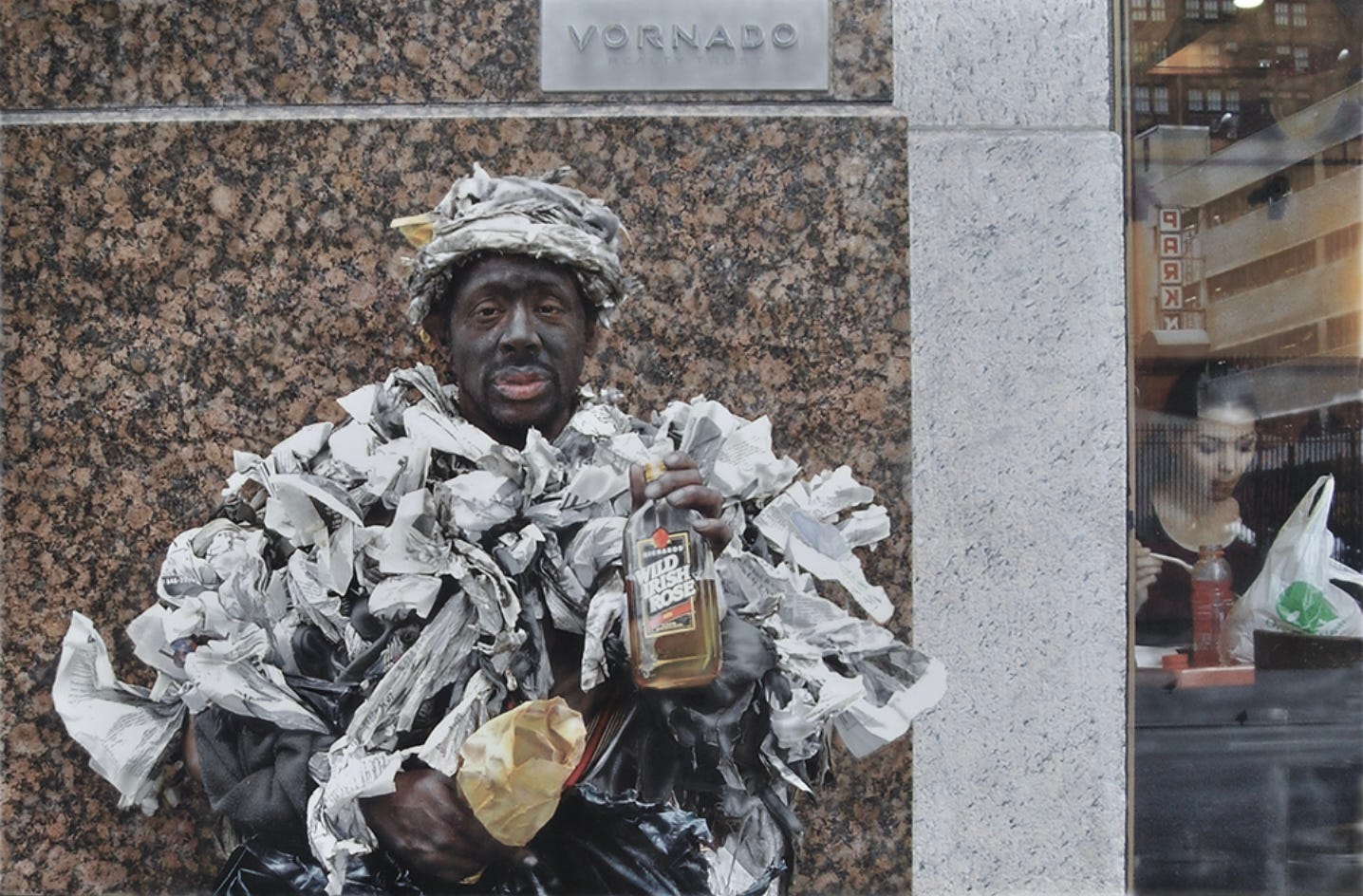
Illusion is secondary to content, a means to an end. My ultimate objective is to create timeless compositions that can mesmerize the viewer and evoke a core response. – Denis Peterson (American, b. 1944)
Peterson is a contemporary artist who prefers to describe his work as Hyperrealism rather than Photorealism. His work focuses on people suffering the ravages of political or social oppression with the hope of provoking change. The artist works in series and Vortex is from the group called The Wall in which Peterson asked individuals to pose against an urban wall. In this example the man shown was wrapped in an assemblage of plastic containers. As Peterson took the photograph, the man pulled out his bottle of liquor, a detail Peterson didn’t notice until he was reviewing his images at home. The oblivious woman in the restaurant was also a serendipitous feature of the photograph. Peterson hopes that when the viewer recognizes the great effort, time, and skill invested in the work, they will ask themselves what about the subject was worthy of that investment and perhaps recognize, as the artist does, that all people are worthy of such an investment.
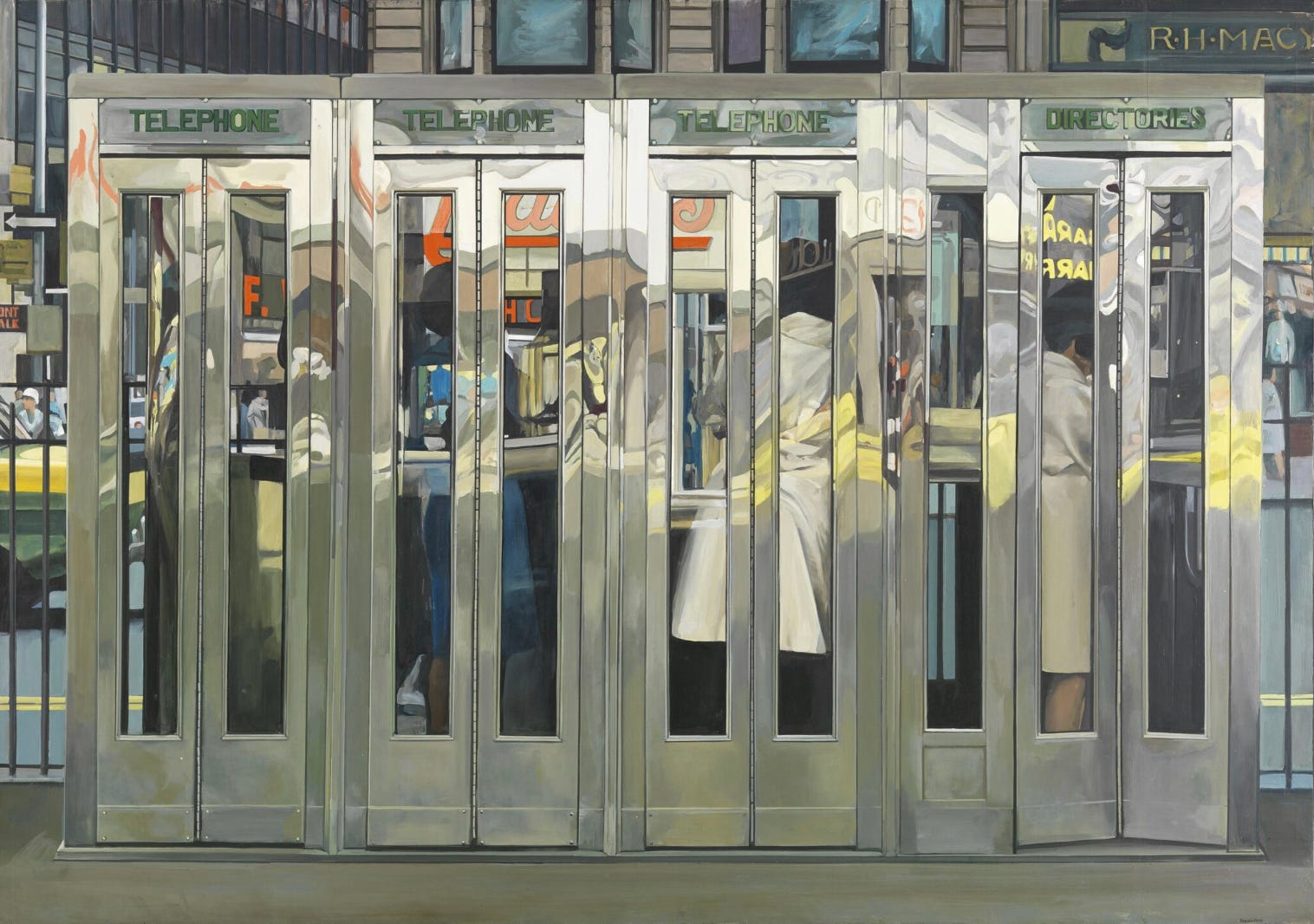
Richard Estes (American, b. 1932) was one of the founding artists of Photorealism and his scenes of urban architectural spaces are among the most recognizable examples of the style. The artist was educated at the School of the Art Institute of Chicago and while visiting the galleries of the associated museum, found himself drawn to traditional American Realist artists like Thomas Eakins (1844-1916) and Edward Hopper (1882-1967). Though not all of his Photorealist colleagues would have agreed, many shared Estes’ admiration for the tradition of realism that can be found in Western Art from the Renaissance onward. Estes had a career in graphic design for a decade before he was able to paint full time starting in 1966. Estes takes his own photographs, often multiple views of the same scene from different angles and distances so that he did not miss even the smallest detail. Though our first sense of an Estes painting is of an ordinary photograph, he incorporates more detail than a single photograph or an ordinary glance at the scene would reveal. The visual experience is more intense and active as a result of the artist’s approach.
A photograph is just values. It doesn’t have line. When you use the photograph, you use the values, but you are adding line and space and movement, coming from your own experience. – Richard Estes
Early on the artist began to focus on reflective surfaces and the way that even a clear window could be obscured by the objects reflected in it. Telephone Booths from 1967 is unusual among Estes’ early works for the clear presence of people inside some booths. More typical works are surprisingly devoid of human beings, an effect that Estes described as feeling like “vacant and quiet Sunday mornings.” In spite of the human presence in this painting, the glass and metal surfaces create a curtain of colorful reflections between us and the booths’ occupants.
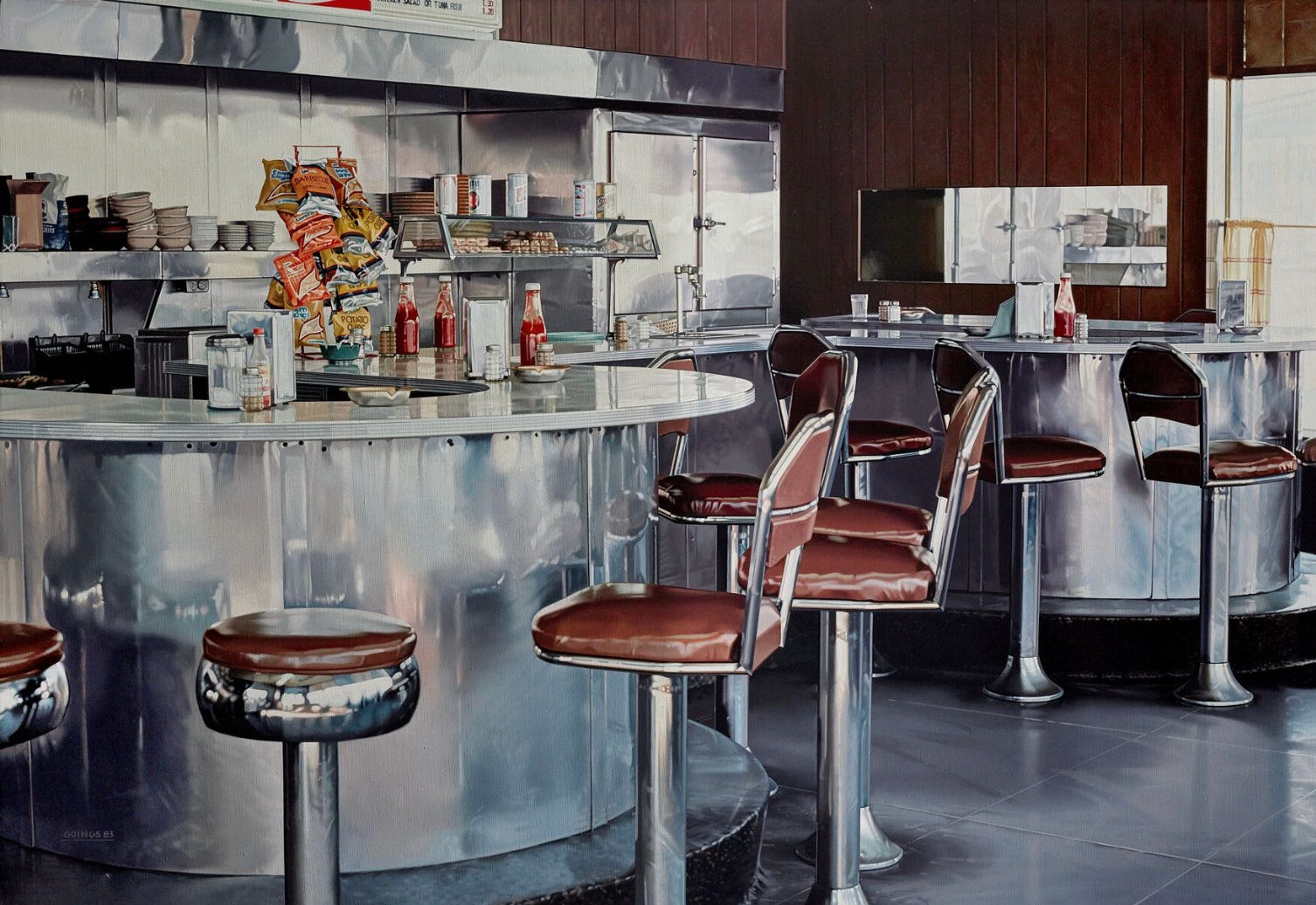
Another artist in love with reflective surfaces was Ralph Goings (American, 1928-2016). Known for his paintings of diners, pickup trucks, and California banks, Goings was first exposed to art by a high school freshman art class and the discovery of Rembrandt in a library book. The artist turned to Photorealism because he found the flatness and ironic tone of Pop Art disappointing.
In 1963 … It occurred to me that projecting and tracing the photograph instead of copying it freehand would be even more shocking. To copy a photograph literally was considered a bad thing to do. It went against all of my art school training... some people were upset by what I was doing and said “it's not art, it can't possibly be art.” That gave me encouragement in a perverse way, because I was delighted to be doing something that was really upsetting people... I was having a hell of a lot of fun... – Ralph Goings
Goings wanted no sign of the artist’s touch to interfere between the viewer and the subject. The light and space are so convincingly rendered that one feels that they have just walked into the Richmond Diner, though one wonders where all the people are. This painting is included in the exhibition at the Museum Frieder Burda (see below).
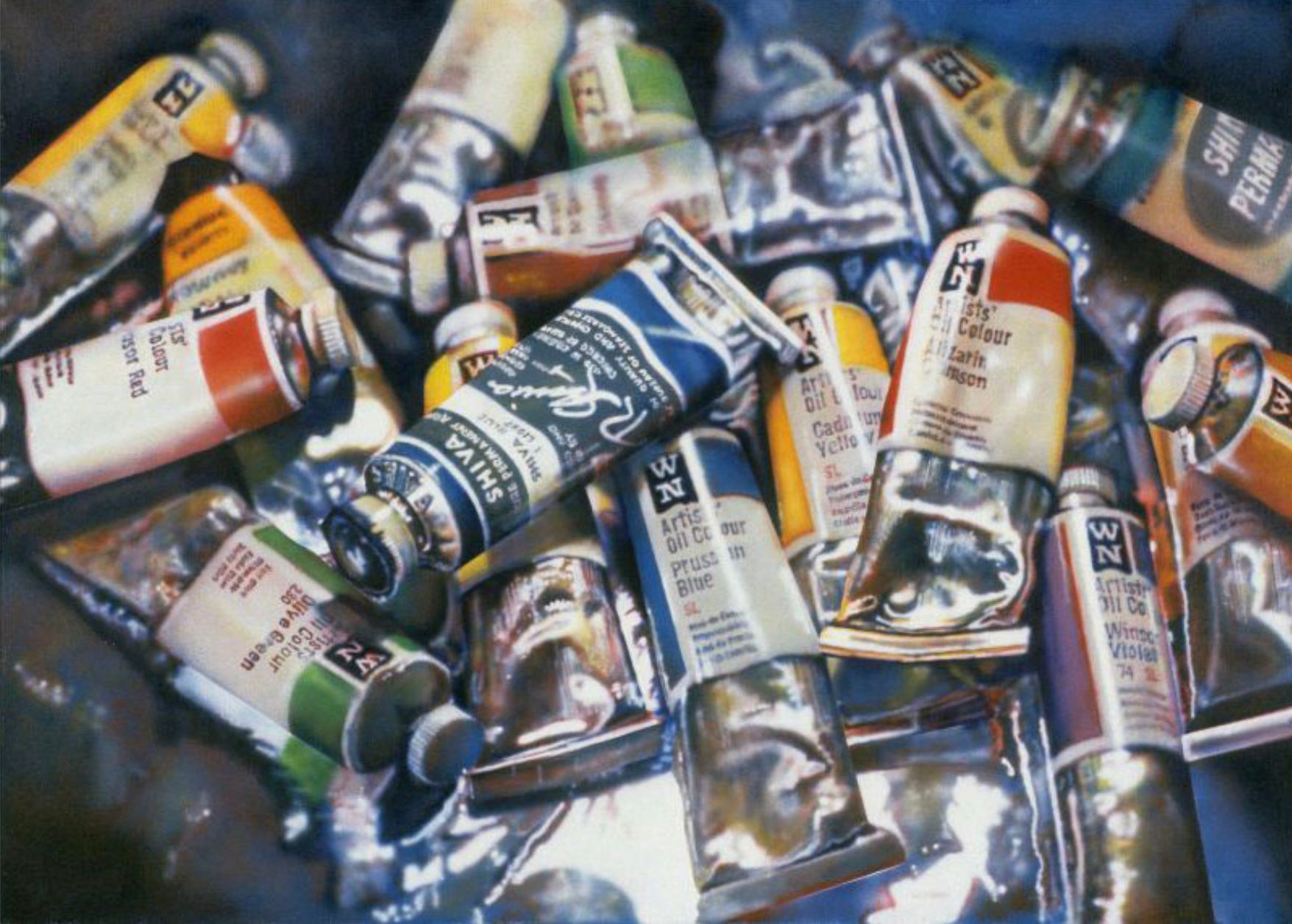
Audrey Flack (American, 1931-2024) was the only woman among the original Photorealists. (For more on this artist and her career, see In Memoriam: Audrey Flack https://irequireart.substack.com/p/in-memoriam-audrey-flack.) Her works tended to be more personal and sensual than the cityscapes and mechanical themes of many of her colleagues.
Photorealists painted cars, motorcycles and empty street scenes. Cool, unemotional and banal were the terms used to describe the movement. My work, however, was humanist, emotional and filled with referential symbolic imagery. – Audrey Flack
Flack began her Photorealist journey with photos of her children and portraits based on them. After copying news photographs into paintings for a short time, she began copying her own photographs of art historical monuments and sculptures. Flack is best known for her still life compositions, which she began creating in the early 1970s. These works show objects that were meaningful to the artist, often making reference to art history and her own life. The example here, which is part of the current exhibition at the Rose Art Museum (see below), shows a jumble of paint tubes through which one can imagine the artist rummaging as she prepared to begin a new work. Flack’s own importance to the history of art in which she was always deeply interested is apparent from the fact that 36 of the 50 Photorealist works she created are held in museum collections and that, along with American Impressionist Mary Cassatt (1844-1926), she was one of the first women to be included in the standard art history textbook Janson’s History of Art.
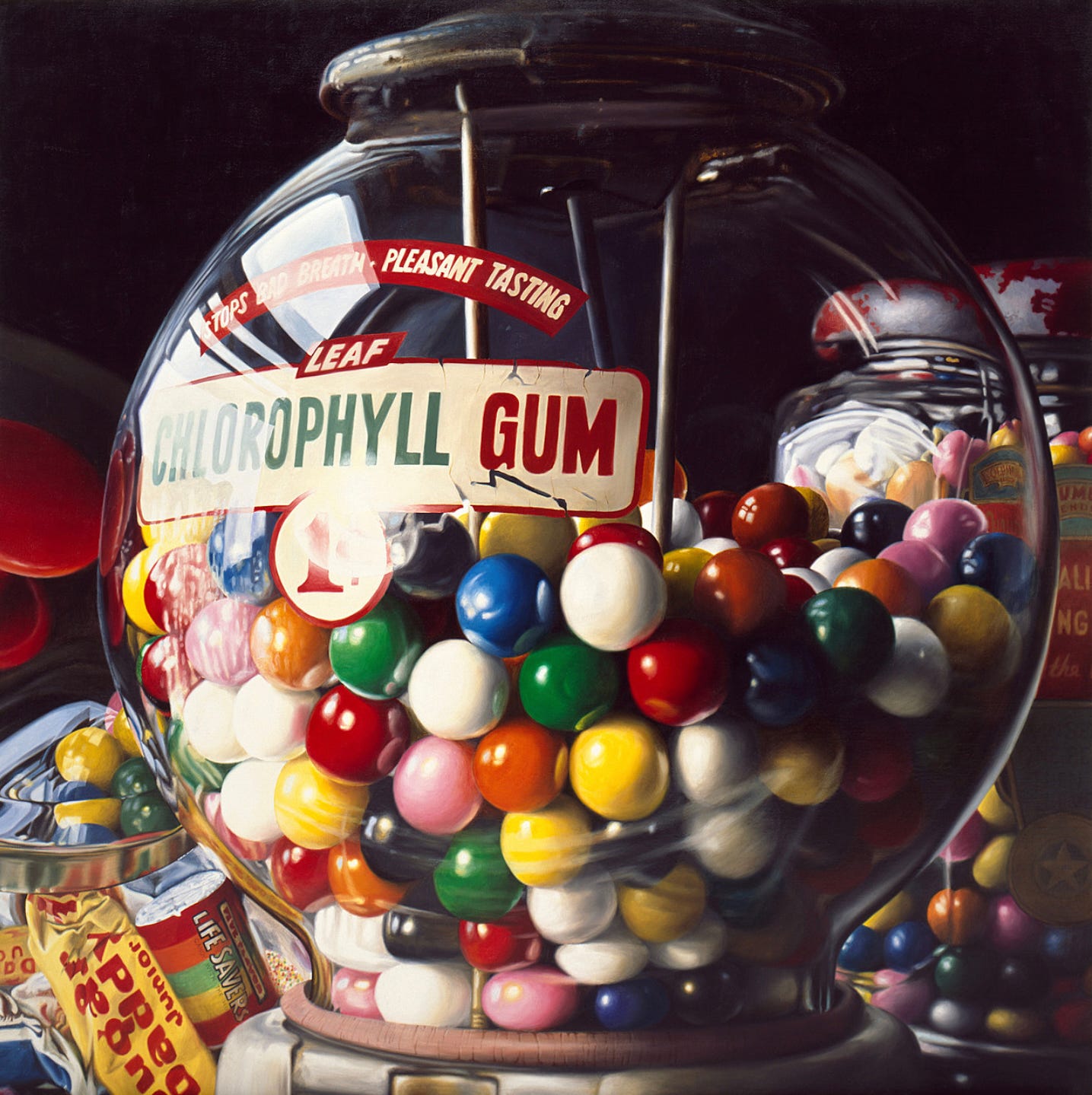
The last example in this edition is by Charles Bell (American, 1935-1995), another of the original practitioners of Photorealism. Unlike the other artists covered in this edition, Bell was largely self-taught, though he worked in an artist’s studio for a time where he was able to gain practice with his materials. In spite of moving to New York to set up a studio in 1967, the artist worked in finance until 1980 before he was finally able to devote himself to art full time. Bell is known for his large scale, close-up views of still life subjects, often incorporating candy, toys, and games. Gum Ball No. 10: "Sugar Daddy" is part of his series of gum ball machines, created between 1971 and 1977. In the latter year, he began painting pinball machines and other objects illuminated from within, but for these earlier works he was interested in light reflecting off glass and colored surfaces an effect that photography was well suited to capturing. Bell felt he was bringing pictorial majesty to these ordinary and familiar themes, many of which seem to recall carefree days of childhood and youth.
The golden age of Photorealism was between 1965 and 1985. Several of the original artists abandoned the style in their later careers; Flack for example stopped painting for a time beginning in 1980 and never returned to a Photorealistic style again. Today only Estes of the original group is still active. Eight have died and the others no longer practice Photorealism. That doesn’t mean the style has disappeared however. If the world was awash in photography in the 1960s, it is now completely swamped with such imagery. Many younger artists are drawn to using photographs as sources and subjects for a wide variety of purposes, just as the first generation of artists discussed here had been.
The fascination of photorealist paintings lies partly in their apparent replication of life, but these are not merely replications. These paintings are out of life scale, varying from over life-size to under life-size, from brilliant heightened color to pale undertone hues. – Audrey Flack
Exhibitions:
“Be Still” at Louis K. Meisel Gallery, 141 Prince Street, New York, New York, USA, through May 2, 2026 https://www.meiselgallery.com/exhibition/be-still/
“Photorealism In Focus” at Rose Art Museum, Brandeis University, 415 South Street, Waltham, Massachusetts, USA through May 31, 2026 https://www.brandeis.edu/rose/exhibitions/2026/photorealism.html
“Rivaling Reality: 60 Years of Photorealism (Wettstreit mit der Wirklichkeit: 60 Jahre Fotorealismus)” at Museum Frieder Burda, Lichtentaler Allee 8B, Baden-Baden, Germany through August 2, 2026 https://www.museum-frieder-burda.de/en/ausstellung
“Hyperrealism: This is Not a Body” (sculpture exhibition) at Musée des Beaux-Arts du Québec, 179 Grande Allée W, Québec City, Québec, Canada, through October 12, 2026 https://www.mnbaq.org/en/programming/exhibitions/hyperrealism-this-is-not-a-body
Thank you for reading, liking, sharing and commenting. If you aren’t yet a subscriber, please consider signing up. It’s free. I’ll be back soon with more art to explore.
BTW, I was going to tell you which one was my favorite, but I realized that at least four of them were it😜
Unlike Priscilla Wyeth, I LOVE ALL OF THEM. But of course you already knew that. Thank you so much for sharing them with us.