
Chance Encounters, Edition 74
The Great Unseen Collection at David Zwirner New York

In a special presentation continuing through June 13, 2026, David Zwirner New York is exhibiting a selection of works from the Joel and Carole Bernstein Collection. The Bernsteins frequently loaned works from their collection to museum exhibitions but, preferring to keep the focus on the works rather than the collectors, dubbed their works “The Great Unseen Collection.” The Bernsteins acquired abstract art when they began to collect but in the 1980s, they decided that they wanted their collection to reflect the human context in which it was created. Their focus shifted to mostly figurative work.
Art has taken me places in my life that I never thought I would see, or become part of. Our pictures have been in museums. It’s been quite a ride. Joel put me on that ride. – Carole Bernstein
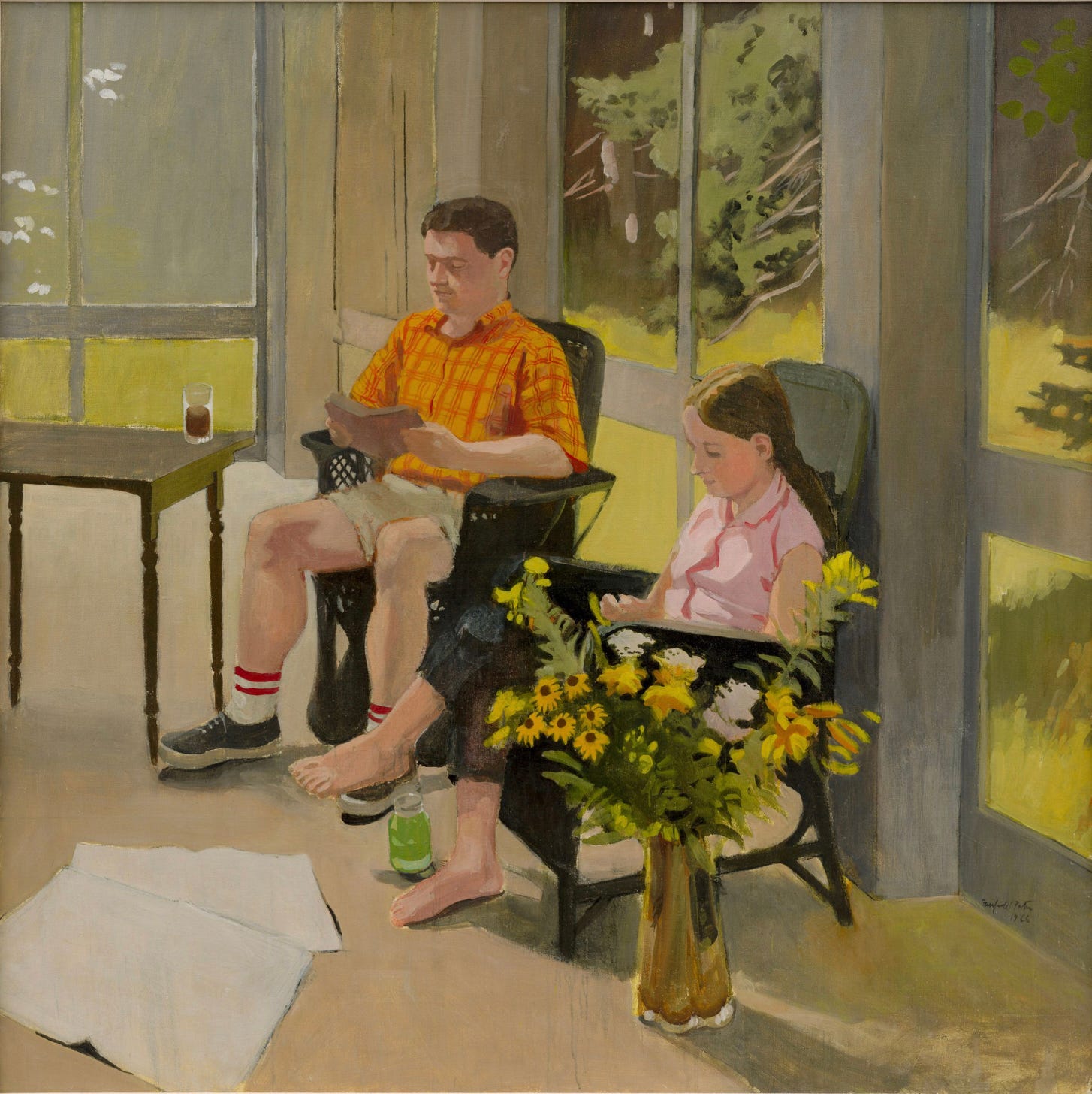
This edition of Chance Encounters will also focus on figurative works, beginning with Iced Coffee by Fairfield Porter (American, 1907-1975). A painter and art critic, Porter was part of an accomplished artistic family, his father was an architect, his mother a poet, and his brother Eliot (American, 1901-1990) was a photographer who was important in introducing color photography to art galleries and museums. Fairfield Porter moved to New York in 1928 and for a short period focused on Social Realism, a style which emphasized economic and other social issues. Soon the artist shifted his subjects to familiar landscapes, domestic interiors, family and friends. Iced Coffee blends all of these themes by showing two people reading in a windowed space with the nearby woods visible just outside. Throughout his career, Porter remained committed to figurative painting even as abstract and non-objective art began to dominate the art world.
When I paint, I think that what would satisfy me is to express what Bonnard said Renoir told him: “make everything more beautiful.” – Fairfield Porter
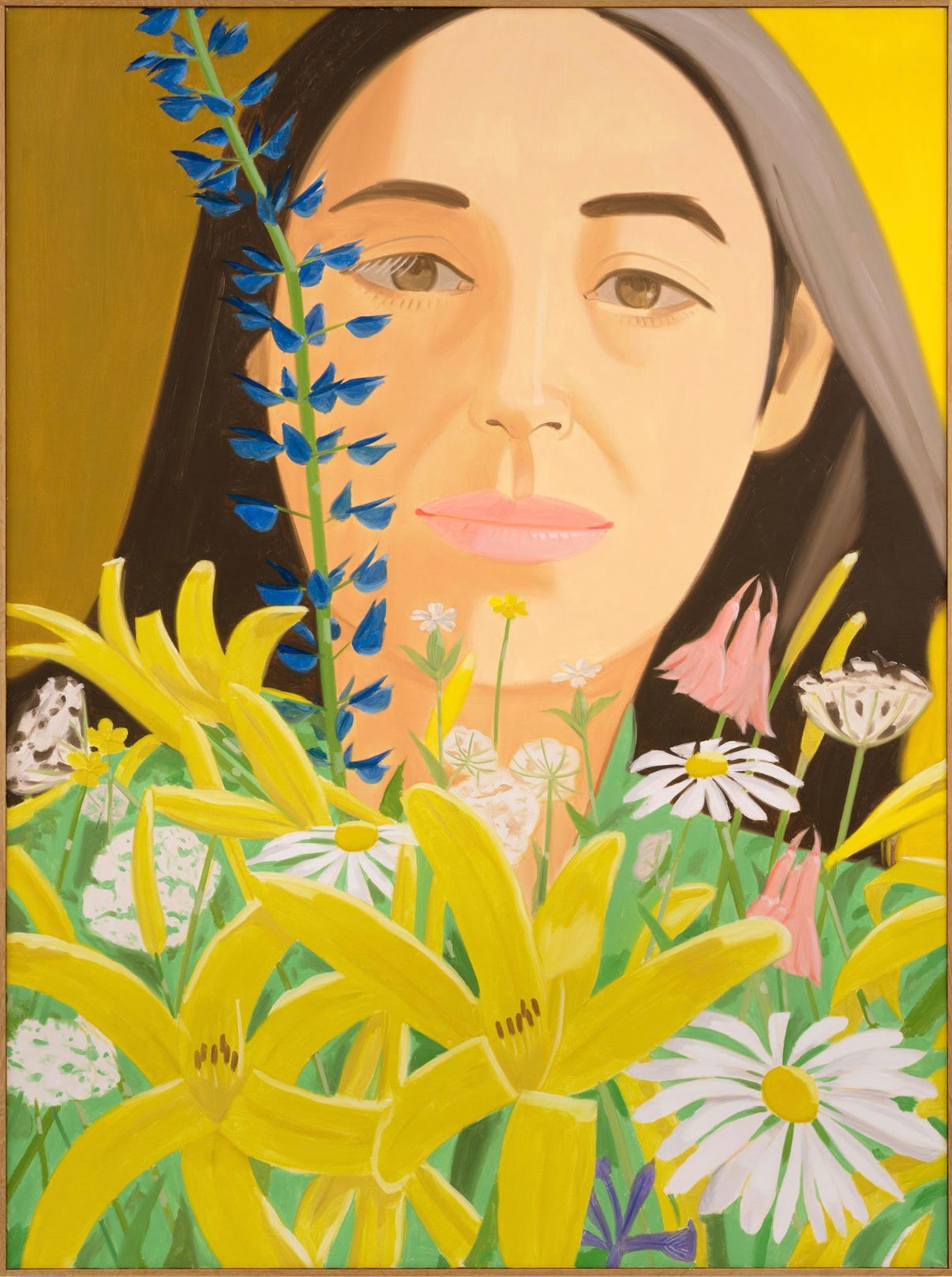
Alex Katz (American, b. 1927) also devoted himself to figurative painting in spite of beginning his career during the ascendancy of Abstract Expressionism. (See Chance Encounters 23) Katz said he had destroyed a thousand paintings he created as he was discovering and developing his signature style which is characterized by mostly flat color and simplified form. Landscapes and portraits are his preferred subjects. The subject of Ada and Flowers is the artist’s wife who appears in hundreds of Katz’s paintings. Ada Katz (American, b. 1928) met the artist at a gallery opening in 1957 and the two were married three months later. The painter begins with a small oil paint sketch of his subject which he copies into a charcoal sketch. That sketch is enlarged, often using a projector, and the enlargement is transferred to the painting’s support using pouncing, a traditional technique for copying a design that dates back to the Renaissance, if not earlier.
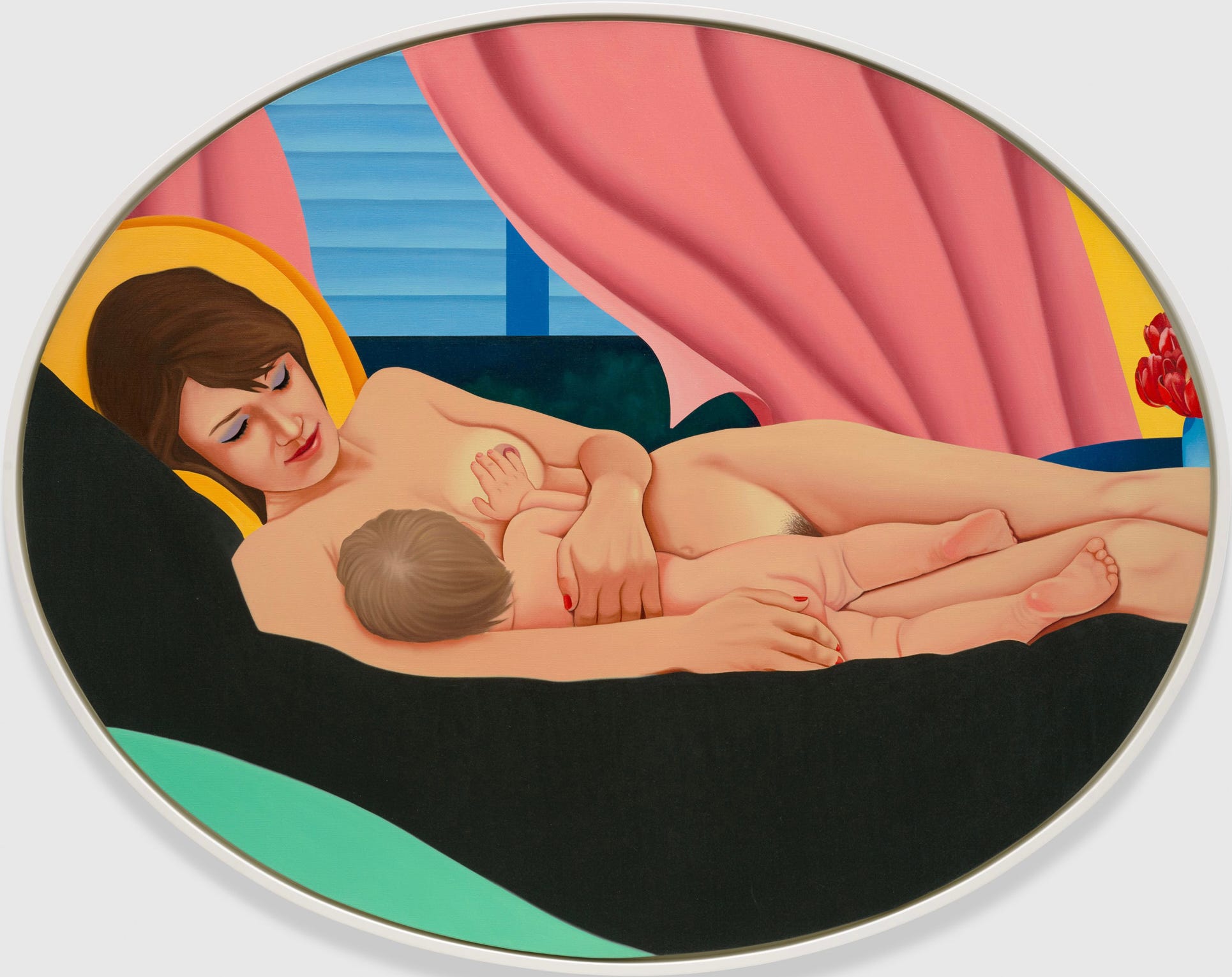
Tom Wesselmann (American, 1931-2004) began a career in cartooning, but realized that painting was a career option after taking some classes in New York. Though the artist admired Abstract Expressionists like Robert Motherwell (American, 1915-1991) and Willem De Kooning (Dutch-American, 1904-1997), he rejected their approach in his own art. Instead, Wesselmann depicted still life and the human form, especially nude women, in bright colors with reduced detail. Many of Wesselmann’s paintings stress the erotic character of his well-endowed female nudes, but Barbara and Baby shows a slender, reclining nude woman nursing a baby. In an otherwise highly modern interior full of bright pastels, the pillow of bright yellow and orange behind the woman’s head is reminiscent of the haloes that framed the Virgin Mary’s head as she nursed the infant Jesus in Renaissance art. Because of his depiction of everyday objects and the bright, simplified shapes in his works, Wesselmann is often described as a Pop Artist but he disliked the association. He believed his use of everyday objects was an aesthetic choice rather than a comment on consumer culture.
The prime mission of my art, in the beginning, and continuing still, is to make figurative art as exciting as abstract art. – Tom Wesselmann
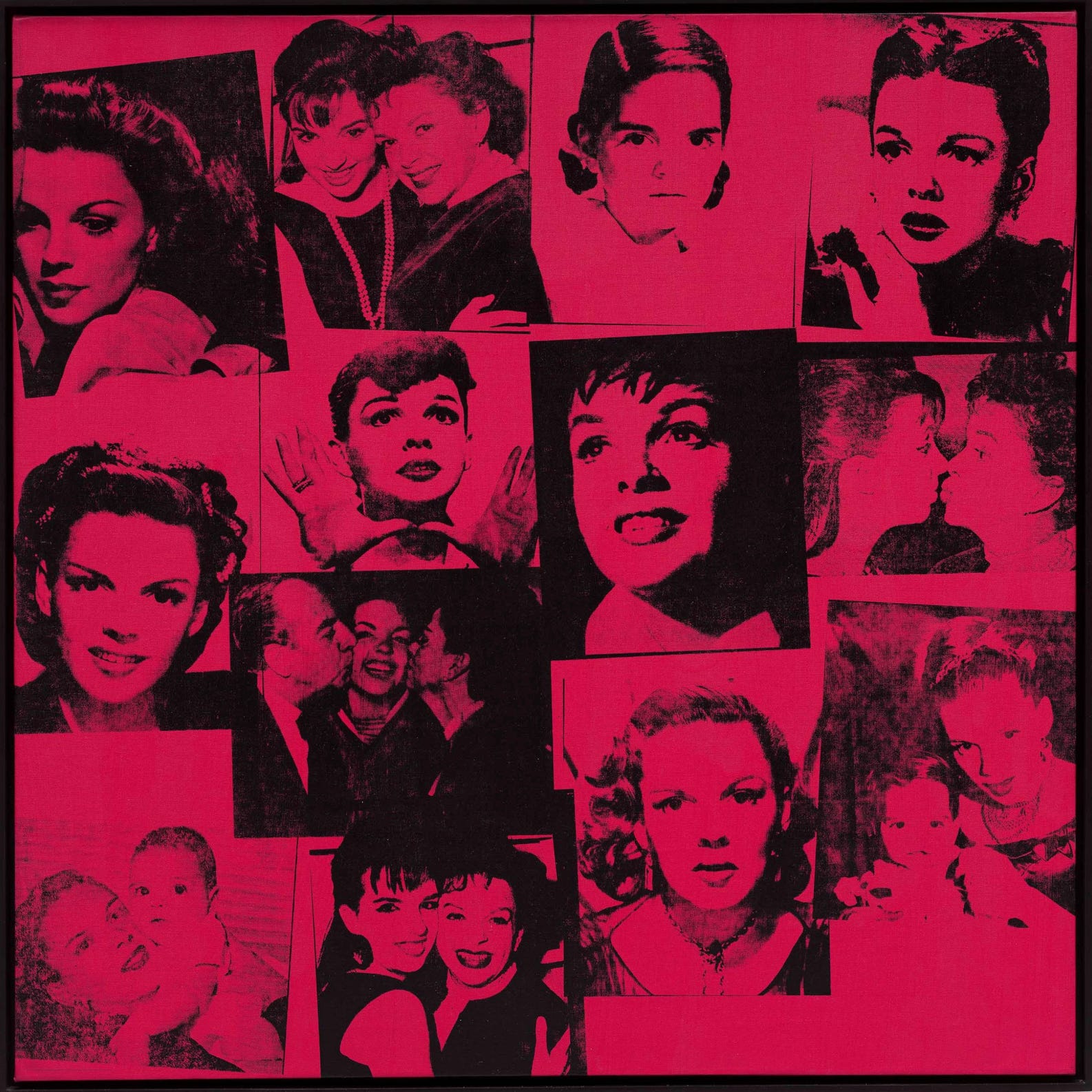
The artist everyone thinks of in connection with Pop Art is Andy Warhol (American, 1928-1987). Born and raised in Pittsburgh, Pennsylvania, today the site of the Warhol Museum, the largest museum dedicated to a single artist in the United States, Warhol’s work explored the interactions among advertising, consumerism, mass media, and celebrity culture. In addition to his use of non-traditional subjects, the artist’s techniques challenged traditional notions of so-called high art. Warhol used photographic reproduction to create stencils from which he could produce almost infinite repetitions of the same image. He adapted the silkscreen printing technique to creating paintings as well as its typical use for works on paper. In Judy Garland, Warhol created the effect of casual photomontage using photographs of the actress and her actress-singer daughter Liza Minelli. The informality of the layout is unusual for the artist who usually arrayed his images in grids. The photographs Warhol used here were given to him by Minelli, who was a friend with whom he partied at Studio 54. In return, the artist gave her a multicolored version of this composition. Warhol had created scrapbooks from Hollywood magazines as a child and he never lost his delight in rubbing shoulders with movie stars.
To meet a person like Judy whose real was so unreal was a thrilling thing. She could turn everything on and off in a second; she was the greatest actress you could imagine every minute of her life. – Andy Warhol, writing in his book POPism about meeting Judy Garland at a 1965 party
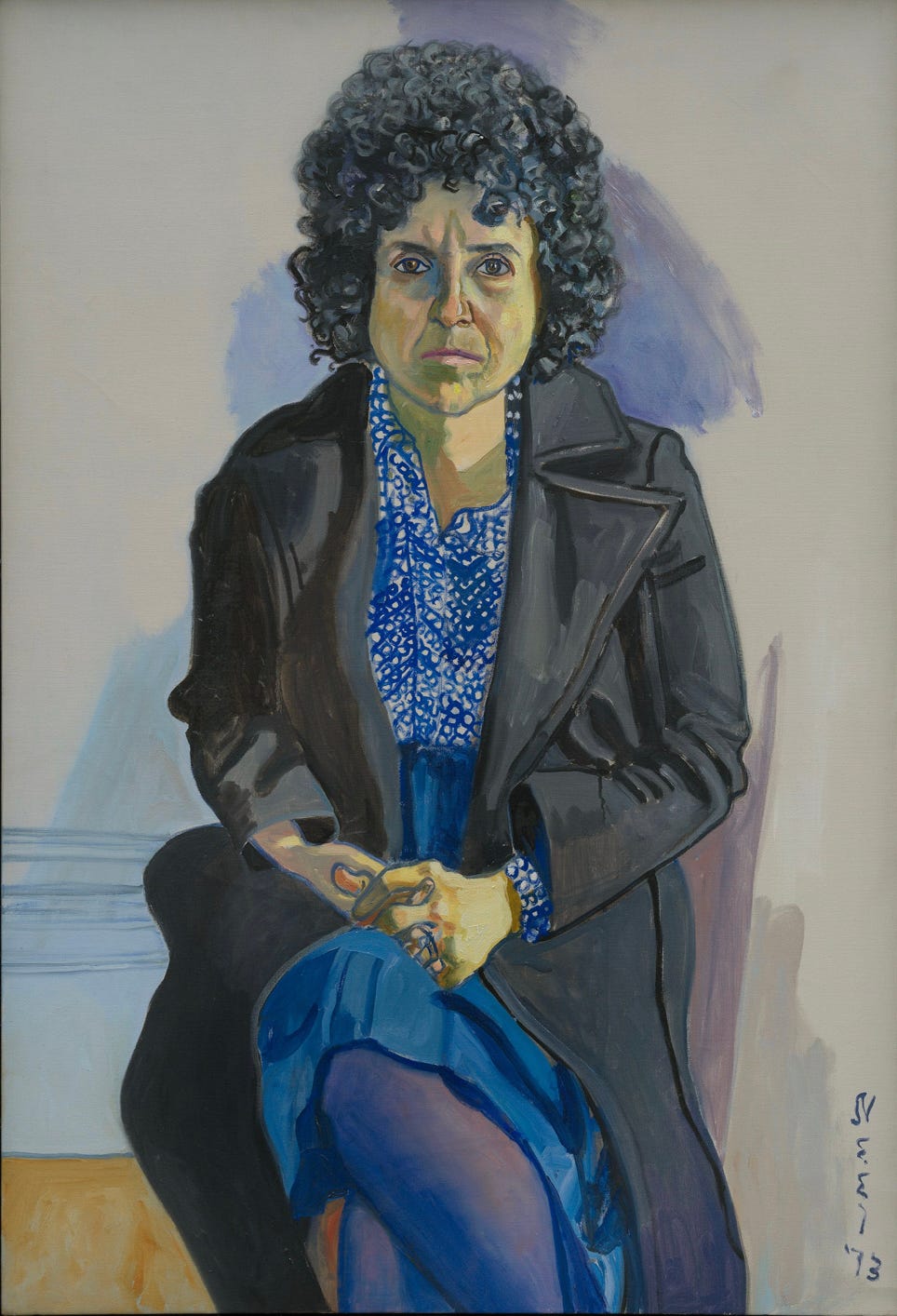
Like Porter, Katz, and Wesselmann, Alice Neel (American, 1900-1984) persisted with figuration in spite of criticism and lack of sales during the heyday of Abstract Expressionism. As a student, Neel had rejected the dominant style of Impressionism and had turned toward the Realism of the Ashcan School. (See Chance Encounters 59) From that beginning, the artist began to incorporate more expressionist distortions, such as unfinished details, limited backgrounds, and lack of any idealization. Throughout her career, Neel focused on portraiture. Her likenesses of friends and family are extremely emotional and psychologically insightful.
I do not pose my sitters. I do not deliberate and then concoct... Before painting, when I talk to the person, they unconsciously assume their most characteristic pose, which in a way involves all their character and social standing - what the world has done to them and their retaliation. – Alice Neel
Dorothy Pearlstein shows the wife of figurative painter Philip Pearlstein (American, 1924-2022). She appears anxious, twisting her hands, and perhaps impatient to be on her way since she’s wearing an overcoat and seems perched on the edge of her chair. Though Neel experienced poverty in the 1930s and 1940s, she persevered in her career, painting into the 1980s. Positive critical recognition didn’t come until the 1960s but today she is considered one of the greatest portraitists of the 20th century.
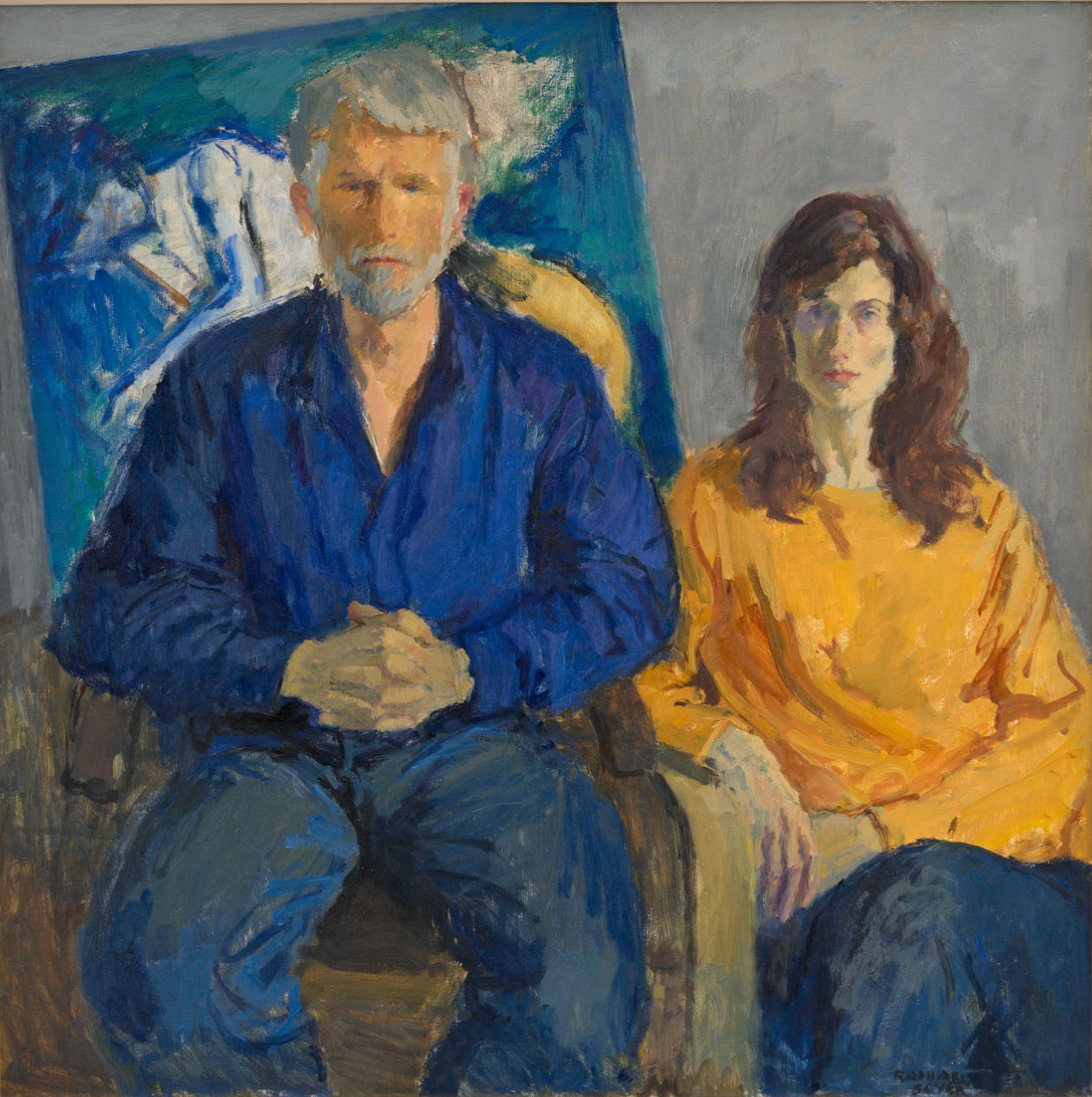
Raphael Soyer (Russian-American, 1899-1987) came to the United States in 1912 when his family fled the Russian Empire and the persecution of its Jewish communities. Soyer, his twin brother Moses and another brother, Isaac, all became painters. Like Neel, who was a friend and the subject of one of Raphael Soyer’s portraits, Soyer’s early style was influenced by the Ashcan School. The artist is often considered part of Social Realism because of his lifelong interest in depicting ordinary people in everyday circumstances. Like most of the artists in this edition, Soyer was an outspoken advocate for figurative painting, expressing his opinions in memoirs and in the magazine Reality which he co-founded. In his portraits, Soyer often depicted fellow artists. R. B. Kitaj and Sandra Fisher is a case in point. Both sitters were figurative artists and the portrait was created the year they married. Sandra Fisher (American, 1947-1994) is known for her paintings of male nudes. The two artists lived and worked in London where R. B. Kitaj (American, 1932-2007) advocated for figurative painting and coined the name School of London for himself and like-minded colleagues.
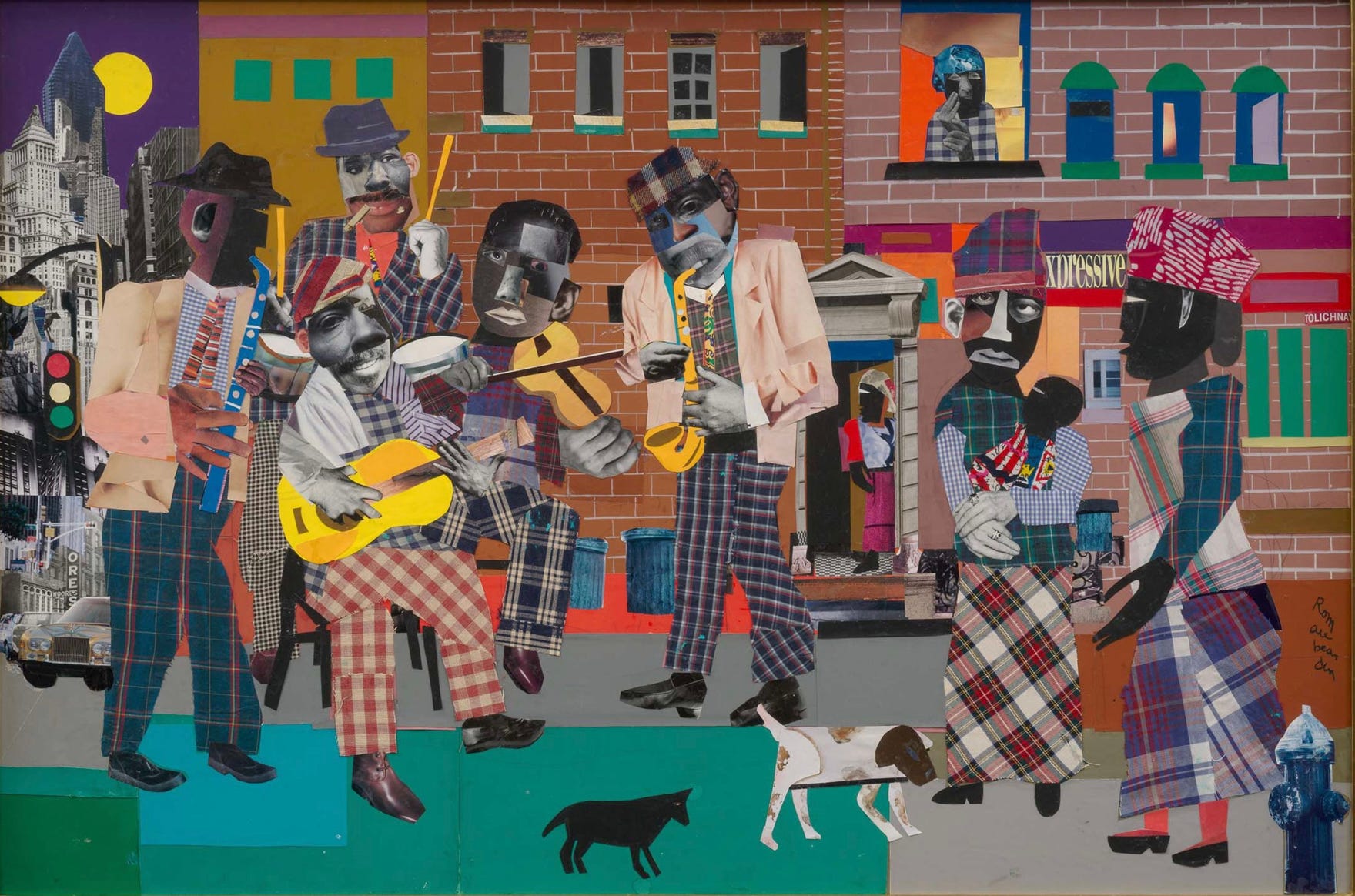
A different approach is taken by the next artist in this edition. Romare Bearden (American, 1911-1988) was an artist, songwriter, author, and scholar. Growing up, Bearden encountered leading Harlem Renaissance figures in his family’s apartment. (See Chance Encounters 35 for more about the Harlem Renaissance.) He worked in several media but he is best known for the collages which he began creating around 1964. He came to the collage technique after spending the earlier part of his career painting, first in a Regionalist style and then using abstraction. He experienced a sense of conflict between wishing to use the popular abstract approach and the desire to depict the Black experience. After serving in the military during World War Two, Bearden wanted to depict the humanity he felt was missing in the world by depicting unity and cooperation in the African American community. Street Serenade depicts a group of male musicians playing on a city street while passersby and apartment residents enjoy the music. The composite faces and bodies are typical of the artist’s collages. The painted backdrop of buildings allows the busy patterns of clothing and complex faces to stand out. Bearden’s collages were among the first to use details cut from glossy magazines as these had not been available to earlier artists.
If you're any kind of artist, you make a miraculous journey, and you come back and make some statements in shapes and colors of where you were. – Romare Bearden
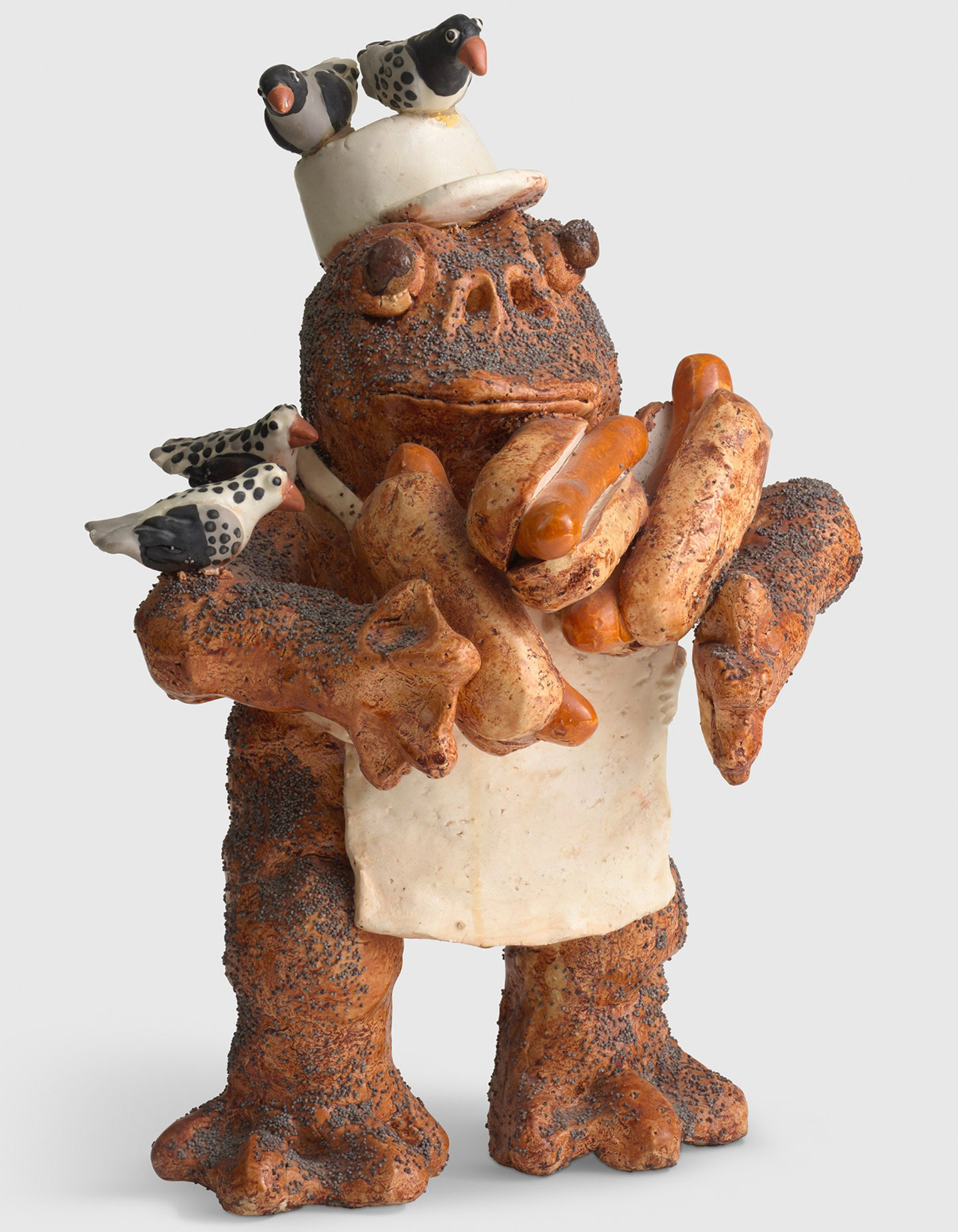
David Gilhooly (American, 1943-2013) stands out from the rest of this group because his work is a ceramic sculpture rather than a two-dimensional image. Aside from the figural nature of his work, Gilhooly doesn’t fit with the rest of this group but I couldn’t resist sharing Breadfrog as Hot Dog Vender at Dodger Stadium.
… even my most maiden old aunt or my most drugged-out cousin can get at the meaning of the work or at least experience it! – David Gilhooly
The artist was a pioneer of the Funk Art movement; based in the Bay Area of Northern California, this was one of many anti-abstraction movements arising in the period after Abstract Expressionism. The name was derived from the musical term “funky,” meaning passionate and quirky. Funk Art was popular in the 1960s and 1970s and developed from the free-thinking and activist culture of San Francisco. Though never an organized or conscious group of artists, most wanted to feel a sense of personal connection with their works, often using humor and absurdity to suggest that viewers should not take art or themselves so seriously. Gilhooly was a sculptor, painter, and printmaker as well as a ceramicist. He and his mentor Robert Arneson (American, 1930-1992) helped to establish ceramics as a fine art medium rather than a purely utilitarian one. Gilhooly’s sculpture is part of his long series of frog-themed works. In Breadfrog, the ceramic surface of the frog was glazed so it appears to made of bread, then real poppy seeds were attached to the surface with glue. The frog’s serious expression, apparent juggling of multiple hot dogs, and birds attentively waiting to pick up a snack all combined to make me smile. I hope they do the same for you.
The artists included in this edition were all advocates of figurative art, most at a time when pure abstraction was dominating the art galleries. It took commitment and persistence to keep working in a less popular style, but as the Bernsteins’ collection demonstrates, that determination paid off. The artistic approaches represented by these artists aren’t the only ones included in the current exhibition. If you have a chance to see it, you’ll find many other styles and mediums to explore. Please share your experience of the show in a comment if you get a chance to visit.
Exhibition:
The Great Unseen Collection: A selection of Works from Joel and Carole Bernstein, through June 13, 2026, at David Zwirner, 537 West 20th Street, New York, New York USA. https://www.davidzwirner.com/the-great-unseen-collection-joel-carole-bernstein
Thank you for reading and subscribing. We appreciate your likes, shares, and comments. I’ll be back soon with more art.
It's exciting to see the re-emergence of figuration in contemporary art. This was an interesting article, exploring some exceptional artists, and demonstrating the versatility and vibrancy of figurative art.