
Chance Encounters, Edition 75
The Brooklyn Bridge: Monumental Muse

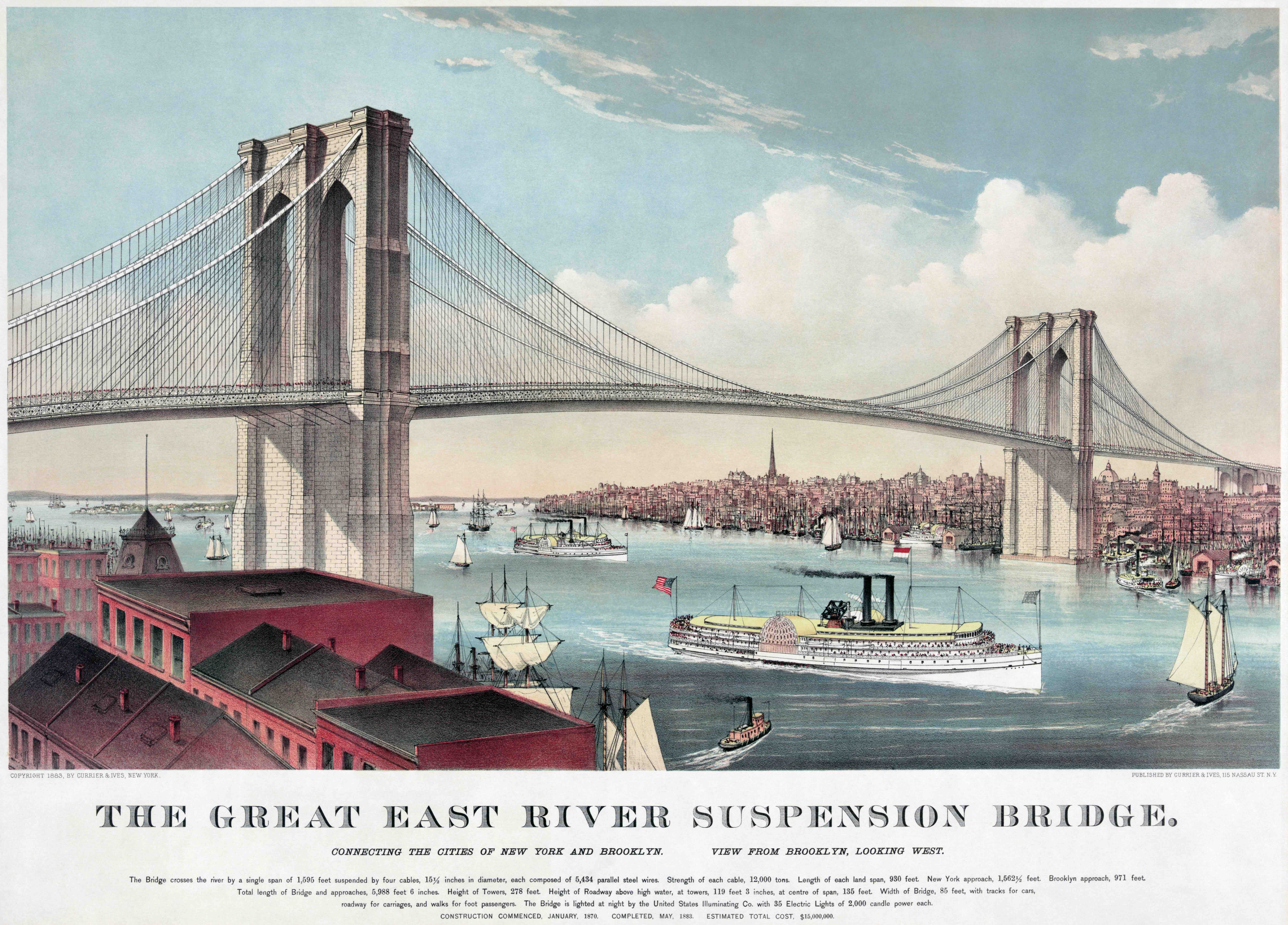
It so happens that the work which is likely to be our most durable monument, and to convey some knowledge of us to the most remote posterity, is a work of bare utility; not a shrine, not a fortress, not a palace, but a bridge. – Montgomery Schuyler (American writer and critic, 1843-1914) in Harper’s Weekly, May 24, 1883
On May 24, 1883, the Brooklyn Bridge was opened, connecting the separate cities of New York and Brooklyn. This cable-stayed suspension bridge was the first fixed crossing over the East River and remained the longest suspension bridge in the world from its opening until 1903. The building of the bridge is a reflection of the optimistic confidence and innovative imagination of the era. The full caption of the Currier and Ives print above indicates the extraordinary achievement of the construction and the awe the completed bridge inspired.
Connecting the cities of New York and Brooklyn. View from Brooklyn, looking west. / The Bridge crosses the river by a single span of 1,595 feet suspended by four cables, 15½ inches in diameter, each composed of 5,434 parallel steel wires. Strength of each cable, 12,000 tons. Length of each land span, 930 feet. New York approach, 1,562½ feet. Brooklyn approach, 971 feet. Total length of Bridge and approaches, 5,988 feet 6 inches. Height of Towers, 278 feet. Height of Roadway above high water, at towers, 119 feet 3 inches, at centre of span, 135 feet. Width of Bridge, 85 feet, with tracks for cars, roadway for carriages, and walks for foot passengers. The Bridge is lighted at night by the United States Illuminating Co. with 35 Electric Lights of 2,000 candle power each. / Construction commenced, January, 1870. Completed, May, 1883. Estimated total cost, $15,000,000.
The span’s original name was The New York and Brooklyn Bridge. Occasionally also referred to as the East River Bridge, the name Brooklyn Bridge was officially bestowed in 1915. John A. Roebling (German-American, 1805-1869) was the designer of the bridge, a project he had first proposed in 1857. In 1867, the New York State Legislature approved the project. Before construction began in January of 1870, Roebling’s foot was crushed between a boat and pier, leading to an infection that cost the designer his life. Roebling’s son Washington (American, 1837-1926) took over as chief engineer. When his health was damaged during construction, Washington watched the building with a telescope from his apartment while his wife Emily Warren Roebling (American, 1843-1903), an engineer in her own right, served as messenger between her husband and the building site. Emily oversaw the day-to-day running of the construction for 11 years and was the first person to cross the bridge when it was officially open.
The design of the towers identify the bridge’s style as Gothic Revival; each tower is pierced by two pointed arches 117 feet (36 meters) high and 33.75 feet (23.9 meters) wide. At the towers’ completion in July 1876, the towers were the tallest structures in either city, with the exception of the spire of Trinity Church in Manhattan. The Brooklyn Bridge originally carried horse-drawn vehicles and elevated trains; today it carries passenger vehicles, pedestrians, and bicyclists. The video below reproduces an 1899 film taken aboard a train from Brooklyn to New York, advertised by the Thomas Edison company as “the best picture of the Brooklyn Bridge yet secured.” You can see pedestrians to the left of the camera and carriages to the right.
Video: Brooklyn to New York via the Brooklyn Bridge. Thomas A. Edison, Inc., 1899.
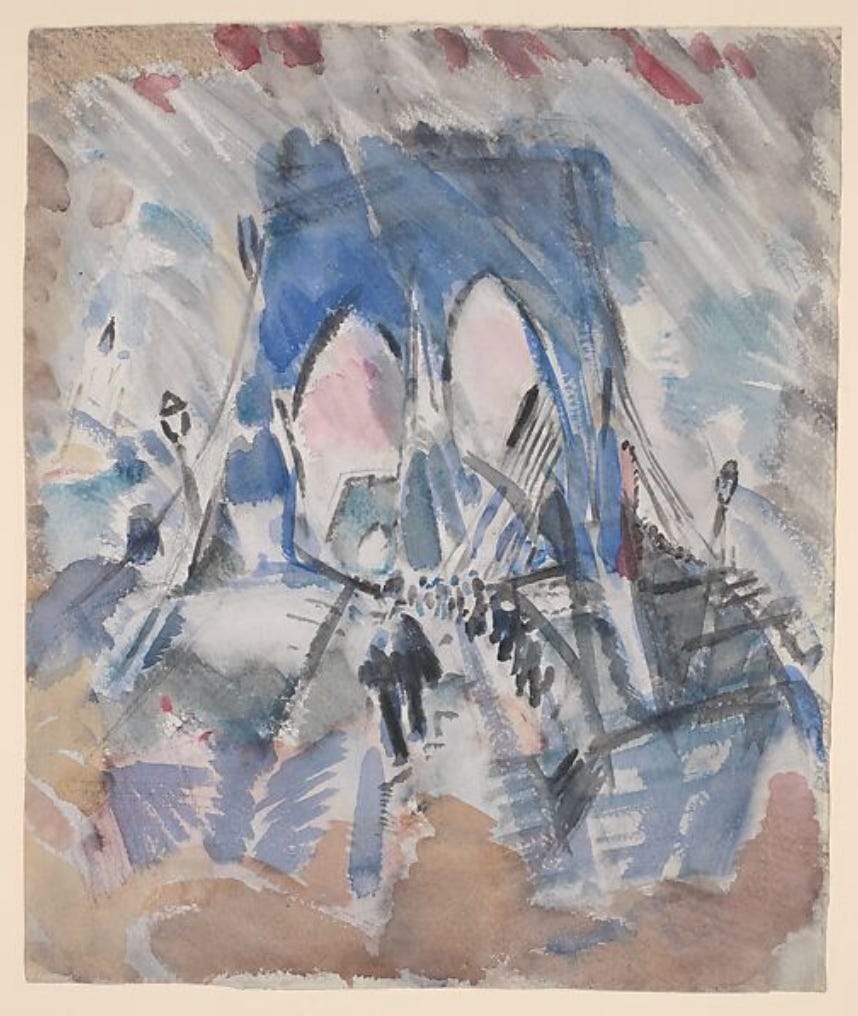
The Brooklyn Bridge inspired artists and photographers from the beginning. For many, it symbolized a synthesis of technology and humanity that was very appealing at the turn of the 20th century. John Marin (American 1870-1953) was among the first Americans to use abstraction and in this watercolor from about 1912, he gives the bridge a life and energy of its own. Earlier Marin had studied to be an architect and he frequently reinterpreted bridges and skyscrapers in his abstract compositions.
While these powers are at work pushing, pulling, sideways, downwards, upwards, I can hear the sound of their strife and there is great music being played. And so I try to express graphically what a great city is doing. – John Marin
Brooklyn Bridge was painted in the period when Marin returned to New York after traveling and studying in Europe. The artist had become friends with Alfred Stieglitz (American, 1864-1946) whose 291 gallery was an outpost of the avant garde in a conservative art environment. Stieglitz gave Marin his first one-man show and the two men were friends for forty years. Though Marin’s later works are more abstract than this, we can already see the artist’s preference for creating movement with color and brushwork.
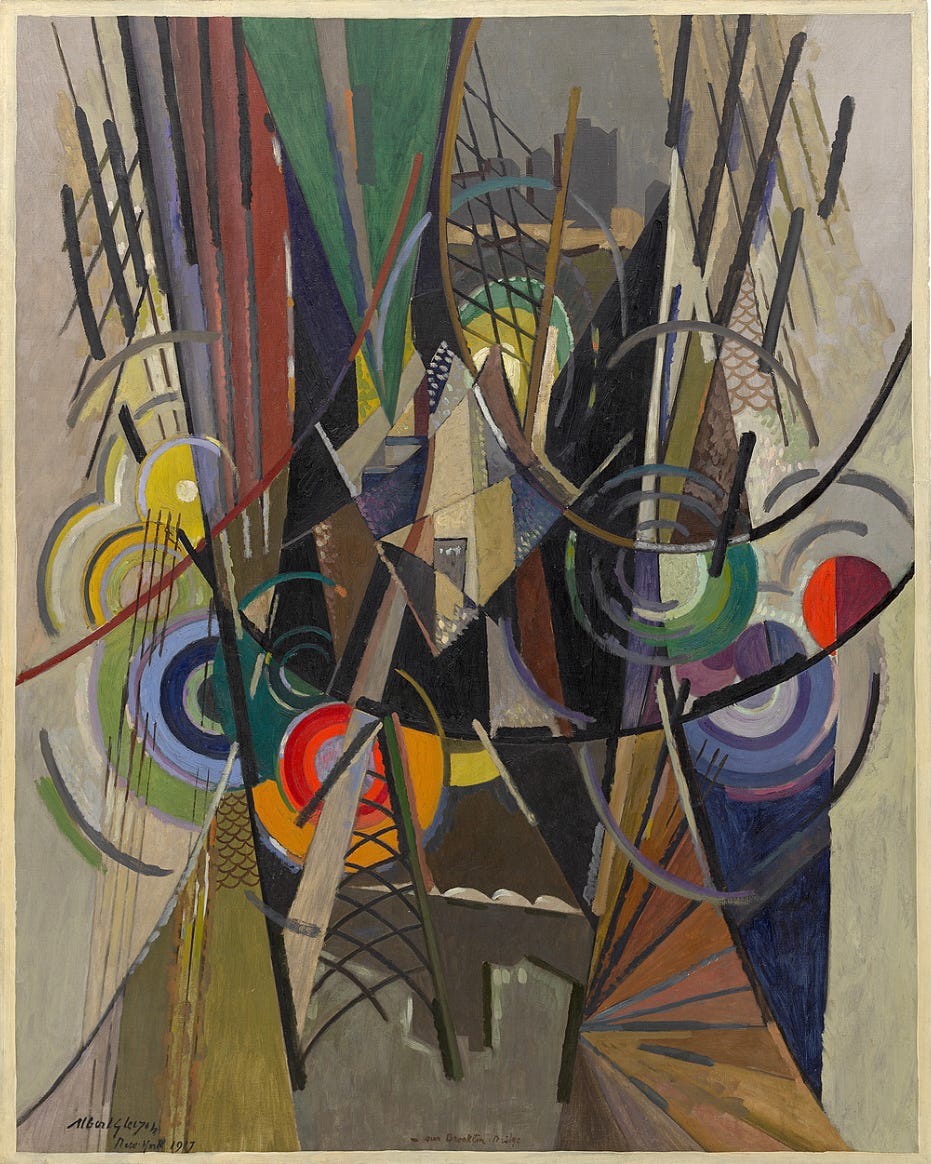
Cubist Albert Gleizes (French, 1881-1953) transformed the masses and cables of the Brooklyn Bridge into an array of lines and colors in keeping with his theories of composition. Gleizes was a philosopher and author as well as a painter and co-wrote the first monograph about Cubism in 1912. Unlike the original Cubists Pablo Picasso and Georges Braque, Gleizes wasn’t interested in using Cubism as a reflection of physical reality. Instead he believed it was a "normal evolution of an art that was mobile like life itself” and that Cubism would continue to evolve allowing for ever greater self-expression. (For more on Picasso’s and Braque’s Cubism, see Chance Encounters 11.)
Gleizes and his wife moved to New York in 1915 to escape World War One. The New York skyline and the energy of the city impressed Gleizes and he tried to capture those aspects in a series of drawings and paintings made between 1915 and 1919. On Brooklyn Bridge shows Gleizes employing his compositional theory, that forms should be converted into planes that overlap and rotate to enliven the two-dimensional surface of the work. At the same time, the radiating orbs of color demonstrate the influence of Robert Delaunay (French, 1885-1941), a friend of Gleizes and a founders of the Orphism movement (See Chance Encounters 46.)
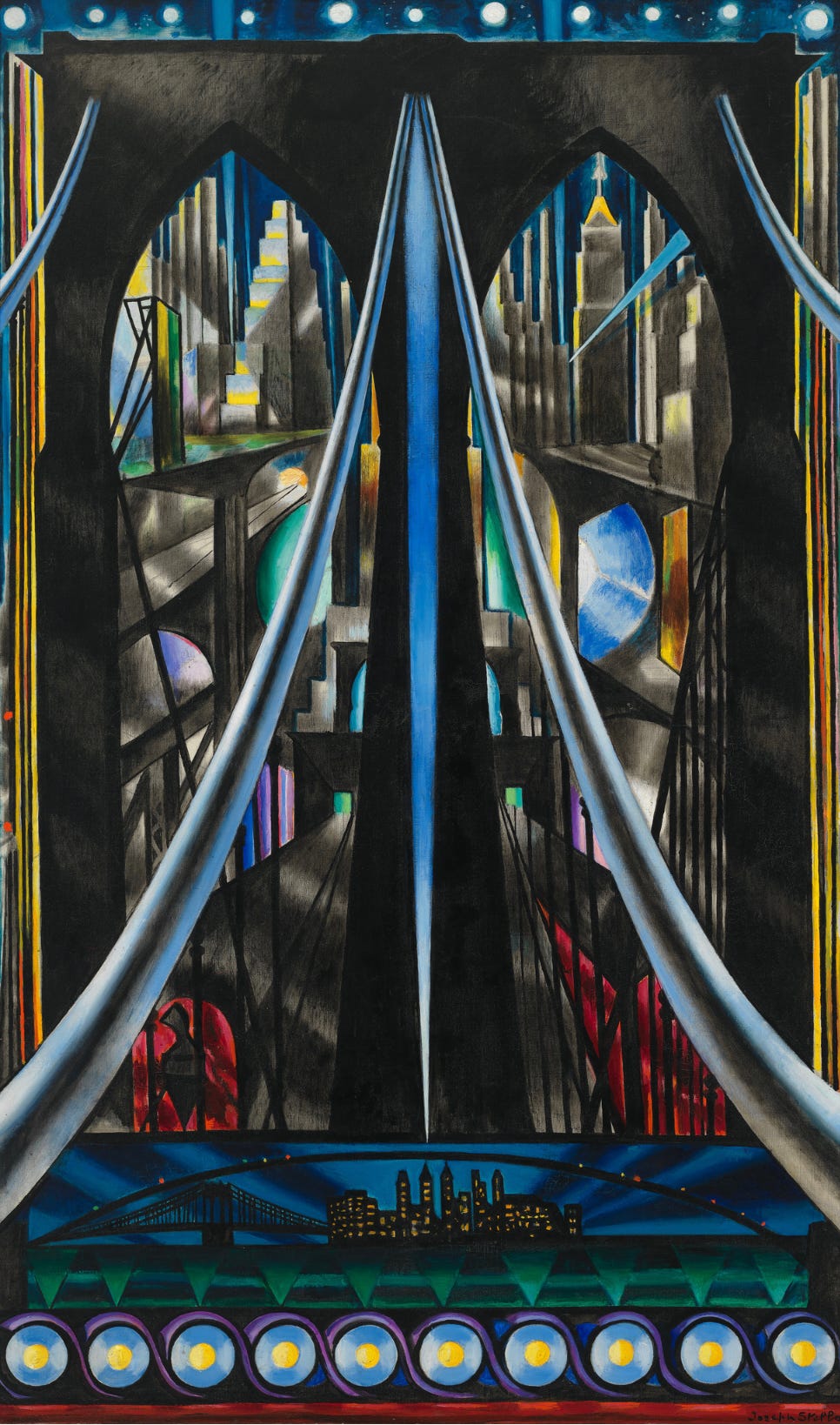
One of the many European artists Gleizes encountered in New York was Joseph Stella (Italian-American, 1877-1946). Stella is best known for his scenes of industrial America, especially the Brooklyn Bridge, which Stella first painted in a Futurist style in 1912 and to which he returned many times, as indicated by the subtitle of this 1939 painting, Variation on an Old Theme. The composition of The Brooklyn Bridge is more structured than his earlier Futurist works, using the bridge’s architecture as a framing device for distant layers of buildings and colored shapes. The whole work seems like a modern and secular version of a Late Gothic or Renaissance altarpiece. It is almost 6 feet tall and beneath the larger upper section is a more naturalistic nighttime view of the skyline and bridge, similar to a predella (or the lower panels) of an altarpiece where narrative scenes would amplify the main subject above.
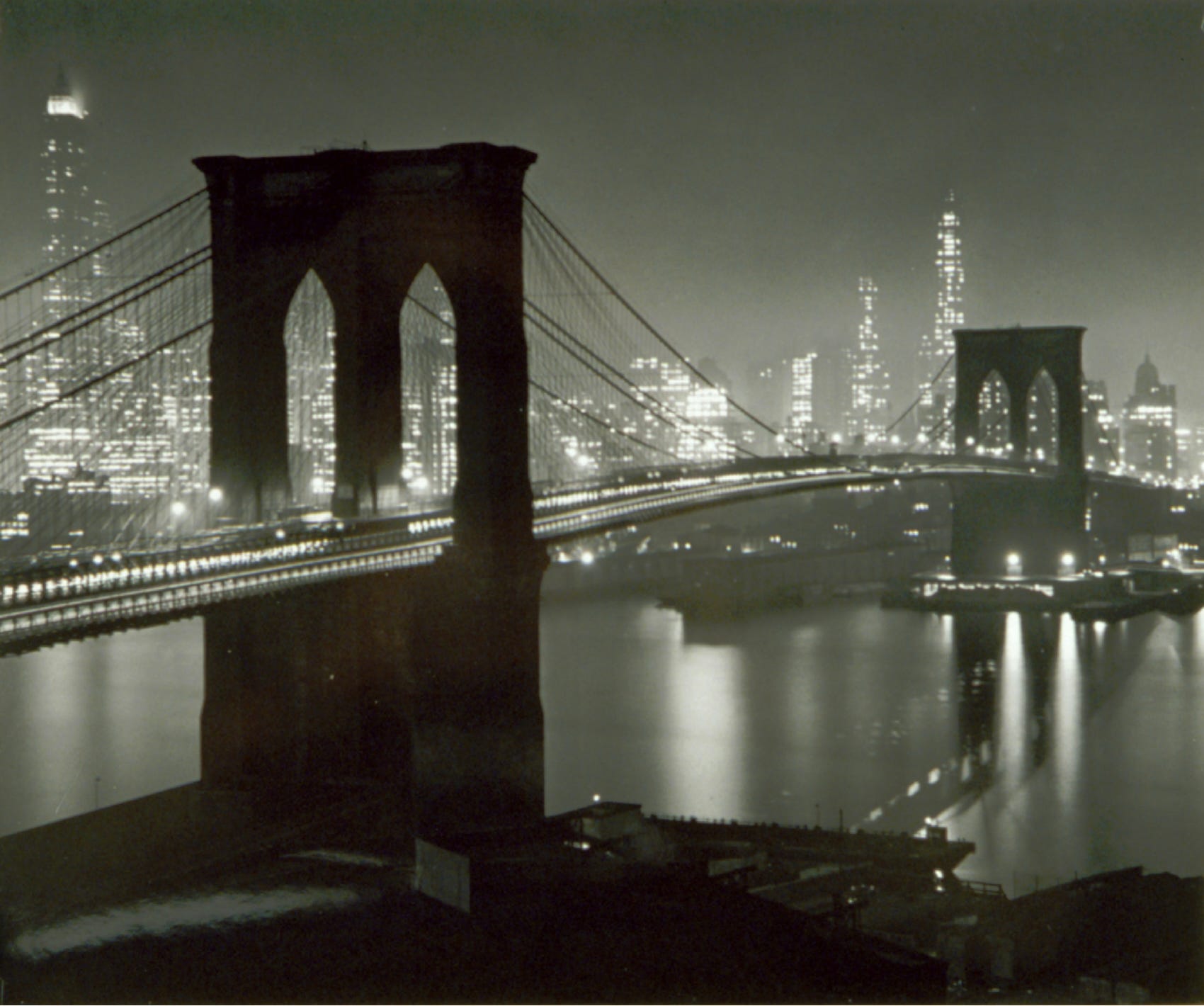
The Brooklyn Bridge has attracted the attention of photographers since it was under construction. This evocative image of the bridge and city at night was created by Andreas Feininger (American, 1906-1999) in 1948. The velvety black piers stand out from the misty light of the city which bleeds into the sky and reflects from the river. Feininger was the eldest son of the painter and Bauhaus instructor Lyonel Feininger (German-American, 1871-1956). Andreas was born in Paris and attended the Bauhaus to study woodworking before attending university to become an architect. The artist had taken up photography in his youth and offered his services as a photographer to architects in Sweden when he was unable to get a work permit as an architect. Finding success in this new field, the artist came to New York in 1939. In 1943, Feininger was hired as a staff photographer for LIFE magazine, a position he held until 1962. In addition, the artist published articles, manuals, and textbooks on photography.
It’s nothing but a matter of seeing, and thinking, and interest. That’s what makes a good photograph. – Andreas Feininger
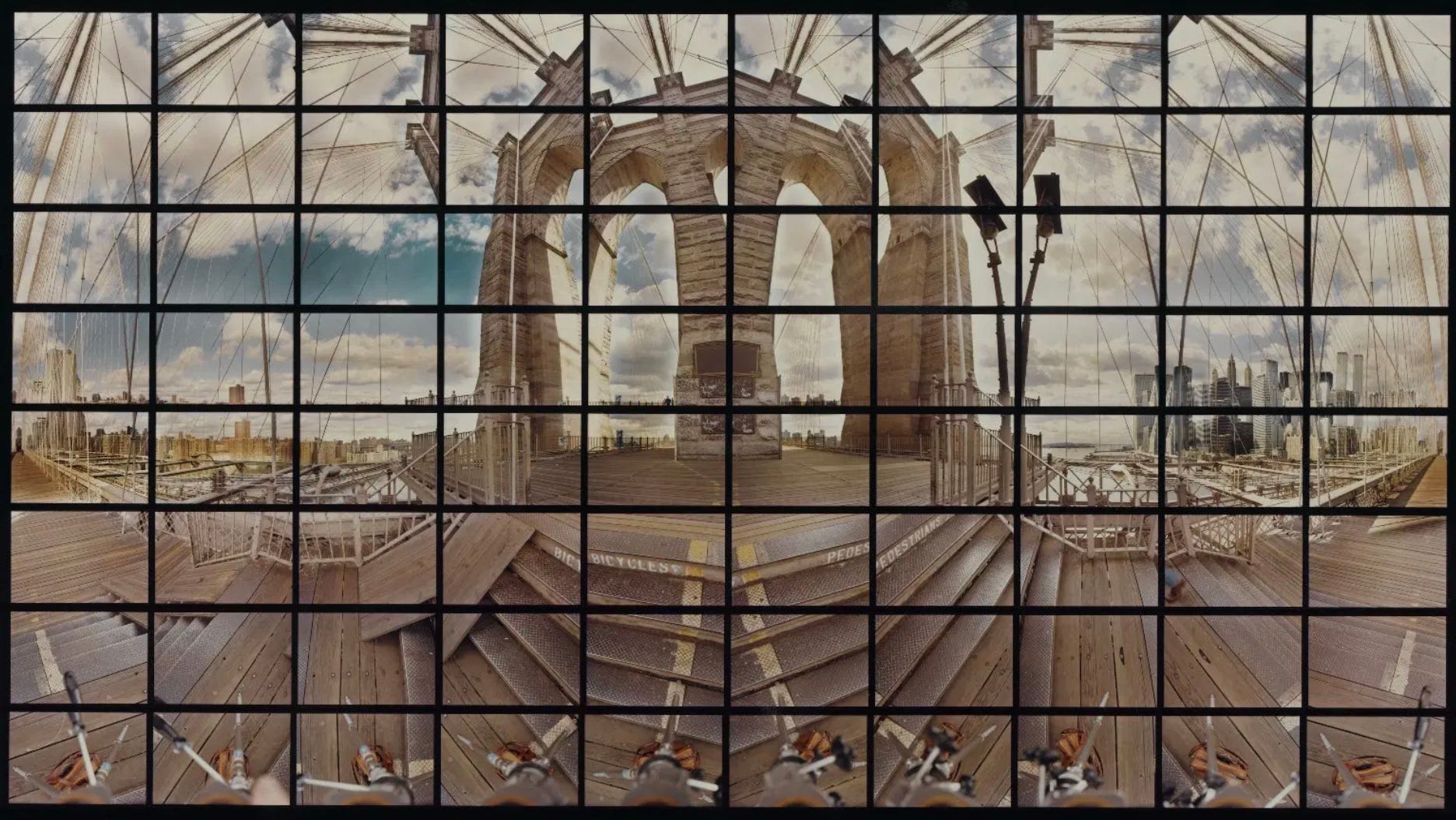
In 1983, the Centennial of the Brooklyn Bridge was marked by a reenactment of the Grand Opening, fireworks, and other celebrations, including exhibitions at the Smithsonian in Washington, DC and the Brooklyn Museum in New York. One artist who responded to the centennial in his work is David McGlynn (American, b. 1957). McGlynn works as a commercial and fine art photographer in New York and in his fine art photography has specialized in photocollage for over thirty years.
The common thread through all of this work is the deconstruction of the photograph as an objective visual record, and the creation instead of a subjective work of art, using photography as a means rather than an end. – David McGlynn
In The Brooklyn Bridge Centennial 1883-1983, the artist took multiple images of the bridge and its surroundings from many angles. The photos were then broken into smaller details and arrayed in a ten by seven grid. The result could hold its own with many Cubist works from 70 years earlier. The composition brings the bridge down to a more human scale by emphasizing the pedestrian walkway and turning the steel cables into a spiderweb surrounding the foreshortened and deformed pier.
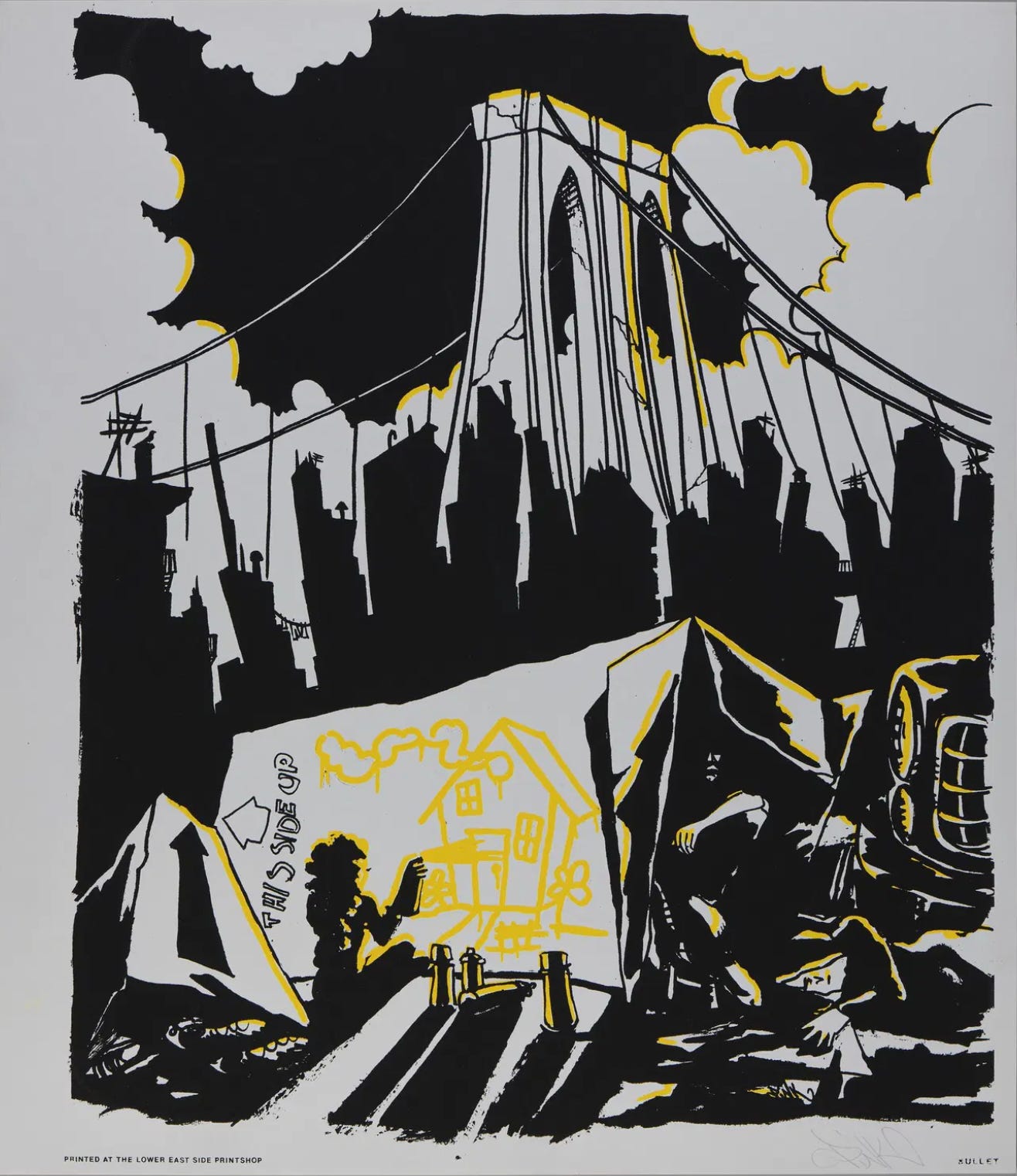
In contrast to the mostly celebratory images in this edition, this screenprint by Lady Pink (born Sandra Fabara, Ecuadorian-American, b. 1964) depicts a different urban reality. With the distinctive pier of the Brooklyn Bridge and a ragged skyline as a backdrop, a woman graffiti artist spraypaints a childlike rendition of a house on the side of a packing case. Dead or sleeping figures lie among the boxes and abandoned vehicles beneath the bridge. Originating around 1988, this print was part of Your House Is Mine, a series by various artists addressing poverty and life on the streets, published by Bullet Space, New York in 1989. Lady Pink later expanded the composition in a mural for an exhibition at Queens Museum in 1990. Under Brooklyn Bridge expresses the artist’s awareness of the unhoused communities that dwell in neglected corners of our cities.
Born Sandra Fabara in Ecuador, she moved to New York with her family when she was six years old. The artist joined the graffiti writers in the city as a teenager in 1979. She was given the nickname “Pink” by a fellow graffiti artist; it was meant to convey her gender in contrast to her male contemporaries and because of its aesthetic possibilities as a tag. The artist herself added Lady because of her interest in Victorian historical romance, but she never used “Lady” in her graffiti work. One of the first graffiti writers to make the transition to works on canvas, Pink has focused on her studio and mural works since the late 1990s. Throughout her career, Pink has used graffiti and street art style as forms of self-expression and resistance, and as a means of addressing the experiences of women within a male-dominated subculture.
Video: Olafur Eliasson, The New York Waterfalls, 2008. Public Art Fund, New York, New York, USA. Artwork © Olafur Eliasson.
In 2008, Olafur Eliasson (Icelandic-Danish, b. 1967) installed four manmade waterfalls in New York Harbor. Commissioned by The Public Art Fund, they ranged in height from 90 to 120 feet (27.4 to 36.6 meters) and were in place from June 26 to October 13, 2008. The sites were chosen to activate spaces that weren’t ordinarily used (under the bridge, East River Esplanade Pier 35, between piers 4 & 5 near Brooklyn Heights Promenade, and Governors Island). Installed at a cost of 15.5 million dollars (none of it public money), the project attracted 1.5 million visitors and had an estimated economic impact of 69 million dollars. Olafur is primarily an installation artist who uses light, air, temperature, and water to alter the viewer’s environment and perhaps their perceptual and psychological states. As is typical for Olafur’s works, no attempt was made to hide the scaffolding and mechanics of the Waterfalls installations. By doing this, the artist makes the viewer aware of both the illusion and the artificiality of the installation at the same time.
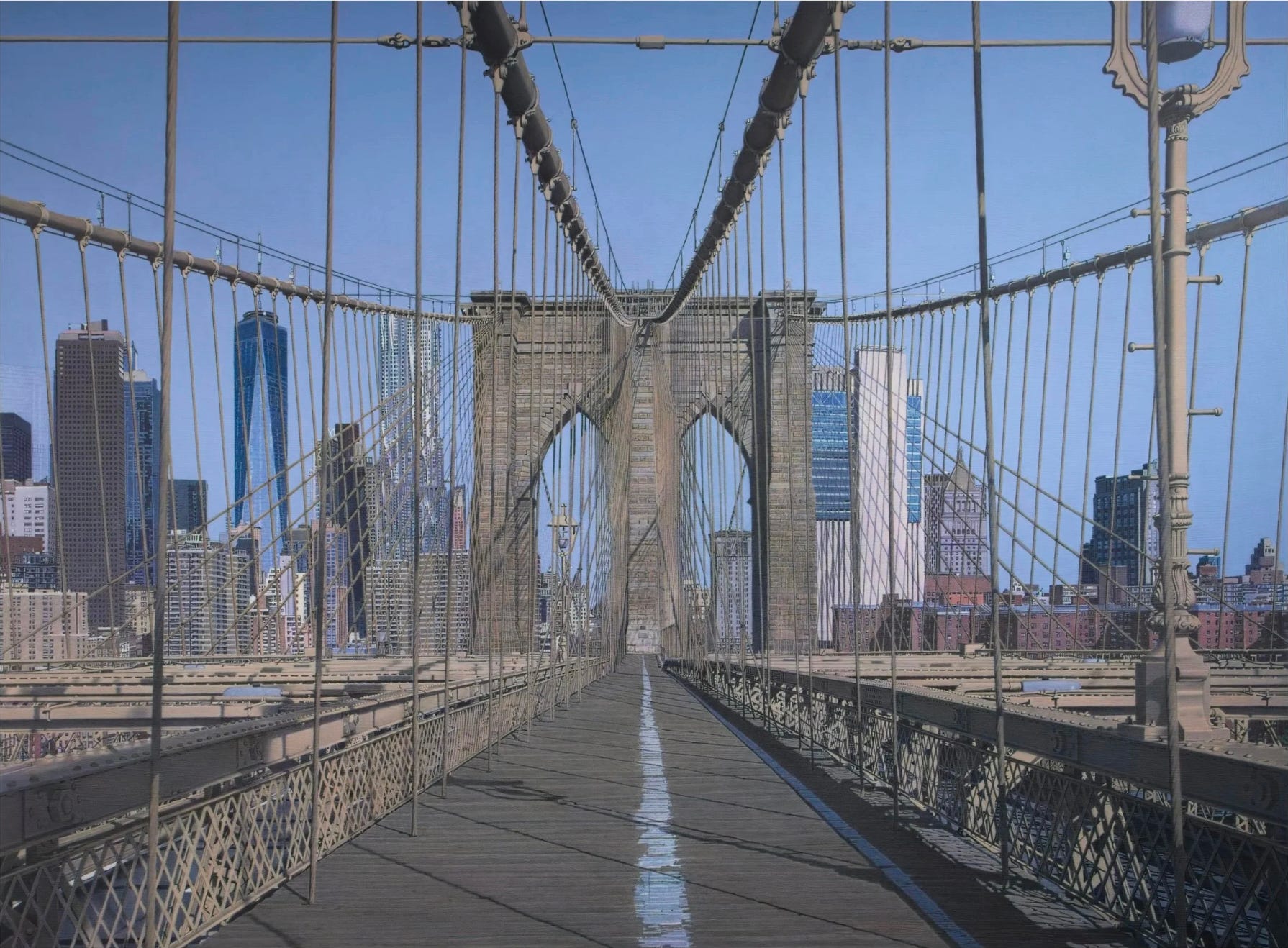
This edition closes with Empty Places V, a 2025 painting by Don Eddy (American, b. 1944). At first glance, nothing seems unusual about this view of the pedestrian walkway of the Brooklyn Bridge. However, in spite of the broad daylight and cloudless sky, there isn’t a person in sight. The painting is based on a photograph the artist took during the COVID shutdown, before the conditions that spread the disease were fully understood and almost no one was venturing outdoors. Every detail of the scene is rendered with photographic precision. Eddy first came to prominence in the 1970s with the rise of the Photorealists, though this artist disliked the term. (See Chance Encounters 72, published earlier this year.) To Eddy, the name “Photorealism” emphasizes the appearance of the work to the exclusion of any sociological, conceptual, or other content.
How does one deal with the richness of experience as it is embodied in simple “things”? – Don Eddy
Eddy’s technique requires as many as 30 layers of paint. Using an airbrush enables him to apply small details in a controlled manner. Working in series and often with multiple panels displayed together, the artist creates webs of meaning among images of manmade and natural landscapes. In a work like Empty Places V, a mundane subject gains a deeper meaning through its precise detail, subtle asymmetry, and eerie emptiness.
The Brooklyn Bridge is a National Historic Civil Engineering Landmark, a New York City Landmark, and on the New York State Register of Historic Places. It is also on the National Register of Historic Places and is a National Historic Landmark. May 24, 2026 will be the 143rd anniversary of the opening of the Brooklyn Bridge. Though it needed renovations in the 1950s, 1980s, and 2010s, the bridge remains an icon of New York and has served as a monumental muse to artists of every generation.
Thanks for reading. We appreciate your subscription, likes, shares, and comments. I’ll be back soon with a new topic.
I greatly enjoyed this mix of views and media! Thank you for the survey.
I always learn from these. This time I it was the fact that it was originally designed for trains since there were not many cars on the road in the 1800’s